
Editor’s note: This is a personal account reported as an interview. The resident lives in North Frontenac and asked that his name be withheld. NFNM is using “John Doe” as a pseudonym. This story describes one person’s experience and does not claim the same outcome for others.
A North Frontenac resident who sought specialist care in Ottawa says a traumatic brain injury more than a decade ago left him with memory loss, difficulty finishing sentences, trouble handling everyday tasks, and chronic pain that reshaped his life. “Loss of memory, long and short-term, dropping things, unable to complete sentences…The list was long, the memory short,” Doe told NFNM.
He describes years of trying to navigate the conventional route. He says he worked with medical professionals, including pain specialists and psychologists. Over time, he was prescribed antidepressants and other medications to manage symptoms. At one point, he says an Ottawa specialist had him taking what he describes as an extreme number of pain medications each day. He recalls side effects building until he started looking for alternatives. “The more medicine they gave me prescriptions for, the more problems I incurred,” he said. “It felt like I was being tested by my doctor to see how many different drugs I could take before one worked.”
Doe says his trust in that path fell apart after what he describes as an investigation related to over-prescribing. He began researching traumatic brain injury recovery on his own, trying to understand what might help him function day to day. He first turned to CBD. Doe says it helped reduce inflammation and improved his sleep after years of insomnia. He also shared personal views about the history and politics around cannabis, which NFNM is presenting as his perspective.
From there, Doe says he began using lion’s mane mushroom nearly three years ago after reading early studies and discussions suggesting potential cognitive benefits. Lion’s mane, known scientifically as Hericium erinaceus, has been studied for compounds that may affect nerve growth in lab and animal settings. Human evidence exists, though it remains limited.
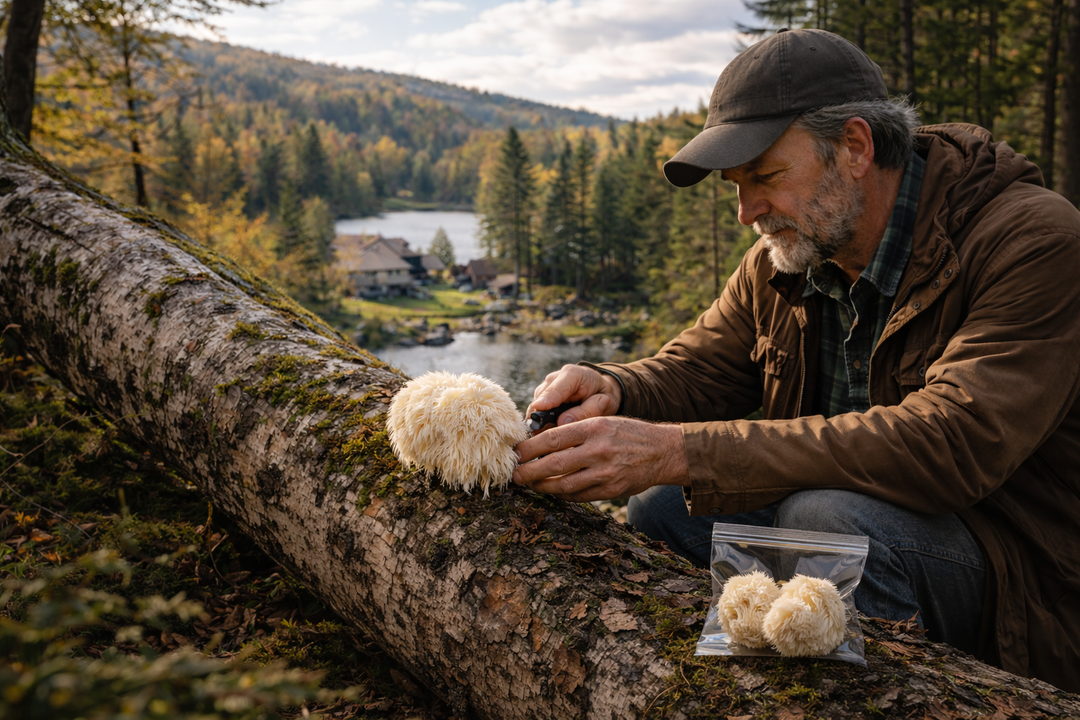
Doe does not describe it as a sudden change. He describes it as gradual, measured in small returns. He says he foraged lion’s mane in local woods during warmer months and relied on supplements during winter. He recalls the first year as subtle, with memories returning in pieces. He says the second year brought clearer improvements, including better conversation and reading. Today, he describes his cognition as the strongest it has been since the injury, and says that improvement has helped him write, plan, and take on tasks he once avoided. “I have now been taking it daily for almost 3 years, stopping 3 times now to check its efficacy,” he said. “The long-term use of lion’s mane has kept my memories growing, my cognition improving.”
Doe emphasizes that he is speaking as a patient, not a clinician. He says he chose to share his story because long-term brain injury recovery can feel isolating, especially for people living outside major centres. In his view, the slow grind of recovery pushes people to look for options when the formal system feels focused on maintenance rather than rebuilding.
“I’m not a medical doctor,” he said, “just an ordinary man with a life experience that may lead to better life for others.”
What his account ultimately describes is a gap that rural residents recognize immediately: distance, limited specialty access, and the long stretch after the initial crisis when support becomes harder to find. In North Frontenac, that distance is not abstract. It shapes what recovery looks like, and how much of it happens alone.