
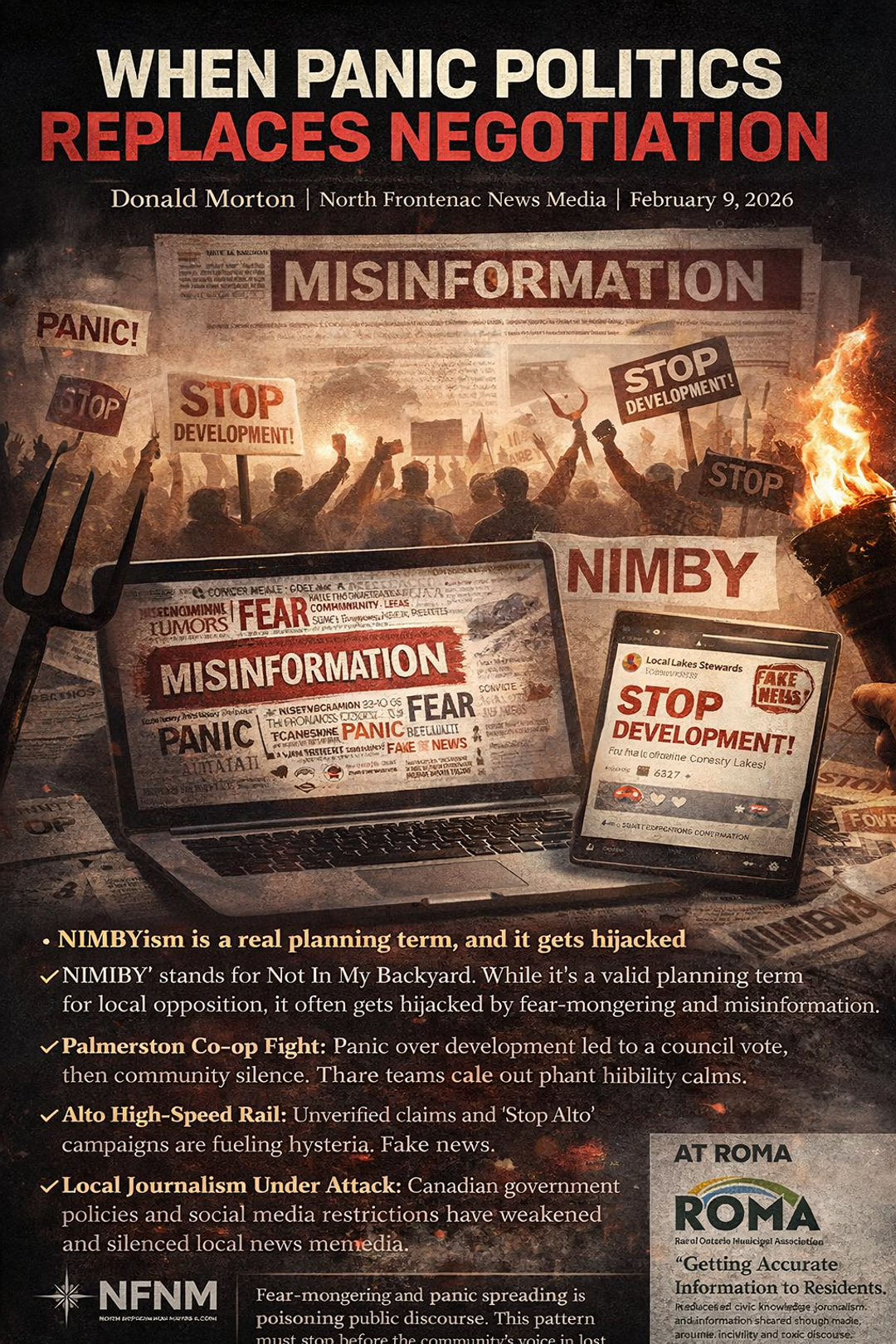
NIMBYism is a real planning term, but it gets hijacked
“NIMBY” has a real meaning in planning. It describes local opposition to a project because it sits close to home, wetlands, watersheds, conservatories, etc, regardless of whether the objections are grounded in evidence, values, inconvenience, or fear. The term becomes dangerous when it turns into an identity. People start treating opposition itself as the civic mission. They chase every rumour. They reward the loudest claims. They escalate the mood. They pressure neighbours. They treat information like ammunition. That shift creates panic, and panic drives bad process.
The same hijack happens from the other direction. “NIMBY” gets thrown around as a moral insult to shut down legitimate planning concerns, especially concerns about precedent, permitted uses, enforcement, and long-term impacts. That produces a civic stalemate where the public conversation fills with emotion and prevents constructive negotiation.
BESS: fear at the doorstep, leverage on paper
The most shameful moment of the BESS debate came during the last public forum. An elderly resident in their 90s spoke. She described people coming to her door with frightening claims about the project. The fear landed first, they were visibly terrified. That is what fear campaigns do. They trigger emotion ahead of reasoning, especially in people who have less appetite for conflict and less capacity to sift competing claims. That is a civic failure in a small community, because it turns neighbours into pressure vectors and turns public participation into intimidation by tone.
I later spoke privately with Rob Lesperance, who played a major role in the campaign atmosphere around that file. He acknowledged he would have approached parts of it differently if he could do it again. He also cooperated with NFNM when our coverage focused on clear explanations of the project’s stated benefits and trade-offs, because a community conversation needs room for people to discuss the upside without being socially punished for reading and thinking. The part of BESS that actually moved the needle came from enforceable demands and measurable obligations that created cost and liability for the proponent. Dark-sky lighting requirements, berms and screening expectations, decibel mitigation, a community improvement package, decommissioning guarantees, and a letter of credit shifted the business case. Those terms shape outcomes because they survive meetings, they sit on paper, and they can be enforced.
Palmerston Co-op: escalation first, silence when the bill arrived
The Palmerston Lake fight produced a public posture that forced council into a defining vote. Residents and lake associations mobilized hard, council took the political risk, and the township committed to hiring independent legal representation to handle tribunal exposure on the taxpayer dime. That is the high-cost stage of a file. It requires public consistency after the vote, because the vote triggers process and process triggers spending.
Then the follow-through collapsed. The same community that drove the pressure did not show up when visible moral support mattered. That changes the conversation inside the township building fast. It forces council to ask what the lawyer gets hired for. A record-driven defense requires ongoing backing for a long, technical fight. A settlement posture often becomes attractive when political cover disappears, because settlements reduce uncertainty and reduce burn rate. This is where fear-driven activism often fails the public interest. The campaign energy spikes early, then the work shifts to evidence, hearings, written submissions, and real money. The room goes quiet and taxpayers carry the file anyway.
Alto: the same pattern is forming, and negotiation is the only tool that holds up
The Alto high-speed rail discussion shows the same fear mechanics forming in real time. Panic spreads faster than verified reporting. Social media rewards dramatic claims and punishes nuance. People absorb pressure before they absorb facts. Councils start moving in response to atmosphere. South Frontenac has already provided an example of how quickly political bodies can head toward decisions shaped by a public mood that runs ahead of the record.
Within North Frontenac, Councillor John Inglis has been pressing a different posture. He has been pushing negotiation early, with clear terms, clear protections, and a serious recognition that senior-government infrastructure has its own momentum. That approach tracks with what worked on BESS: push conditions, push mitigations, push enforceable commitments, push financial securities, and push community benefit structures that are written down and defensible. Indigenous communities negotiate this way, and they do it effectively. They show up early with leverage, terms, and expectations. The same logic applies to rural townships that live with impacts and deserve enforceable protections and negotiated benefits.
ROMA put the problem on the agenda
This pattern is widely understood at the municipal leadership level, and the conference record shows it. The Rural Ontario Municipal Association program included a session titled “Getting Accurate Information to Residents.” The description spells out reduced civic knowledge, the decline in local journalism, and misinformation shared through social media as drivers of incivility and toxic discourse, with municipalities looking for strategies to get accurate information about municipal services and council decisions seen and understood by residents.
That agenda item matters because it confirms the problem in plain language. Local governance gets harder when reliable local reporting weakens, and it gets even harder when the main information pipes reward sensational content. Civic unrest becomes easier to trigger. Civic trust becomes harder to sustain. Council spends time and money managing turbulence that did not originate in the evidence.
Groups that claim stewardship are driving the panic
A hard fact in North Frontenac is that some of the organizations that present themselves as lake stewards are increasingly operating as protest organizers. That shift matters. Stewardship means evidence, mitigation, standards, monitoring, and enforceable conditions. Protest organizing often means rallying fear and treating every development question as a moral fight.
That shift radicalizes people. It also drowns out serious journalism and serious information. When panic becomes the primary fuel, accurate reporting gets treated as “soft” and misinformation spreads faster than corrections.
This is visible right now on Alto. Panic is driving public opinion so hard that established media coverage gets buried. Municipalities start responding to pressure rather than records. South Frontenac has shown how fast a council can move when the public atmosphere is dominated by fear instead of facts.
BESS showed what actually changes outcomes:
Dark-sky lighting requirements.
Berms and visual screening expectations.
Decibel mitigation expectations.
Community improvement commitments.
Decommissioning guarantees.
A letter of credit to secure the end-of-life obligations.
Those were all material obligations with price tags. Those obligations reshaped the business case. That is why the project became fiscally unattractive.
This approach matters because it gives council leverage. It also puts public concerns into a form that survives public meetings. Conditions and securities live on paper. They can be enforced. They carry consequences for non-compliance. They effect budgets, and the profit structure, and the intent of the project.
NFNM’s role stays the same
NFNM has taken a consistent position across these files. The work sits in the terms: the mitigations, the safeguards, the securities, the enforceable conditions, the precedent language, and the written record. NFNM stays independent because independence protects the freedom to say what the record says, even when the crowd wants a simpler story. Try and share News on facebook. The gurilla news strategy NFNM employs is out of neccessity. independant journalism has been at war with the federal government for a decade. Choice comes with a cost. It also protects the core function of local journalism in small communities.
The public record keeps proving the same outcome.