When NFNM first reported on the proposed Battery Energy Storage System (BESS) in Plevna, it was about awareness. This follow-up was meant to be about progress.
Instead, it feels like we need to take a step backwards.
I asked Alectra Energy Solutions direct questions on behalf of this community. I made it clear, I wanted real answers, not a sales pitch. They responded — but much of what came back reads like a bid-room presentation, not a community-first commitment. It left me disappointed.
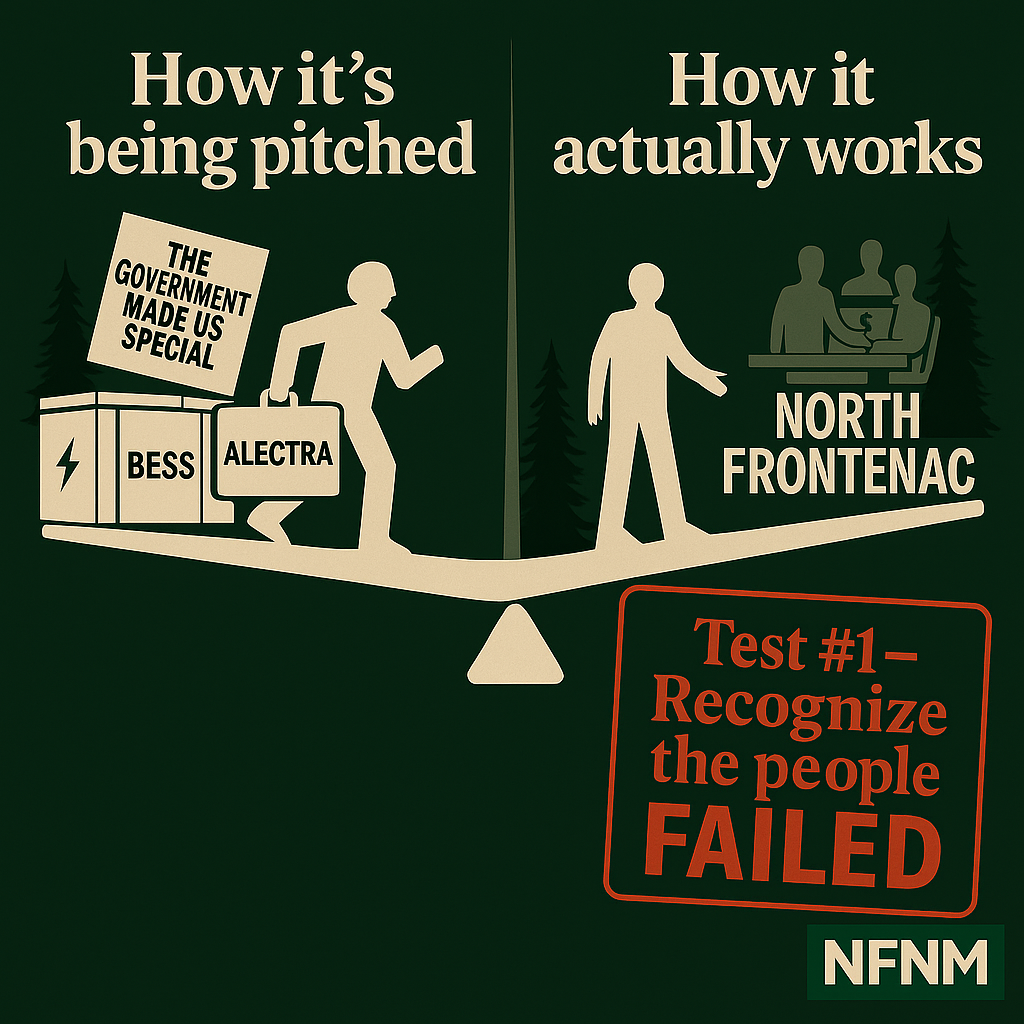
The most important, and very first, test in this process is simple: does Alectra recognize who holds the power here? On that test, they failed.
Let’s be clear: North Frontenac is not competing for Alectra. Alectra is competing for North Frontenac. We are not lucky to be “considered” for this project. We are not here to help them win a provincial bid. They are here to prove — if they can — that they deserve our trust, our land, and our approval.
This article is not about being for or against BESS. It is about reminding everyone, especially Alectra, where the authority lies: with the people of North Frontenac. Without us, there is no “willing host” and there is no project.
What follows is an exclusive Q&A: NFNM’s questions, Alectra’s answers in their own words. Some responses are clear. Others leave holes. All of them remind us that this community is the gatekeeper — not the company. If Alectra does not like it, then they know where the door is.
Judge for yourself whether Alectra has done enough.
Fire Safety
NFNM: Your proposal mentions compliance with national safety standards. How will local volunteer fire departments be trained and equipped to handle a thermal runaway event, and will Alectra fund the necessary equipment and hours needed to train and keep training fresh for both longtime and new firefighters?
Alectra: Provided the systems are installed in a manner consistent with standards and the requirements of the local authority, fire departments do not require specialized or additional equipment to respond to a BESS fire. The BESS systems themselves are designed and installed in accordance with fire-specific standards such as NFPA 855, which sets out minimum requirements for spacing of units, setbacks, fire detection and protection. Alectra will be using safety certified equipment and the design that meets the established standards to safeguard against failures.
As part of the municipal approvals process for the project, the fire department will also be reviewing and commenting on the site layout and design, from a fire safety perspective. Our plans must be signed-off by the fire department in order to get site plan approval and building permits.
As part of our engagement process we are discussing the project with the local fire department to understand any concerns they may have. Prior to commencing operation an emergency response plan will be developed in collaboration with the local fire department, and training and orientation sessions will be held with fire personnel to ensure a thorough understanding of the project and emergency protocols.
Utility-scale battery energy storage systems are becoming increasingly common and there are published guidelines for firefighters from both the Ontario Fire Chiefs and the International Fire Chiefs Associations.
Environmental Safeguards
NFNM: The project is beside the 506 WDS waste site. What specific measures will be in place to prevent leaching or contamination of surrounding soil and waterways if a fire or chemical leak occurs? It is right beside a creek. Is Alectra going above and beyond to protect the environment, or just meeting minimum standards?
Alectra: Generally speaking, modern Lithium-Ion battery systems are constructed with individual cells contained within sealed modules, which are then installed in enclosures — this provides multiple barriers against any battery components contacting the outside environment. With regards to BESS units, there are generally no chemical substances present on site which could pose a hazard. In the case of fire, use of water is generally not recommended, and instead modern battery systems are designed to limit the extent of a fire to a single container, which can be isolated and monitored, allowing the fire to burn out in a safe manner.
The systems have evolved and become more modularized over time to further lessen the footprint of each unit, creating individual, small systems separated by multiple layers of protection from one another. In all cases, battery systems are installed in accordance with electrical and fire safety standards as well as any provincial, municipal, or conservation authority requirements for setbacks from sensitive natural areas such as waterways.
As part of the site design process, we will be performing environmental site assessments, surveys, and hydrology studies. If determined to be needed, secondary containment systems are put in place to prevent run-off. These requirements reflect best practices, and are also typically required by the municipal and provincial authorities.
Decommissioning Plan
NFNM: What commitments is Alectra prepared to make for end-of-life decommissioning and site restoration, so this doesn’t become another stranded industrial site?
Alectra: With all of our projects, we take responsibility for fully decommissioning the site at the end of the project life, and this becomes a contractual requirement of our land lease. Where needed, a decommissioning security such as a letter of credit can be provided for additional assurance. Since the BESS are containerized and highly modular, removal from site is fairly straightforward to allow for subsequent restoration or re-use of the site depending on the municipality’s intentions.
Community Benefits
NFNM: You’ve proposed $1,000 per MW/year in community benefit funding (about $140,000 annually). Will that amount be tied to inflation or renegotiated over time, or is it fixed for the 20-year contract?
Alectra: The community benefit proposal is currently under discussion with the Municipality.
Lease Transparency
NFNM: Since this is municipally owned land, will the option-to-lease agreement be public, and what revenue is guaranteed for local taxpayers?
Alectra: Yes, we are supportive of the municipality making the option to lease document public in line with public disclosure requirements. Given this is a competitive bid process, we will be asking that the commercial items be held back until after the submission date in December.
Local Impact
NFNM: Beyond minimal employment, what concrete economic benefits will residents of North Frontenac see?
Alectra: The community benefit, lease payments, and lift in property tax for the site will provide additional revenue to the municipality for the duration of the agreements. The lease would be up to 25 years to allow for construction and decommissioning, and the IESO contract is 20 years. We prioritize hiring local where possible for site prep work and on-going work associated with maintaining the site. The BESS units themselves will provide added reliability to the grid in a time when the Province’s grid is already seeing strain due to high demand. Added reliability is good for residents and businesses as a whole.
Equity Partnership
NFNM: Your proposal states that consultations with the Algonquins of Ontario have already begun, with a goal of equity partnership. How will those benefits be distributed within the Algonquin community, and will local Algonquin residents outside the AOO framework have input?
Alectra: The goal is for the Algonquins to be an equity owner in this project. The IESO encourages and incentivizes proponents to seek First Nations to be equity partners for new projects. The Algonquins will see on-going benefits from the project that any other equity investor would realize.
Grid Reliability
NFNM: If Ontario experiences power shortfalls as early as 2027, how soon could this project realistically come online if awarded in 2026, and will it actually help address that gap?
Alectra: This IESO long-term RFP is an ongoing process which has included two previous rounds of capacity procurement (ELT-1 and LT1). We were awarded three BESS projects in ELT-1, all of which are under construction right now and which will achieve operations before 2027. There are thousands of megawatts of BESS projects under construction right now in Ontario. The IESO has staged these procurement activities based on their forecasted needs, and taking into account the time required to construct and connect each of the facilities. Each new energy generation and storage asset that comes online will help close the anticipated gap between energy demands and availability.
Projects being proposed under the current LT2 RFP are intended to address capacity needs starting in 2030. You can read more here: IESO – Six Graphs and a Map: 2024 Annual Planning Outlook and Emissions Update.
Alternatives
NFNM: Why should North Frontenac host an 18–20 acre lithium-ion facility instead of investing in smaller-scale, community-based renewable generation and storage to net more profit?
Alectra: There are a number of factors in place for when sourcing a suitable location to host a BESS (or other energy) facility. First, it’s determined by the IESO where capacity on the grid exists to actually host projects. Second, we look for land that is available in proximity to viable power lines. For these projects we are seeking to avoid prime agricultural areas, as well as lands where the local municipality is planning alternative development, and seeking areas where the project would be minimally disruptive to the local community.
Battery energy storage and community-based renewable generation are not mutually exclusive — in fact battery storage is a key technology for enabling more renewable energy to be deployed on the grid as it increases the flexibility of the grid to adapt to a more variable supply.
This LT2 Capacity RFP is separate from the LT2 Energy RFP which aims to procure new energy generation resources. In the LT2 Capacity RFP BESS will be directly competing against natural gas plants such as those which currently provide a significant portion of Ontario’s capacity services. Developing local, emissions-free projects such as this one as opposed to large centralized gas generation has benefits for the environment, as well as reduces the requirement for more transmission lines to convey power from large centralized generation.
There are community-based renewable generation projects being put forward by ourselves and other proponents under the energy RFP, but for purposes of the capacity RFP, we believe BESS technology is a preferable, cleaner alternative to natural gas and will help support increased deployment of renewable energy in appropriate locations.
Transparency Commitments
NFNM: Will Alectra commit to annual public reporting to North Frontenac on safety incidents, community benefit payments, and environmental monitoring results?
Alectra: Reporting of safety incidents is a legal requirement in Ontario, and as a municipally owned company Alectra is committed to the high standards of safety, environmental, social and governance (ESG) performance. Alectra publishes its safety and ESG performance on an annual basis, as well as an annual sustainability report. Alectra’s model is that we own and operate the assets over the course of the assets’ lifetime and be a long-term partner with the community. Alectra will commit to sharing information subject to the requirements imposed under the contract by the IESO and other commercial agreements in place.
Alectra answered directly, but the tone matters. Much of what you’ve read here reflects the reality of the bid process: companies compete for contracts, and municipalities are told they should be “willing hosts.”
But here in North Frontenac, the dynamic is different. We are not chasing after this project. We do not need to be grateful. If Alectra wants to build here, they must earn it — and earn it completely.
That means hard guarantees: real fire safety support, real environmental protections, real transparency, and real benefits that last. Minimum standards and vague assurances will not do.
The people of North Frontenac are not spectators in this process. We are the decision-makers. And any company that wants to operate here should be walking carefully, knowing that it is the community’s trust — not the IESO’s contract — that ultimately makes them welcome.
This is the moment to ask your own questions. To decide whether Alectra’s promises are good enough. To remind them — and our Council — that North Frontenac does not exist to serve corporate bids. If BESS wants to be here, it will be on our terms.