At 9:00 a.m. this morning, North Frontenac’s Housing Advisory Task Force meets again in Council Chambers.
Housing is the most serious issue facing rural communities right now. When a task force is created to deal with it, the minimum expectation is simple: get the definition of affordability grounded in the lives of the people who actually live here.
The Task Force has already missed that mark.
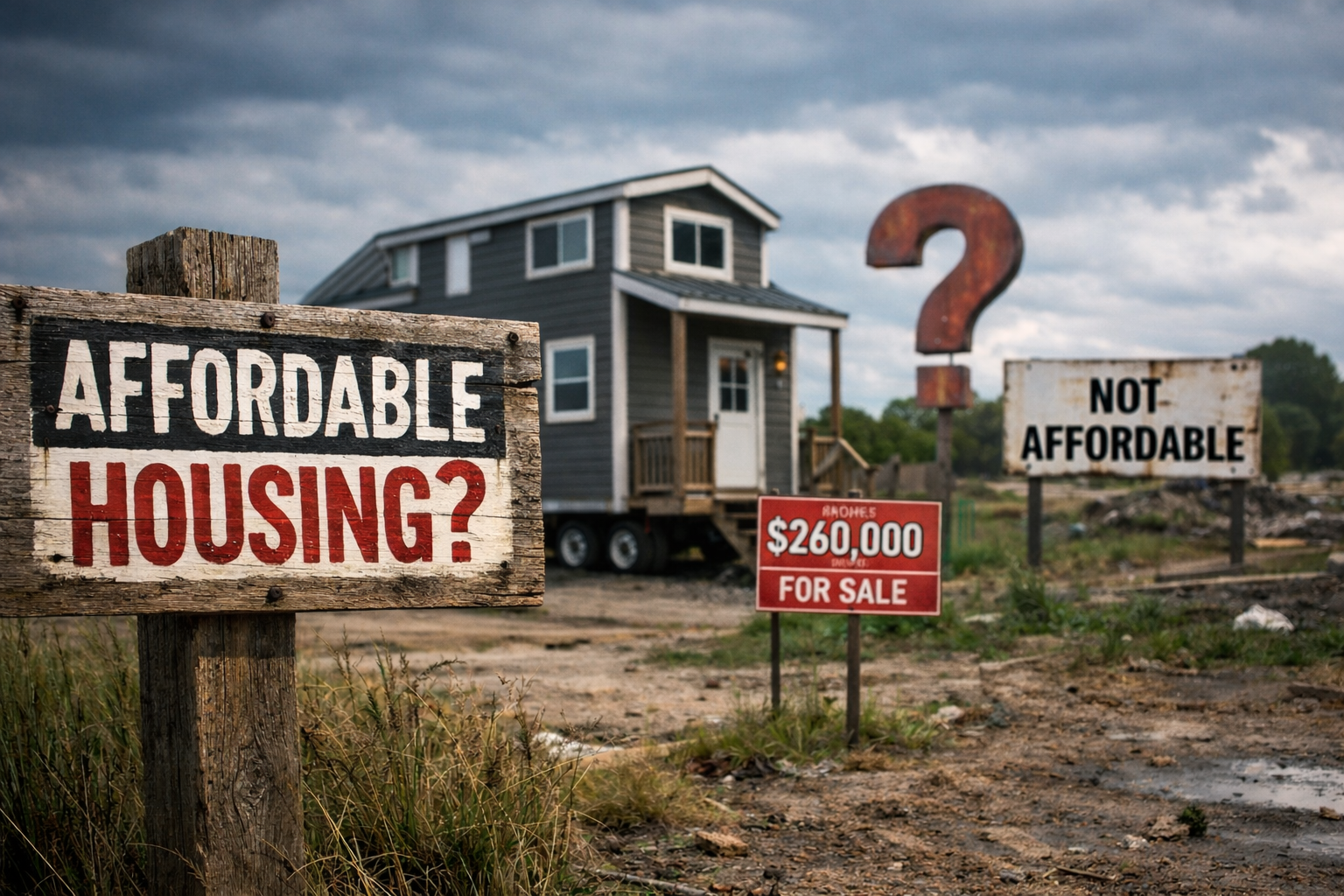
In its own work materials, the HATF chose a “base number” for affordability and admitted it was simply what they “believe” is affordable: $1,300 per month rent and $260,000 purchase price. That pair of numbers is not a definition. It is a guess. And it is a guess built around the wrong people. Affordability for who?
North Frontenac is not a big-city market. It is not a condo market. It is not a two-income professional market.
It is a senior-heavy township. Nearly four out of every ten residents are 65+. The median age is over 60. A very large portion of the community is living on pensions, fixed incomes, part-time work, seasonal work, or a mix of all four.
That matters, because when affordability is defined using “moderate income” assumptions, the numbers get inflated fast. They start describing the top of the local income ladder instead of the bottom half that housing policy is supposed to protect.
It also matters because tiny homes are being floated as an affordability tool, and that conversation keeps getting hijacked into a fantasy where “smaller” automatically equals “affordable.”
It doesn’t. $1,300 rent is not affordable housing in this township
Here is the basic reality.
One-person households in North Frontenac have a median after-tax income around $32,800. If you take the standard affordability rule people love to cite (30% of income), you land around $820/month. Even if someone insists on using gross income rules instead, you still land closer to $900/month, not $1,300.
At $1,300/month, you are not talking about “affordable.” You are talking about 40% of a typical single person’s after-tax income, and that is before heat, hydro, internet, groceries, fuel, insurance, and everything else rural life requires. That is rent stress by design.
And it gets worse when you remember what “no employment income” looks like in this township. Hundreds of residents have no paycheque at all in a given year. That often means retirees. It can also mean disability. It can mean precarious work. It can mean caregiving. It can mean “surviving.”
Those residents are not helped by a Task Force picking a rent number that fits a completely different household type.
Families are not the yardstick for “affordable tiny homes”
The HATF’s affordability thinking is drifting toward a quiet insult: the idea that local families can simply be compressed into smaller and smaller boxes and told it’s progress.
A family with two adults, a kid, and a dog does not live well in a sub-400 square foot space. That is not “a lifestyle choice.” That is crowding. That is stress. That is constant negotiation of space. It also creates safety and dignity issues as soon as you introduce aging bodies, injuries, mobility limits, or stairs.
Tiny homes also aren’t a clean fit for seniors. Narrow corridors, tight corners, loft ladders, steep stairs, and cramped bathrooms are not “cute.” They can be dangerous. Many seniors are already managing balance issues. Plenty of younger people are too.
So when affordability is framed around “moderate income” households, and then the solution offered is “smaller homes,” the policy ends up squeezing the wrong group. It pressures the people who already have the least flexibility.
That is how rural affordability policy turns into a slow-motion version of third-world crowding, sold with a fresh coat of paint.
North Frontenac is not in the real estate business
There is another hard truth here that nobody wants to say out loud.
Municipal government is not a landlord operation. It does not have the staffing, the systems, the maintenance capacity, the inspection routines, the dispute handling, or the risk tolerance to own and rent out a fleet of housing units like a private operator.
And even if it tried, taxpayers would be dragged into problems that have nothing to do with good governance: damage, abuse, neglect, repairs, enforcement, and the politics of who gets a unit and who doesn’t.
That path turns housing into a permanent municipal liability.
There is a cleaner model that matches rural reality. The land-rental model matches rural reality
North Frontenac has land. That is the one advantage this township actually has.
A serviced-lot rental approach keeps housing grounded in personal responsibility and keeps municipal exposure low:
The township provides the basics: an accessible maintained road, a prepared pad, a legal setup, a well or water plan, and a hydro connection. The resident provides the unit.
If someone builds a tiny home for $20,000, that is their asset. If they buy one turnkey for $60,000 to $75,000, that is still their asset. If they damage it, it’s their problem. If they walk away, they take it with them. If eviction happens, the unit can be removed like any other trailer, with proper legal process.
The municipality remains a landowner, not a housing corporation. The risk profile stays sane. The costs stay visible. The incentives stay aligned.
That model also avoids the single biggest lie floating around in this debate: the idea that $260,000 units rented at $1,300/month is “affordable tiny housing.” That isn’t tiny-house affordability. That is a municipal version of the same profit logic people are already trapped under, with the public carrying the risk.
The seasonal reality cannot be ignored
There is one more piece the HATF’s affordability framing tends to dodge: the seasonal distortion.
North Frontenac has far more dwellings than year-round residents. That means a lot of the housing stock is not actually available to the people who live and work here. It also means the incomes of seasonal residents aren’t part of the year-round resident income picture that housing affordability is supposed to be measured against.
So if the Task Force’s “base numbers” feel like they came from somewhere else, there’s a reason. They don’t fit the resident reality.
This morning’s meeting is a chance for the HATF to show it understands that.
Because a Task Force that can’t define affordability for the people who need it most has already failed the first test, and nothing built on a bad definition will land anywhere good.