Council saw a “tiny homes” deck this week presented by Rob Lesperance in Council chambers. It had polish, rent figures, and ROI’s. Here’s the problem: a slide is not a policy, a label is not a law, and the path a file takes matters as much as the pictures on it. If North Frontenac wants small-footprint housing that actually works here—on our roads, on our soils, under our winters—then this concept needs to be pulled out of the spotlight and walked through the public process that every serious housing idea should face.
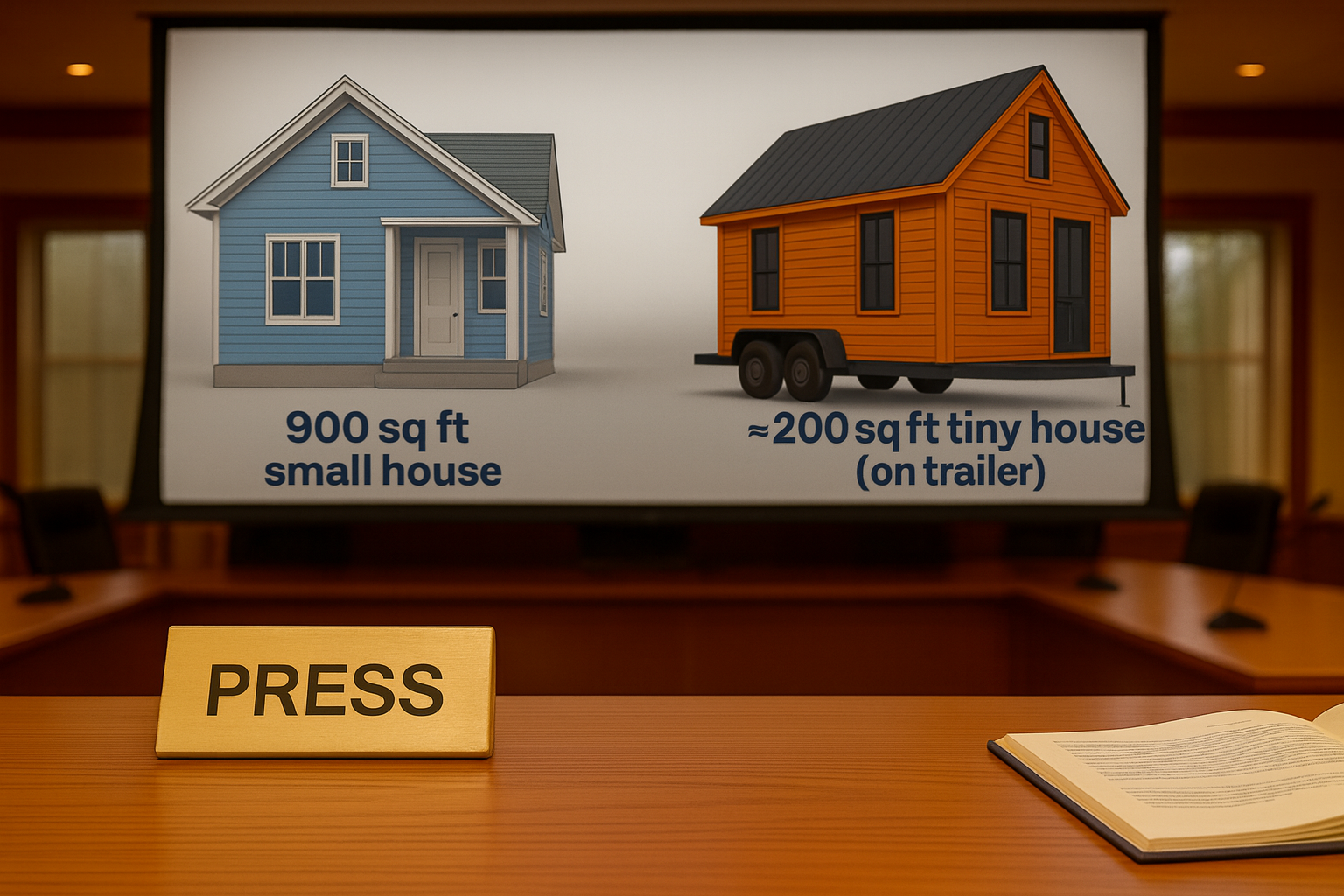
Start with the words. Lesperance’s presentation called a nine-hundred-square-foot dwelling a “tiny home.” That isn’t a quibble; it’s a category error. In ordinary use, “tiny house” evokes a movable unit on a trailer chassis. In our by-law language, “tiny home” means a permanent, code-built dwelling at the very small end of the spectrum, roughly two to four hundred square feet, not almost a thousand. Nine hundred square feet is a small house. If the pitch is really about small houses, say so and test it as such. Don’t borrow the social license of “tiny homes” to rebrand something twice the size.
I should disclose that I live in a tiny house myself. It’s a movable unit on a trailer bed with wheels, about 150 square feet—eight by twenty-six. That isn’t my private definition; it’s the globally understood concept of a tiny house: a compact, house-built dwelling on a trailer chassis. Our by-law, separately, defines “tiny home” for permanent, code-built dwellings in the roughly two-to-four-hundred-square-foot range. Both ideas exist, but neither stretches anywhere near nine hundred square feet.
The route this file took to the chamber is just as telling. This concept did not start at the Housing Advisory Task Force, where new housing ideas get tested in daylight, with written public input and a clear map back to Council. It came straight to the horseshoe. We are told that was a choice made to secure credit for the idea. Credit is not policy. A public path exists for a reason: it separates enthusiasm from evidence and forces the numbers to live outside a slideshow. Sending the concept to HATF first is not a stall. It is the difference between an argument and an audit.
NFNM has been following this file long enough to see that incentives are not neutral. Through our reporting, we know figures tied to the presentation sit in important chairs. One is a volunteer member of the Economic Development Task Force. One is a Councillor. One is the face of the deck. I personally witnessed a discussion about pre-built houses sold through a local Home Hardware, with ballpark numbers in the thirty-to-fifty-thousand range per unit, while the public pitch floats one-hundred-fifty-thousand dollars. Those figures are not inherently incompatible—finishing, servicing, and soft costs are real—but the spread demands daylight. Who profits, who votes, who advises, and who gets paid are not side issues when public decision-making is in play.
There are rules for this. Members of Council must disclose a direct or indirect pecuniary interest, file it in writing, and step away from the debate and vote when the matter is before them. Members of local boards and advisory bodies are expected to steer clear of personal benefit as they advise Council. The Township keeps a public registry of declarations. The Integrity Commissioner exists to advise and, if necessary, enforce. None of that is punitive. It is the scaffolding that keeps public work upright. If anyone tied to this file has a financial interest in products, land, construction, servicing, or management, that interest belongs on paper before recommendations move an inch.
Now to the numbers. The deck was long on promise and short on the math that survives a snowstorm. There was no real sensitivity testing—no demonstration that the concept still stands if rents land below the headline, if capital costs overrun, if operating costs creep, if interest rates tick the wrong way, or if vacancy and bad debt arrive like they always do. There was no clear operator model. If the Township is implied as the operator or maintenance body, then insurance, utilities, staff time, administration, and a reserve for replacements belong in the model, not in the margins. And there was no approvals map tying unit counts, site plan control, or any changes to additional residential unit rules to the by-laws that actually bind North Frontenac. If this is meant to live near water, say so and show what that triggers.
There is also the plain fiscal reality in the room. Residents have no appetite for a two-million-dollar municipal build of ten small dwellings, and the Township does not have a mandate to become a speculative developer because a deck says “ROI.” Nothing on September 18 suggested Council was about to sign North Frontenac up for a $2-million municipal build. If this concept imagines public capital up front and public operations thereafter, it needs to say that in black and white and face the test. If the idea is better delivered by a non-profit partner or a private proponent, then open the door to competition and let the best value win. An open request for proposals isn’t a barrier to good ideas; it’s how good ideas prove themselves.
Process is not theater. It is the work. Here is the honest sequence this file should follow. Send the concept to HATF, where the public can read it, respond to it, and watch it be tested against the definitions and limits we already enforce. Require the proponent to file the full spreadsheet, not a summary, and let staff test the assumptions. Have staff bring back a neutral report on a defined timeline that compares delivery models on their merits: an arm’s-length municipal approach, a non-profit partnership, or a private route through an open competition. That report should show rents at more than one level, run capital and operating costs up and down to reveal where the project still stands, price financing at the interest rates we live with, and state plainly who would operate anything the Township touches. It should also put a map of approvals on one page: what a tiny home means here by law; how many dwellings are actually legal on a lot today; where site plan control is unavoidable, especially near water; and what would have to change, if anything, to go further. Along the way, contacts and interests around the file belong on the record before recommendations return. That isn’t a trap. It’s how grown-up municipalities protect residents from surprises later.
NFNM’s role will be the same tomorrow as it was last night. We are formally recognized press in these chambers, and our job is to follow the paper, not the personalities. We will keep tracking this file from the language on the slides to the numbers under them, and we will keep pressing for the public path: HATF first, a neutral staff report on a clock, conflicts disclosed, documents posted, decisions in the open. If the concept is as strong as its pictures, it will clear those steps easily. If it fades under daylight, better to find out now, before sentiment turns into sunk cost.
Call a small house a small house. Call a tiny home what our by-law calls a tiny home. Send the idea to the task force built for this, then let staff come back with the math and the map. That’s what a serious Township does when housing is more than a slogan and residents deserve more than a promise. That’s what we’ll keep asking for, loudly, until the work—not the deck—decides the outcome.