
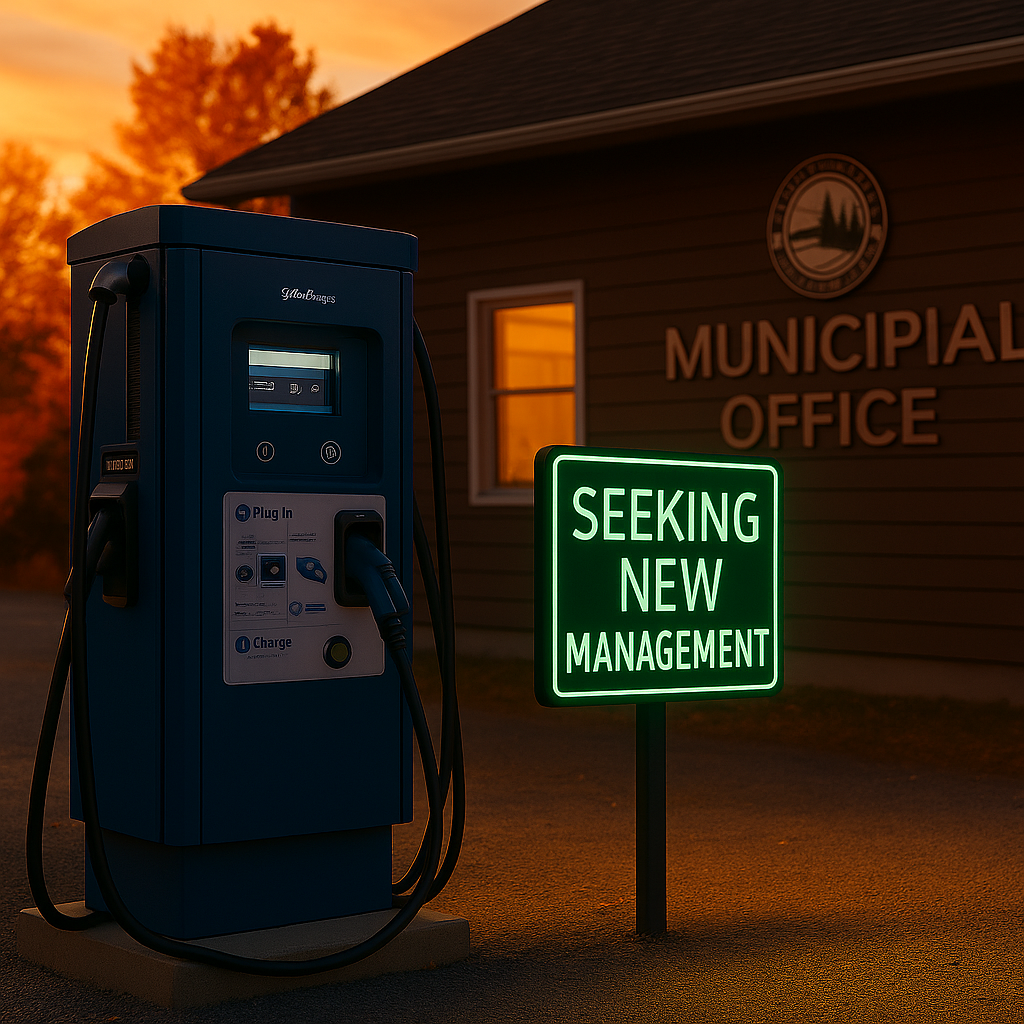
We were told the hardware was mostly covered by grants. True. What wasn’t spelled out was how Hydro bills these sites: not by how much you sell, but by the biggest bite of power you pull in any one hour that month. One spike and the “delivery” charge jumps—whether five cars used it or fifty. That’s how you can lose money even when the charger isn’t busy.
Our own paperwork shows it. In one early-summer period (June 17 to July 18), the delivery line alone was $2,266.70 on a $3,134.91 bill; even after credits, the Township was still on the hook for roughly $2,460. Since the first charge on March 21 to the latest bill tallied in mid-August, the station brought in $1,759.01 and racked up $11,645.30 in hydro costs. That’s a near $10,000 hole in under half a year.
Council’s fix so far: switch to per-kWh pricing and set the fast-charge price at $0.75/kWh, then “monitor.”
Fine. Clearer pricing helps. But the main problem isn’t the sticker at the plug—it’s the unmanaged peak that sets off those delivery charges.
Staff’s analysis made that plain. Under the old time-based setup, drivers effectively paid anywhere from $0.22 to $1.21 per kWh depending on how fast their car could draw, which wasn’t fair or predictable. Moving to per-kWh pricing was the right call. But price alone won’t beat a bill pegged to the highest draw. For that, we need to manage the unit.
Most modern chargers can do exactly what this situation demands: cap the site’s total power and share the load between the two plugs. You set a top limit so the site never pulls more than a set number of kilowatts. If two vehicles plug in, the software splits the juice so the site stays under that cap. Keep the monthly peak down and the delivery line calms down. That’s the whole game.
What are rural neighbours are doing?
Rural townships aren’t sitting on their hands. Prince Edward County publishes simple, no-nonsense fees at municipal stations—$2.50/hour for Level-2 and $20/hour for a municipal DC fast charger—paired with time limits to keep stalls turning over. That’s small-town pragmatism: clear prices, less loitering, steadier revenue. Haliburton County teamed up with Ivy Charging Network to roll out public chargers across villages under a “Park & Charge” model that happens to include a professional operator, standard software, and the kind of power-sharing controls that avoid nasty surprises on the utility bill. The theme is consistent: rural communities manage the site first, then the price.
We can do the same here without turning EVs into a luxury. Put the cap in writing and stick to it. Share power between the plugs so two cars can charge without tripping the meter to full blast. Then publish the facts every month—the cap we set, the peak we actually hit, and a simple bill summary—right in the usage report Council already ordered. If the cap works, those peaks will settle. If it doesn’t, adjust and try again. At least we’re steering, not getting dragged.
Manager of Community Development Brooke Ross brought Council the numbers and a fairer pricing model. Council set the rate. Now finish the job: cap it, share it, and show the numbers. There’s even relief coming from the province: a new EV-charging delivery rate is scheduled to roll out in 2026 for low-use fast chargers like ours. When it opens, we should be first in line. Until then, the fix is in our hands.
We don’t have to choose between soaking visitors and bleeding the budget. Manage the peak, not the people. Cap it. Share it. Stop the bleed.