
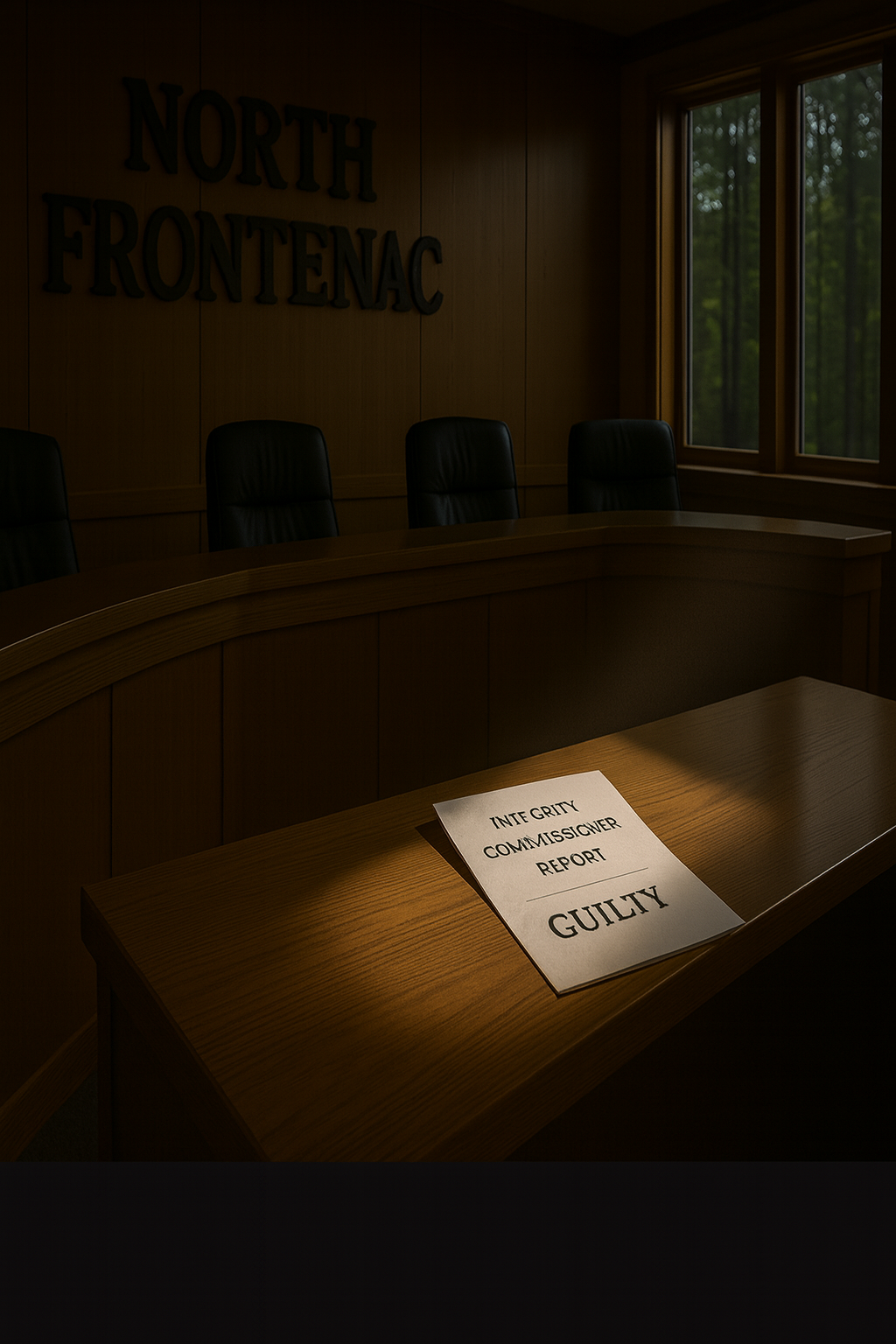
An independent Integrity Commissioner has ruled that Councillor Stephanie Regent breached North Frontenac’s Code of Conduct by misleading the public about council’s handling of affordable housing and the Economic Development Task Force (EDTF).
In a November 11, 2025 “Code of Conduct Complaint – Final Report” sent to Mayor Lichty and Council, Integrity Commissioner Tony Fleming of Cunningham Swan concludes that Regent “did not make honest statements and did mislead the public” in a series of Facebook posts earlier this year about the EDTF workplan and affordable housing. He recommends a seven-day suspension of her council remuneration as penalty.
Council, as a whole, was the complainant. The report notes that all of council voted to forward the complaint and describes “frustration” with Regent that was already visible in previous meetings.
Under Ontario’s Municipal Act, the Integrity Commissioner’s report must be made public and can only be received or rejected as a whole. Council has no authority to change the findings, only to decide how to publish the report and whether to adopt the recommended penalty.
The report directs the Clerk to place the item on the agenda for the next open council meeting and notes that the Commissioner is prepared to attend virtually to answer questions.
What the Investigation Looked At
The complaint dealt only with Regent’s public posts about the EDTF and affordable housing, not with any other matters.
The Integrity Commissioner examined a series of Facebook posts Regent published between May 16 and May 24, 2025, in which she:
Announced that affordable housing was no longer on the EDTF workplan and invited residents to “take another route” with her on housing work.
Blamed her absence from one EDTF meeting for allowing the workplan to be “taken apart,” with “important issues removed” and budget items added.
Told residents that the “validity” of the EDTF itself was going to be discussed by council.
Asked, in public, “How did this happen? Who made these suggestions? How did it get approved?” regarding the removal of affordable housing work from the EDTF plan, and warned she could not let those changes be “buried” in meeting minutes.
By the time the complaint was filed on August 8, 2025, some or all of these posts had already been deleted. The report notes the removal as a small mitigating factor, but makes clear that deletion does not erase the original conduct or undo the impact on public trust.
What Actually Happened at Council, According to the Record
Fleming’s report walks through the council timeline in detail. In short, the official record shows Regent actively participating in and voting on the very decisions she later framed as something done to her and to the public.
Key points from the report’s findings:
April 4, 2025 – EDTF workplan sent back The EDTF brought its 2025 workplan to council. After debate, council passed a resolution to send the workplan back for reconsideration. Regent did not oppose this. She was the one who moved the motion that added the direction to have the workplan reconsidered, and she voted in favour of the amended resolution. She later told the Integrity Commissioner she believed the EDTF had become “too heavy with events and not actually about economic development.”
April 22, 2025 – EDTF changes the workplan Mayor Lichty attended the EDTF meeting. The committee revised its workplan, removed two tourism events, and removed the housing work from the EDTF agenda. Regent was absent from this meeting, which she later highlighted in her social media posts.
May 15, 2025 – Council accepts the minutes Council received the EDTF minutes, which contained the revised workplan, including the removal of the housing sub-committee. Regent voted in favour of those minutes. The report notes that she did not raise any concern at that time about affordable housing disappearing from the EDTF’s work, did not ask that housing be restored, and did not ask council to direct the EDTF to reconsider the change.
June 12, 2025 – Housing Task Force created, EDTF housing committee dissolved Council created a new Housing Task Force reporting directly to council and dissolved the EDTF housing sub-committee. Regent spoke at that meeting to express her “deepest disappointment” that the sub-committee’s work was being removed. She then voted against the resolution that created the task force. She did not put her name forward to serve on that new task force.
Those are the decisions the Commissioner uses as the factual backbone. The problem, in his view, is that Regent’s later Facebook narrative did not line up with that record.
Where the Integrity Commissioner Says Regent Crossed the Line
North Frontenac’s Code of Conduct requires councillors to “seek to advance the public interest with honesty,” to avoid making statements “known to be false or with the intent to mislead,” and to “accurately communicate the decisions of Council.”
Fleming frames the case as a clash between two things: A councillor’s right to political expression, which is protected under the Charter of Rights and Freedoms. The duty, under the Code of Conduct, not to mislead the public about what council has done.
His conclusion is blunt: the obligation to be truthful is a reasonable limit on expression, and “spreading falsehoods is not a protected right.”
The report highlights two main problems.
First, Regent’s May 16 post stated that affordable housing was no longer on the EDTF workplan and presented herself as the one councillor still treating it as a priority. The Commissioner writes that there is “no other way to interpret” that message except as telling the public that affordable housing mattered to her but not to council. Given that council had just moved to pull housing out of the EDTF so it could be handled by a dedicated task force, and that Regent had voted along the way, Fleming finds that framing misleading.
Second, her May 24 post asked how the changes happened, who made the suggestions, and how they were approved. The Commissioner points out that Regent was in the room for the April 4 vote to send the workplan back, and that she voted to accept the May 15 minutes that contained the revised plan. From his perspective, she knew exactly how it happened and who approved it, because she was one of the people who approved it.
By telling the public she “could not allow” the changes to be “buried” in the minutes of the next meeting, Fleming says she invited residents to believe that she had opposed those changes or had at least tried to challenge them in council and been ignored. The report is clear that this did not occur.
Finally, the report notes that Regent’s posts left out a key fact: council was already moving to create a dedicated Housing Task Force that would report directly to council, not through the EDTF. That context never appeared in her online messaging, even as she presented herself as the lone housing advocate.
Taken together, Fleming finds that Regent’s Facebook narrative presented a false picture in which: Council was indifferent to affordable housing. The EDTF’s housing work had been quietly dismantled behind her back. She alone was standing up for the issue.
The Commissioner’s view is that this was not just political “spin” but a breach of the duty to accurately communicate council decisions.
Council’s Frustration Boils Over
One sentence in the report tells residents a lot about where council is at.
Fleming writes that it is “relevant” that all of council voted to bring this complaint forward, and that this “speaks to the frustration of members of Council related to the Member,” which he says is already visible in the meetings he reviewed.
In plain language: this was not a single colleague filing a grudge complaint. The whole table, including people who often disagree with each other on policy, agreed to send Regent’s conduct to an external investigator and to wear whatever political blowback comes with that.
In Regent’s responses to the investigation, she continued to defend her posts as factual and did not appear to understand why council found them offensive or misleading. Because of that last point, Fleming says he is not convinced she has grasped her obligations under the Code of Conduct. To reinforce those obligations, he recommends that council suspend her remuneration for seven days.
Council cannot alter his findings. They can choose to accept or reject his recommendation on penalty. If they refuse to apply any sanction, it will be their decision and their explanation to the public. For a rural council that usually tries to avoid open internal conflict, that is a significant escalation.
NFNM’s Experience and a Different Path to Accountability
This Integrity Commissioner report is about one complaint that council brought forward as a group. It is not the only Code of Conduct concern that has been sitting over this term.
NFNM has had six separate, fully documented Code of Conduct complaints prepared regarding Councillor Regent’s conduct over the past year. Each one was based on public records, meeting footage, written correspondence, or social media posts. Each one could have been filed formally, with supporting evidence, and sent down the same Integrity Commissioner process.
I chose not to file them.
There are two reasons. First, every Integrity Commissioner investigation costs the township money. Filing six separate complaints would have pushed those costs higher and higher, and I am not prepared to offload that bill onto neighbours who are already paying enough. Second, my role is not to hide behind authorities. My job is to put facts in front of the public and let people see patterns for themselves.
Truth is my weapon. Public record is my process. I would rather use free tools that belong to everyone – open council meetings, recordings, minutes, and reporting – than lean on a system that quietly drains the same taxpayers I am trying to stand up for.
This report confirms, in formal language, what many residents already suspected from watching the past year unfold. It is one piece of a larger story. NFNM will keep using evidence, not titles, to tell the rest of it.