
This week, Donald Morton is bringing a delegation to North Frontenac Council on a topic that should be easy to agree on.
Tiny Homes on Wheels, also known as THOWS, have been around for decades. They existed long before “tiny homes” became a formal planning term. People have built small homes on wheeled chassis for years, formed communities around them, and used them as a practical way to stay housed when conventional housing became unreachable. In rural Ontario, they have also been a simple gateway to independence. A person can downsize, simplify, and live closer to the land without needing a mortgage-sized life.
Ontario’s building framework already recognizes that a tiny home can be built on a chassis. North Frontenac also made an important move last year by recognizing tiny homes in the Zoning By-law. The problem is that the definition appears to have missed one key detail.
In Zoning By-law #55-19, the definition of “Dwelling – Tiny Home” includes a clause that states “any wheels shall be removed.” That single line blocks a properly built Tiny Home on Wheels from fitting inside the Township’s own tiny home category, even when the unit is intended to be installed permanently and treated as a real dwelling. It also pulls the hitch issue into the same trap, because if the rule is about removing wheels, the logic quickly becomes removing the parts that make it towable, even when towability is not what should decide whether it is a dwelling. It is worth noting the townships own By-Laws dont explicitly state anything about removing the hitch, however, it has been reported to NFNM by current THOW owners that the township is requesting it. This arbitrary request alone illustrates the confusion that starts around something that is not very well understood by the very people making the rules.
The Fix
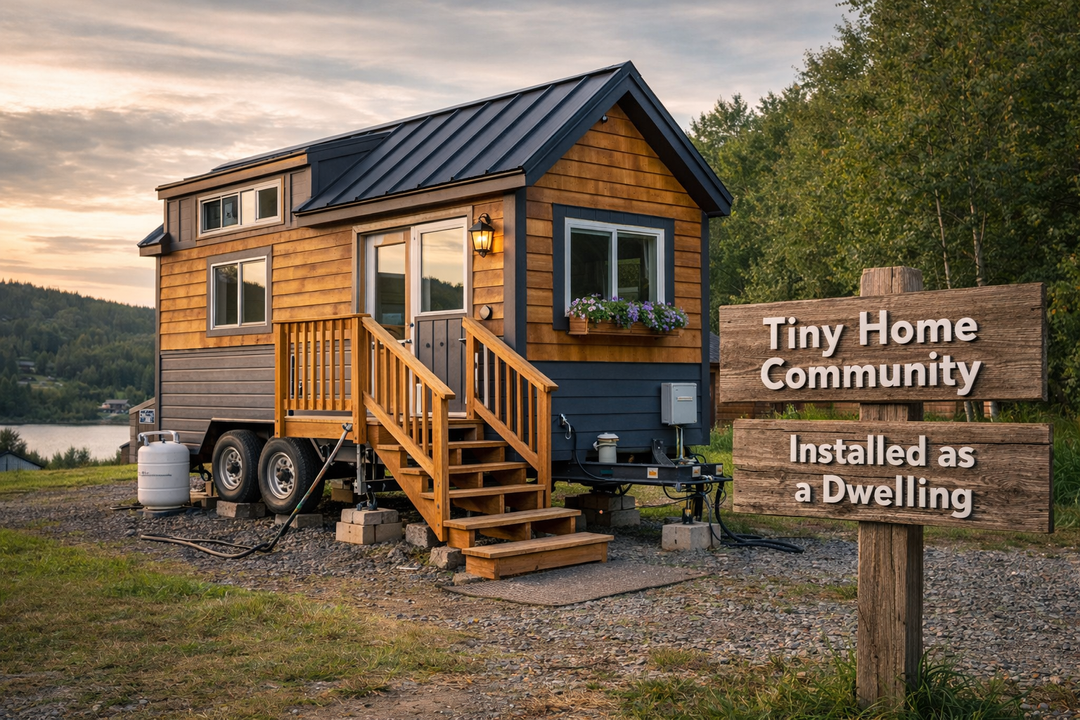
Morton’s delegation is built around a simple correction. North Frontenac does not need a major policy overhaul. It needs a definition that matches how these homes are actually placed and permitted. In real installations, wheels being off the ground is normal practice. A Tiny Home on Wheels that is treated as a dwelling that sits on supports, is levelled, anchored, and tied down. It has stairs or a landing. It is connected to approved services where applicable. Permits and inspections are what make it safe and enforceable. That is the modern, practical reality on the ground, and it lines up with how Ontario treats tiny homes when they are installed as buildings.
Morton is asking Council to direct staff to bring forward an amendment to By-law #55-19 that removes the wheel-removal barrier and replaces it with clear “installed as a building” criteria. The goal is clarity. It provides an obvious compliance pathway for residents. It gives staff a rule that is easy to enforce. It aligns the Township’s definition with the building framework that already exists in Ontario.
Moving Forward
North Frontenac is in a moment where every practical housing option matters. This is one of the rare changes that can expand possibility without expanding confusion. It is a tidy fix that respects safety, respects enforcement, and respects the reality that modern tiny homes are often built on a chassis.
If Council makes this adjustment, it is more than a wording change. It is the Township finishing what it already started: recognizing tiny homes as legitimate housing and making sure the rules match the real world.