NFNM insider special report: The year accountability got personal
The public headline is clean and procedural. Councillor Stephanie Regent’s seat became vacant after a stretch of missed meetings, and council moved to deal with the vacancy under Ontario’s rules. That is the surface record, and it matters.
The deeper story is harder to summarize because it includes the part no one wants to admit out loud. In a small township, accountability does not stay inside the council chamber. It spills into local businesses, friendships, Facebook groups, family relationships, and the willingness of ordinary people to keep building a life here when the temperature rises.
NFNM has been reporting on North Frontenac for almost a year. The goal has stayed the same the whole time. Facts, process, and performance are what guide the reporting, even when the community mood shifts. The last year proved something important: the biggest fight is rarely about the policy. The biggest fight is about whether a community can handle scrutiny without turning into a social club that punishes the person who asks the question.
What the public saw at the end
Regent’s removal from council did not arrive as a dramatic political purge. It arrived through attendance rules, the kind that exist because councils cannot function when a seat goes dark. Multiple meetings were missed, the township documented the absences, and the process moved forward with legal advice.
Frontenac News reported that Regent missed council meetings over a span of months, and that CAO Cory Klatt formally notified her that her seat could be declared vacant if the pattern continued. They also reported that council consulted the township solicitor and declared the seat vacant. They described council’s next step as offering the vacancy to the eligible candidate who received the next-highest number of votes in the 2022 election rather than running an immediate by-election.
That is the ending the public can digest. It is tidy. It stays inside procedure. It avoids the part that explains why this played out the way it did.
Where this actually started
This story began in 2025 with questions that should have been ordinary. NFNM began looking into the Economic Development Task Force and its housing subcommittee because those bodies were being used to shape public messaging, and because “affordable housing” was being sold to residents as a moral mission. When a committee uses a powerful label, the job of a watchdog outlet is to ask what the label means in practice, what the plan actually is, and who benefits.
In NFNM’s undercover report, I described speaking directly with Brandon Hartwig about what “affordable housing” meant inside that committee. I documented that his answer framed it around retirement homes, and that the messaging residents heard in the community sounded much broader. That disconnect matters because it changes what the public believes is being built and who it is meant for.
Then it turned personal in a way that still has not left the community.
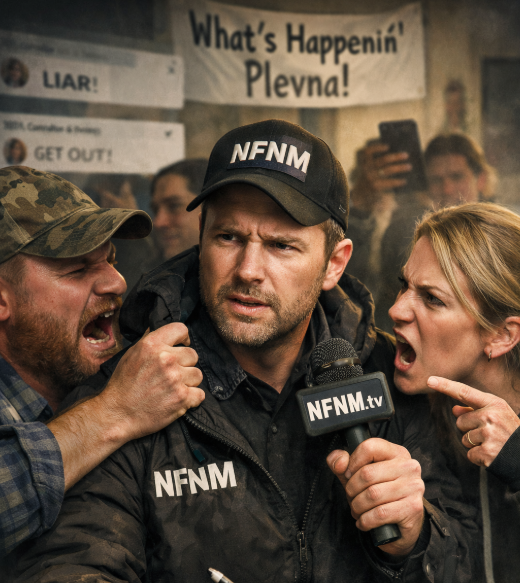
In that same NFNM report, I documented that encounter outside North of 7 in Plevna where Hartwig responded to a direct question about the EDTF’s track record with physically assaulting a reporter and making an explicit threat: “If you say that again, I will drag your face across the parking lot.” That was intimidation in public and does not have any place in a township that is trying to convince people it is open for business and ready for growth.
The tribal reflex that followed
After that point, the response pattern became familiar. Instead of answering questions, a small group tried to make the questions socially expensive. That pressure did not come through formal channels. It came through Facebook, private messages, and local gatekeeping.
In NFNM’s later editorial coverage, I wrote that Hartwig and Tiffiny Tryon-Lesperance, through the “What’s Happenin’ Plevna” Facebook group, had escalated into a full smear campaign after NFNM published performance-focused reporting on Regent. I documented that defamatory accusations were used as weapons, including claims that I “hate women” and “hate native Indian people.” The situation swifty moved from disagreement to reputational sabotage, and it was done in a public forum run by people with influence in local online spaces.
I also documented that the pressure did not stay online. The editorial describes private threats that used family property as leverage and attempts to drive distrust inside my own family. That is the kind of behaviour that makes people hesitate before investing, hiring, partnering, or even publicly supporting something that might put a target on their back.
This is the part the surface story never includes. A township can have the right laws and the right committees and still have a culture problem that punishes transparency and accountability. Culture decides whether people stay, whether new businesses launch, and whether young families picture a future here.
Regent’s role in the blowback
NFNM’s reporting did not begin with Regent. It moved toward Regent because her conduct and public messaging became unavoidable as a matter of public record. NFNM’s July 2025 reporting connected a year of political tension to council’s decision to shut down the EDTF housing subcommittee, a group where Regent had been heavily involved. That article described Regent as visibly angry during the meeting where the decision was made and described continued public criticism and complaints from her circle after the subcommittee was shut down.
At that stage, this was still a recoverable situation. A councillor can correct course. A councillor can set a standard for civility, even while disagreeing. A councillor can choose to lead when the community gets heated.
In my August 2025 editorial, I described reaching out to Regent directly when things escalated, and I documented her response: “Stop harassing me,” followed by blocking me. That is a choice. It signals that scrutiny will be treated as hostility, and it sends a message to everyone watching that accountability comes with social punishment.
The Integrity Commissioner finding that changed the record
In late 2025, the issue shifted from social conflict into formal findings. Frontenac News reported that the township’s Integrity Commissioner, Tony Fleming, concluded Regent breached the Code of Conduct and misled the public through Facebook posts about affordable housing and the EDTF. They reported that council approved a seven-day pay suspension based on that finding.
NFNM’s own December 2025 report described council accepting the Integrity Commissioner’s conclusion and recorded that Mayor Gerry Lichty stated in open meeting that an apology would be expected, even though it could not be ordered. NFNM also documented that Regent made a subsequent post about Frontenac News and encouraged residents to reach out to her privately, while NFNM remained blocked from her page and visibility appeared to vary depending on who had been restricted.
That matters because it goes to the core of what this year exposed. Communication can be used to inform residents, or it can be used to manage perception and punish dissent. When a councillor is found to have misled the public, and then shifts the focus to media narratives while controlling access to their own messaging, the public trust problem grows instead of shrinking.
What this cost NFNM and why it matters to the township
This is the part I am putting on the record plainly. NFNM is a business that is being built here. This work involves relationships, local partnerships, and community trust. The smear campaign and intimidation tactics did real damage, and the damage did not disappear when the facts caught up.
Friendships were lost. Business momentum slowed. Rifts formed between neighbours who used to share the same tables and help each other in winter. That is a high price to pay for reporting that stayed anchored to public records, documented interactions, and the standard expectation that elected officials and public committees can answer basic performance questions without their supporters weaponizing the town against the messenger.
I served cease and desist letters to Brandon Hartwig and Tiffiny Tryon-Lesperance, and the behaviour continued. This report uses their names because the pattern has become part of the story, and because the consequences of refusing to stop have to be real for the people doing the targeting.
The closing truth
NFNM does not feel good about Regent’s outcome. A seat going vacant is not a victory lap for anyone who cares about the township. It represents a breakdown somewhere, and breakdowns cost residents time, money, and trust.
NFNM does feel good about the future, because the future is still being built and the culture can still shift. NFNM was never created to impress anyone, and it was never built to chase popularity. It was built to document reality in a way that stands up when the dust settles.
North Frontenac talks often about “growth” and “rolling with the big kids.” Serious communities handle accountability without turning it into a loyalty test. Serious communities do not run journalists out of town for asking what a committee has done, and they do not tolerate smear campaigns as a substitute for answers. That is the difference between a township that attracts builders and families, and a township that stays trapped in grudges and social club politics.