
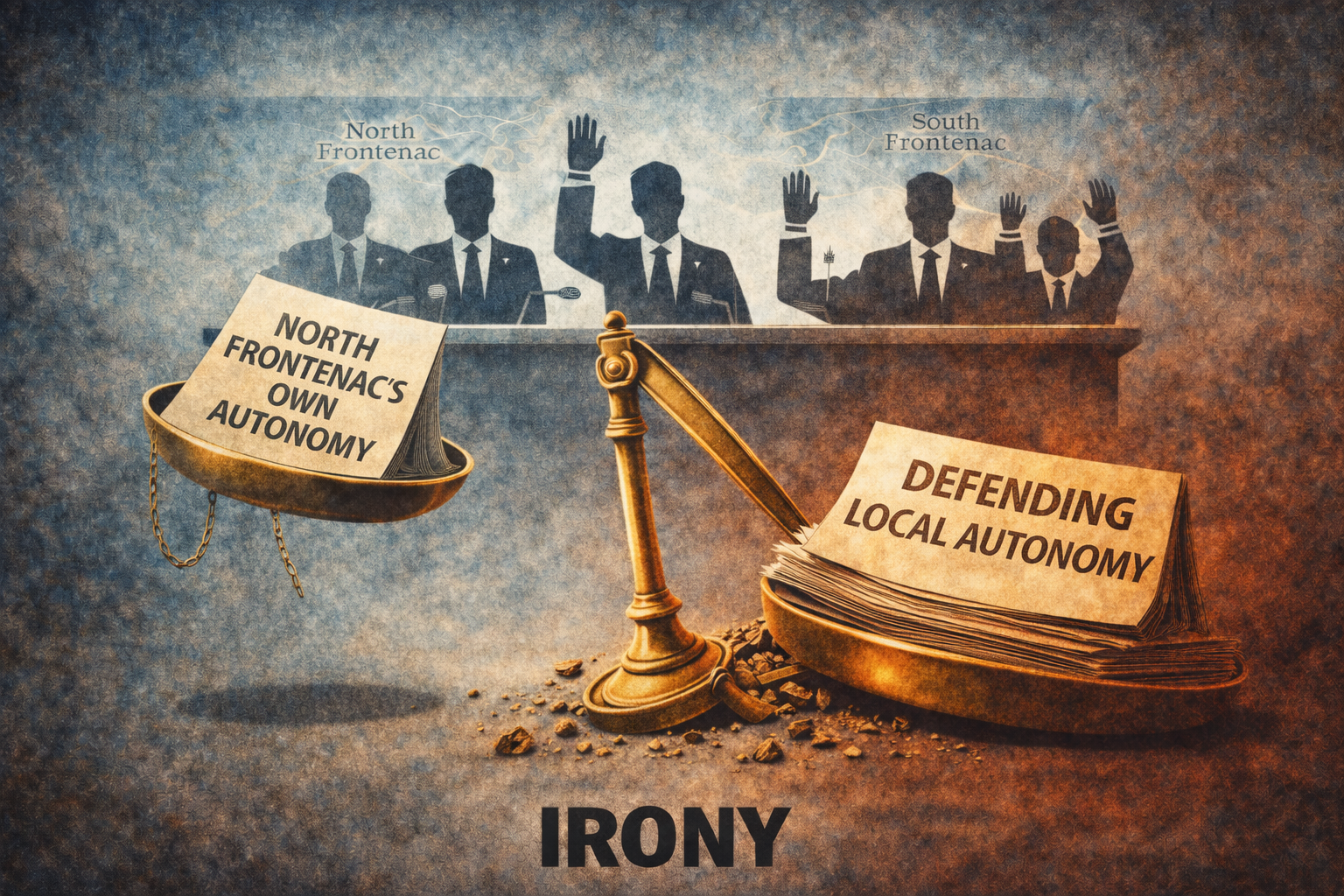
North Frontenac Council carried South Frontenac’s “Defend Local Autonomy” package this morning. Mayor Gerry Lichty voted against it. The rest of council carried it, Councillor Regent was absent, again.
The irony is palpable. In the name of “defending local autonomy,” our council voted in a way that reduces it.
Local autonomy at council is not a slogan. It is the ability to take clear positions issue by issue, and leave residents a clean public record that shows what was supported, what was rejected, and why. A bundled vote does the opposite. It blurs the meaning of the decision, and it hands control of the narrative to whoever wrote the package.
The vote itself was only half the story. The other half was what happened next.
When the vote was over, NFNM raised direct questions aimed at one basic outcome: separating the bundle on the record so residents could tell what council supported and what council did not. Those questions were dodged. No one clearly addressed the bundling problem. No one clearly stated whether they endorsed South Frontenac’s attack on strong mayor powers. No one moved to correct the record.
So the minutes will show a clean yes, but residents are left with a muddy meaning.
Arthur Hannigan said it bluntly after watching this unfold:
“This reflects a deficiency in experience that elevates their apprehensions to a point that may adversely impact our entire community. Why do they not engage in thorough research? Why do they hesitate to seek clarification when faced with uncertainty?”
That is the core of what residents saw today. A decision pushed through without clean explanations, followed by avoidance when the public asked for clarity.
Why the bundle matters
South Frontenac did not send three separate requests. It sent one packaged narrative that ties three different issues together and asks other municipalities to endorse the objections as one unit.
This is the exact governance problem Hannigan warned about in his public statement on political packaging:
“The practice of bundling controversial policy proposals together with more broadly acceptable ideas is a growing concern in municipal governance.”
He described what bundling does in plain terms. It “reduces scrutiny of a contentious issue by sheltering it behind ideas that are easier to support,” and it succeeds “at the expense of transparency, public trust, and responsible decision-making.”
That is why bundling works. It changes the public record. It changes how a vote gets interpreted later. It lets a council sign onto a storyline without owning each part of it separately.
The moment council had to prove it understood the vote
After the package carried, residents needed one thing: clean clarity on the record.
Did council intend to endorse South Frontenac’s position on strong mayor powers. Did council believe strong mayor powers have been working in North Frontenac. Did councillors read the full text they were endorsing. Would council send a clarification so the public record reflected separate positions.
Those questions were raised in the room. The room got deflection instead of answers.
Hannigan’s statement explains why that matters:
“When an elected body seeks endorsement or approval for a policy that is controversial, the burden rests squarely on that body to demonstrate the policy’s merit through sound research, clear evidence, and open debate.”
A council that did the homework has no reason to fear clarification. A council that did not do the homework avoids the spotlight because the questions expose the gap.
Ron Higgins said what many residents were thinking
Former mayor Ron Higgins posted his reaction on the election page, and his comments sharpen the point from another angle. He called the resolution weak on substance and heavy on symbolism:
“This is not a very well crafted resolution.”
“Because it does absolutely nothing other than make local politicians feel good about opposing Provincial legislation.”
He also agreed with the central NFNM complaint about bundling and the public record:
“I agree with the NFNM that they should be separated as a council member may have differing views on each item which would be then transparent and archived as a record.”
And he delivered the verdict that lands hardest in a rural township that needs results, not theatre:
“This is nothing but a feel-good resolution with no substance.”
Council had the ability to separate the issues in the meeting. It did not. When asked directly to clarify, it would not.
Strong mayor powers and why this matters for North Frontenac
Strong mayor powers are not a side issue for North Frontenac’s future. They matter most in the years ahead, when housing and land development decisions need execution, not endless delay.
North Frontenac has not leaned heavily on strong mayor powers so far. The most visible use has been around the budget process, and residents watched a generally open and understandable budget experience.
That is exactly why South Frontenac’s bundled attack on the strong mayor framework does not fit North Frontenac’s lived reality. It also explains why bundling this issue into a package is so dangerous. Once council endorses a packaged narrative, it can be quoted back later as North Frontenac’s position, even if that is not what some councillors intended.
What residents are left with today
A bundled vote carried.
A mayor voted against it.
Council declined to separate the bundle on the public record.
Council declined to answer direct clarification questions after the vote.
That is how apprehension turns into governance. That is how political packaging becomes policy. That is how a council loses local autonomy where it actually exists, in the clarity of its own decisions and the integrity of its own record.
If council wants residents to trust decisions like this, the standard is simple. Do the research. Ask for clarification when uncertain. Answer basic questions when the public asks what a vote means.
Today, that standard was not met.