
Our first preliminary report on the 2026 budget laid out the pressure points. Property tax is still the backbone of revenue. A Municipal Accommodation Tax on tourists is being studied. Fire leadership wants more pay and better perks, and roads fall behind asset targets while money drifts into tourism and trails.
That piece was written before council sat down and tried to finish the budget.
Last weeks meeting is where the numbers became real. Council locked in 3% annual property tax increases and tied that to roads. They left big files like Kaladar Barrie and growth planning half answered or pushed off to specific committees or a future council.
NFNM was present at this meeting and this report sets out, in plain language, what council decided and how it affects the township budget.
What council did with taxes and roads
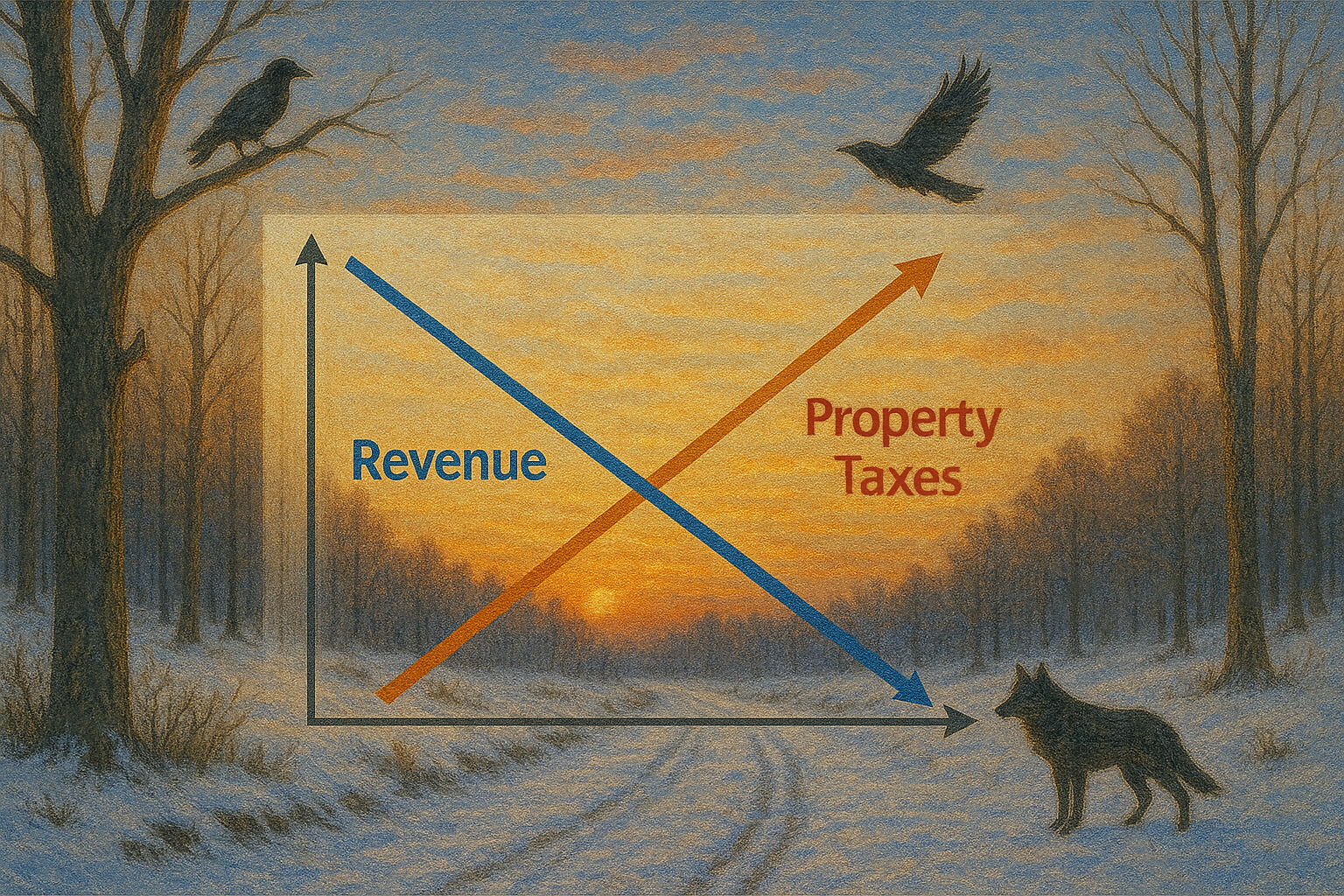
Before this meeting, the 10 year financial plan already assumed a 2% increase on property taxes in the levy every year. At the budget session, council chose to add another 1%. That sets the plan at 3% per year going forward.
Council and staff talked about that 3% as road money. They explained it as a long term push for the road network. They also said, more than once, that 3% each year for 10 years means a 30% climb on property taxes. That is the message residents heard.
In 2026 the total levy change is 4.8% once everything is included. According to township staff, that 4.8% still keeps North Frontenac below neighbouring townships on property tax rates.
Darwin from public works reminded council where things stand. The province expects the township to resurface about 26 km of road a year based on asset grades, with a target of roughly 70% of roads at about 70% condition. Hard top roads are already far below that target and gravel roads are closer but still behind. The report council is relying on uses 2022 data, so conditions are assumed to be worse today. Darwin also said that even a 3% increase for roads does not make up the current deficit and that every year of delay pushes more sections from simple surface work into full rebuild. Councillor Wayne Good and Deputy Mayor Roy Huetl argued for going as high as 4%, but council agreed together to hold at 3% as a compromise based on local population size and income.
Mayor Lichty added that a future council can change the 3% figure up or down if other revenue sources come in.
Roads, gravel and what people actually said
Darwin kept to condition scores and targets. Residents who spoke in the public forum brought it back to cars, tires and safety.
Kelly Willis talked about the difference between loose gravel and microsurface hard top. She said the microsurfaced roads do more than look nice. They cut down on chips, broken windshields and extra tire wear, and they are safer to drive on with clearer lines at night. Gravel chews up vehicles and is harder to handle in winter, with a real danger of flying rocks hitting windshields, paint, and people on ATVs, motorcycles or even walking. She also said the people she talks to in the township are fine with a total increase close to 4.8% this year when they can see that 3% of that is being used for real road work.
Councillor Inglis asked what the network will look like in ten years when half the roads are already rated poor or very poor. Darwin answered that, as of the 2022 report, more than half of the hard top roads were already in that bad shape.
MNR “help”, real support and real invoices
On fire, council leaned on the Ministry of Natural Resources and Forestry. Mayor Gerry Lichty stated the MNR invoice is not in yet and will be massive.
It is important to say this clearly. MNR is not the bad guy in this story. Their crews and aircraft come in when local firefighters are stretched to the limit on wildfires. They bring extra people, tools and air support that a small township cannot afford on its own. When crews are exhausted, people get hurt. Having MNR step in to finish the job can save homes and lives.
The problem is how this is talked about at the council table. The mayor said that with the local MNR office closed, the duty to manage fires now rests with municipalities. That fits the legal picture. It also means North Frontenac will keep getting billed for MNR deployments, even as Ottawa puts more money into wildfire programs, FireSmart work and new aircraft to back up provinces and territories.
There was no slide or clear summary that showed what MNR support has cost citizens here over the last few busy fire seasons. Council used the word “help” without showing the size of the bill or where it lands in the budget. Residents deserve both parts of that story: the value of the backup and the true cost.
Fire management hours, training and pay
NFNM’s preliminary report flagged an earlier push from fire leadership for a large raise linked to extra scheduled hours and certifications. That fight showed up again in a smaller form at this meeting.
The Assistant/Deputy Chief hired two or three years ago has been working on a set number of hours. The proposal this year was to give that role 10 more paid hours every week. Councillor Inglis asked why that need appears now.
The fire chief spoke about training firefighters, making sure they are prepared and having at least one person who can handle daytime calls when volunteers are at work, as well as a big increase in certification requirements in 2022. These are real concerns. They did not turn into a clear breakdown of tasks and time that proves 10 extra hours per week on an ongoing basis.
Council settled on a compromise. They approved 5 extra hours per week for six months and will revisit the role later. The chief accepted this as “direction from council.” He did not seem pleased with the decision.
During the discussion, the mayor explained how council tried to respond to volunteer concerns in the last year. Group benefits for volunteers did not move ahead, partly because of the Kaladar Barrie fire arrangement. Instead, the township increased volunteer pay and started paying training hours by the hour rather than by the session. That gives people more cash for time spent.
One key point is still missing at the council table and in follow up talks with volunteer firefighter Don Morton. Certification is not the same as training. Certification is the course work and testing needed from the OFM that says someone is qualified. Training is the regular hands-on work that keeps skills fresh after that. During the meeting, those two ideas were often treated as one. That blur makes it hard for residents to see how much time is going to true front line training and how much is going to extra administration.
The $37,000 Kaladar Barrie question
For 2026, North Frontenac expects to pay about $402,968 to Kaladar Barrie for Fire Assistance. That total includes an extra $37,000 as the projected increase in our share this year. The mayor says that $37,000 is a fair estimate for the level of fire service we get.
NFNM’s problem is how this number is set. When North Frontenac passed its budget, Kaladar Barrie had not provided a full, detailed fire budget the public could see. Addington Highlands does its budget later in the winter and gets the fire numbers in the spring. North Frontenac now does its budget in the fall. That timing means our council locks in a guessed increase for Kaladar Barrie and asks residents to live with it until the real figures arrive months later.
The mayor says the estimate should be close and that there is a stop-gap. If the final ask is more than $37,000, a reserve fund will cover the difference. If the ask is less, the surplus goes into that reserve. That may keep the books balanced, but it does not change the basic fact that council is voting on a major fire bill without a line-by-line budget from the joint committee.
Staff also cleared up the Ward 1 structure. There is one fire chief, Casey Cuddie, and a committee that looks after Ward 1. North Frontenac helps when needed. NFNM had earlier written that Ward 1 had two chiefs, two CAOs and two councils involved in fire. That was wrong. Tara corrected it and we are fixing it here.
The structure is now clear. The transparency is not. People in North Frontenac are being asked to pay into a shared fire agreement run out of a joint committee in another township, based on an estimated increase, and they will only see the detailed budget after their own has already been passed. NFNM will stay on this issue.
Calcium chloride and the trail system
NFNM has already raised concerns about money flowing into tourism and trails while core assets lag. This budget meeting added more detail about how those trails are being treated.
The trail network is run through Frontenac County, the Eastern Ontario Trails Alliance and local ATV and snowmobile clubs. The township confirmed that calcium chloride is used on those trails as a dust control measure.
This chemical is strong. Staff said the calcium chloride truck is falling apart because the material is so corrosive. Extra powder from winter road work is mixed into liquid. The supplier then takes that liquid back and reuses it on forest trails as a cost saving move.
No one presented an environmental review for this practice. No other dust control options were set beside it for cost and impact. The reason given was simple. It is cheap. At the same time, the ATV and snowmobile clubs themselves warn riders to put boots on their dogs’ feet to protect them in the summer months.
NFNM will keep watching this.
Dump workers on generators in 2026
At the waste sites, staff sit in small shacks in all weather. The current setup uses propane heaters for warmth. There is no direct hydro feed.
Council approved window air conditioners for those shacks. The power source will be gas generators, not a hydro line. Staff said running hydro to the sites would mean major work on spans and poles and called that a big job.
Fuel for the generators does not appear as a clear, separate line in the budget. Generators are also common theft targets.
Front line staff at waste sites will still work in basic sheds in 2026 while the township chases a 3% levy for roads and keeps niche spending like trade shows and special positions in place.
EV charger: $2,500 a year for maintenance
The budget includes an annual maintenance plan for the municipal EV charger at a cost of $2,500 per year.
The contractor was not named in the public discussion. There was no clear statement about how often they will attend, what they do at each visit, or whether this is a proprietary arrangement tied to one brand. The meeting did not make it clear if the plan covers major repairs or only light inspection and software resets.
The figure is simple. Residents are now on the hook for $2,500 every year for this device. They do not get to see much about the service behind that bill. After everyone takes their share making money off the EV charger, North Frontenac is the only one not making money on the deal.
Community halls and the hot water tank that would not quit
The longest-serving “staff member” at one of our local community halls is finally retiring. The hot water tank, installed around 1966, has been on call 24/7 for nearly 60 years without a single sick day. It has survived more winters and more power outages than Hydro would ever admit to.
This steel legend has outlasted sound systems, coffee urns, three generations of folding chairs and more than a few questionable haircuts at community dances. Every year it heard the same promise: “We’ll replace it next year,” and every year it just shrugged and kept the water flowing.
To the old hall tank: thank you for your decades of quiet, reliable service. You’ve earned your pension, your gold watch and a peaceful corner out back to rust in dignity. If the new tank lasts half as long, we’ll call it a win.
Summer Fest and missing numbers
Summer Fest has grown. It is no longer a tiny $2,000 event. The current budget puts the cost closer to $15,000.
NFNM raised concerns about this in the public forum. An event at that cost needs real tracking. How many people come. How far they travel. How much money stays in local stores, lodges and rentals. What is spent on ads and promotion. What comes in from sponsors and grants. How parking, traffic, security, first aid, washrooms and cleanup are handled for a crowd that could reach into the thousands. And what it actually costs in staff and volunteer hours to pull the whole thing off.
The budget itself does not force that tracking into the open. For now, Summer Fest keeps its bigger line and the community is invited to trust that it is worth it.
The “summer student”
One of the strangest items was the $20,000 “economic development summer student” line. That pay works out to about $5,000 a month. The average income for many residents here is around half of that.
During debate, the mayor said the person in question has education and knows how to do the job, but lacks experience. That sounds more like a junior staffer, not a student in placement postion. The word “student” hides that reality.
The treasurer brought a motion that said council would delete the summer student from the budget at a cost of $20,000. Council voted and ended in a tie. Under procedure, a tie vote means the motion id defeated. Because the motion to delete failed, the $20,000 line stayed in the budget and will be put in the reserve. cutting the student did not lower the levy this year.
Councillor Hermer asked out loud whether the motion had been written as a joke. Many people reading the wording after the fact had the same thought.
Where this leaves North Frontenac
NFNM’s preliminary investigation warned that the 2026 budget was heavy on talk and light on long term solutions. The full meeting confirmed that picture.
Council has now locked in 3% a year on the levy as road money while the road system is already below provincial targets. More than half of the hard top roads were rated poor or very poor in 2022 and Darwin says delays only make the repairs bigger and more expensive. Heavy trucks keep grinding through the marsh on 509 without haul agreements or real cost sharing. Dump workers will still sit in generator shacks. Trails are sprayed with a corrosive dust control because it is cheap. North Frontenac will send about $402,968 to a shared fire department based in another township, including a $37,000 increase that was set as an estimate months before the detailed fire budget arrives. Summer Fest grows without solid numbers and a $20,000 “summer student” line stayed alive through clever wording and a tied vote.
There are a few bright spots. Volunteers got some extra pay, council did trim back the full 10-hour ask for fire management, and people in the public seats spoke clearly about roads and safety. Those points do not change the core story.
North Frontenac is in a decade of planned tax increases without matching clarity on how every major line in this budget earns its place. Residents who live here, pay here and drive these roads have a right to see full numbers and straight answers. NFNM will keep pulling those numbers into the open so people can decide for themselves whether this plan works for them.