
NFNM – Tell it like it is
Context and purpose
North Frontenac leans on a simple story of low taxes, volunteer fire service, and rising tourism and short-term rentals. This preliminary investigation pulls together early 2026 budget talk, public reporting and direct quotes. The goal is to see what choices are being made, who is being looked after first, and where risk is building in a small rural township in eastern Ontario.
Tourism money and economic development
In the economic development section of the draft, the mayor describes three new or expanded items: $15,000 for community improvement, $15,000 for Summerfest, and another $15,000 for “outreach.” He says he added these because the economic development task force asked for them, and notes that there is “a lot of money” in that section.
“Outreach” is not some new mystery program. It is the rebranded label for the trade shows and convention trips council has already been sending people to. NFNM has previously questioned why the Township is spending $15,000 on three trade shows. Changing the name to “outreach” does not change what the money is being used for. It is still travel and promotion outward, not direct services at home.
That is $45,000 in new or growing activity tied mainly to events, promotion and improvement grants. At the same time, the Township is under pressure on roads, fire, insurance and enforcement. The early draft choices show clear new money on the tourism-facing side while some basics are still strained.
On top of that sits the larger debate about a future Municipal Accommodation Tax on short-term stays. County work on MAT is being framed as a way to make tourism “pay its way,” so that a small percentage on overnight bills can fund promotion and visitor infrastructure instead of loading everything onto the general levy. The risk is that MAT, if it comes, is treated as extra spending money on top of rising taxes, instead of real relief for year-round property owners who already feel tapped out.
Fire structure, benefits and fairness
The fire budget is one of the sharpest pressure points in this early review. North Frontenac and Addington Highlands jointly run the Kaladar/Barrie fire service through a shared committee. That committee sets policies for pay and benefits, but real change still needs both councils to approve it in their annual budgets. On paper it looks coordinated. In practice it means two councils, two CAOs and multiple chiefs sitting over one shared service of Ward 1. The definition of redundant and a clash of ego.
Group benefits for North Frontenac volunteer firefighters were already turned down in a recent budget. In 2024, council chose not to include a group benefits line for firefighters that would have cost about $24,000. The mayor has said council did not support benefits for the front line, and pointed to the shared structure with Addington Highlands as a barrier, because one township did not want to consider the change.
Now a new budget request is on the table to increase the Deputy Chief’s weekly hours by 10. The 2026 draft shows an increase for this position of about $33,500 a year, with roughly $20,000 of that as added salary and just under $15,000 as added benefits. The mayor argues that the department will gain from the extra hours and that this will help keep the Deputy, since Deputy Chief roles are often used as a step toward a full Chief job. Training and administration do take time. Ten more hours a week can be reasonable if there is clear proof that those roughly 500 hours a year are used for real work: training plans, record-keeping, safety programs and support to the halls.
NFNM is not dismissing that need. Certification is real work and the standards are getting heavier. What raises red flags is the link between those extra hours, a rich benefits package for the Deputy, and how the rest of the fire service has been treated.
There is also a deeper structure problem. If the two townships ever want to offer more to front line volunteers and equipment, they will have to look hard at the current administration setup and talk honestly about some level of amalgamation or streamlining at the top. Outside reviewers have already noted that having two councils, two CAOs and multiple chiefs involved in decisions for Ward 1 makes fire governance slower and more complex. The fear now is that the culture is drifting toward a race for better pay and benefits at the management level, while volunteers and gear are left to fight over what is left. It promotes a system where people feel they have to climb into officer roles just to access basic protections like benefits, while the folks who take most of the on-the-ground risk stay uncovered.
Roads and basic infrastructure
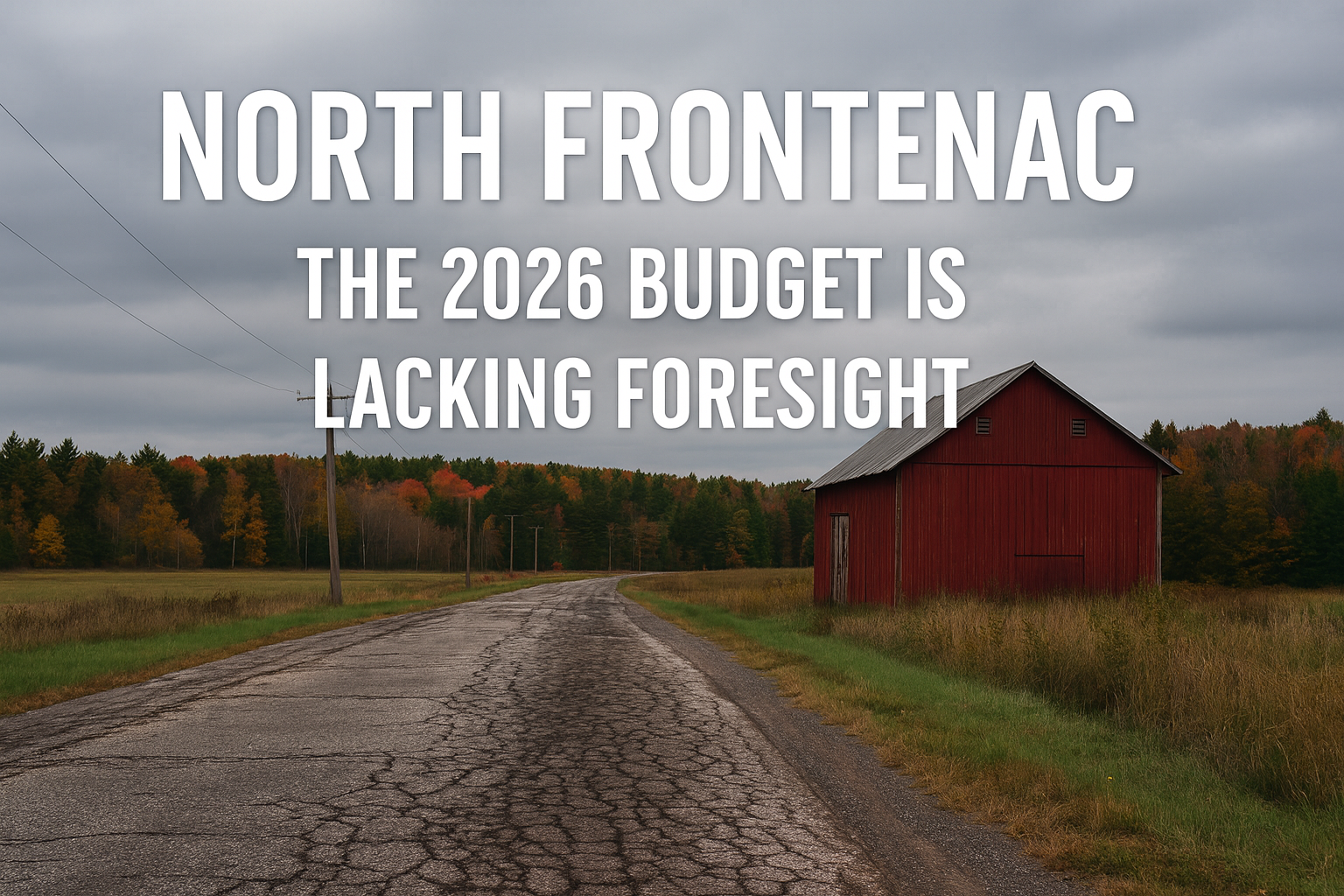
The mayor has been open about the road gap. He has said the Township needs about $4,600,000 for roads and has about $2,100,000 in place. He points to a plan to add 2% per year to the road capital reserve and repeats that full asphalt is the goal, but that North Frontenac is not there yet. At the same time, he predicts a total tax increase somewhere around 4% while nearby townships consider higher numbers.
For people who drive long distances on rural roads, this is not just a chart issue. It shows up as worn tires, rough suspensions and safety concerns when spring thaw and winter storms hit. When you only have about $2.1 million in hand against a $4.6 million need, you are not keeping up. You are pushing work off into the future and hoping the system holds together in the meantime.
The current direction is to raise property taxes by about 2% a year for the next decade and treat that as the serious move on roads. Even in simple terms, 2% a year for ten years only gets you to around a 20% total increase. The road math says the gap is closer to 100%. To actually match the scale of the problem, you would be looking at something more like 10% a year for ten years, not 2%. That is how far behind we are.
Council likes to point out that North Frontenac has some of the lowest property taxes around. That sounds good until you match it against the condition of the roads and the size of the backlog. Low taxes are not a favour if the price is paid through broken suspensions, longer detours, and bigger reconstruction bills down the line. Right now, we are not fixing enough, fast enough. We are running our roads system on the cheap and calling it good news.
Solar, insurance and future costs
Alongside roads and fire, council is also looking at how to manage future energy and insurance costs.
On the energy side, the Environmental Task Force has proposed a $225,000 solar net metering project at the municipal office and attached fire hall. The pitch is that the Township could pay off the investment in roughly 8 to 15 years and then save between about $370,000 and $1.3 million over a 25-year period, depending on how hydro prices move. It is a textbook example of a long-term capital bet: money out now in the hope of future operating relief.
On the insurance side, the trend is already clear. Municipal premiums across Ontario have jumped sharply in recent years as climate risk, cyber attacks and liability claims mount. Homeowners see the same pattern on their own policies. North Frontenac buys coverage in that same market. The Township is writing larger cheques just to stand still. Residents then see the results on their tax bills and blame local “spending” while a big share of the increase simply passes straight through to insurers.
Insurance lines in the budget are a warning signal. They show how markets price fire, storms, lawsuits and other shocks. A good 2026 budget should explain in plain language how much North Frontenac’s insurance cost has risen over the past few years, what share of that comes from hard market conditions, what share comes from local risk, and how council plans to manage it. The number is there. The roadmap is not.
Short-term rentals, Sand Lake and enforcement gaps
Short-term rentals are growing fast in North Frontenac. In messages to the mayor it has already been pointed out that the Township still has very low taxes, has no strong short-term rental rules yet, and may have roughly as many rental places as full-time residents. That has been described as dangerous math. The mayor has replied that Airbnbs are a topic the next council will need to deal with, and maybe this one too, and that other municipalities end up in court often over these files.
On enforcement, he has said the Township will need a full-time bylaw officer instead of a part-time one and that shared arrangements with neighbours might be possible. He has also said the goal is a system that is revenue neutral or revenue positive so that enforcement pays for itself. Past public comments have already admitted that the Township does not yet have a solid way to enforce strict rental rules.
Tourism and rentals keep growing. Complaints about noise, septic, garbage and shoreline damage follow them. The budget talk mentions taxes and future bylaw staffing but there is still a gap between the size of the rental problem and the thin enforcement system in place. Until that gap closes, the real cost of tourism and rentals will keep landing on neighbours, volunteers and the land.
Set beside that is a much smaller line that still matters. The Sand Lake Swim Program asked for its annual Township support to be raised from $1,500 to $2,000 so that no child is turned away based on ability to pay. Council agreed. That $500 increase will never decide a tax rate, but it shows that when council wants to, it can still say yes to basic community programs that protect kids and support families.
Strong mayor control over the budget
All of these choices sit inside a new power structure. Since May 1, 2025, North Frontenac has been operating under Ontario’s strong mayor rules. Under this system, the mayor leads the budget, sees and shapes it before anyone else, and can veto council changes unless two thirds of council vote to override him.
On August 21, 2025, the mayor issued a formal directive under these powers. It instructs the CAO and Treasurer to prepare the 2026 draft operating and capital budget using past practices, to give him regular updates while they work on it, and to release the proposed draft to council, the Clerk and the public on November 20. In practice, that puts the mayor at the centre of the process. Staff build the budget under his direction and council and the public see a near-finished product near the end.
This is not a neutral staff document. It is a political budget that reflects a choice to hold taxes low, add a few visible items, and delay or soften some bigger fixes.
Early conclusions
This is a preliminary investigation. It is built from early budget talk, public reporting and direct quotes, not the final numbers. The pattern that shows up is still clear. The Township is working hard to protect a low-tax image. New spending in economic development and tourism is moving ahead. A large raise in hours, salary and benefits for the Deputy Chief is being discussed while broad group benefits for volunteers were cut from the 2024 budget. The shared fire structure with Addington Highlands remains top-heavy and has not been reworked to push more help to front line volunteers and equipment. Roads have a funding hole in the millions and the plan to close it is slow and far short of what the Township’s own needs suggest. Insurance is rising but not well explained. Short-term rentals are spreading faster than bylaw enforcement grows.
None of this proves bad intent. It does show where the weight of the 2026 budget is resting. Taxes stay low. Risk is pushed into the future and onto the people at the bottom of the system. That is the tradeoff this budget is building. The next step in this work is to pull the full 2026 budget pages, line them up against 2024 and 2025, and test what is being said at the table against what is written in the numbers.