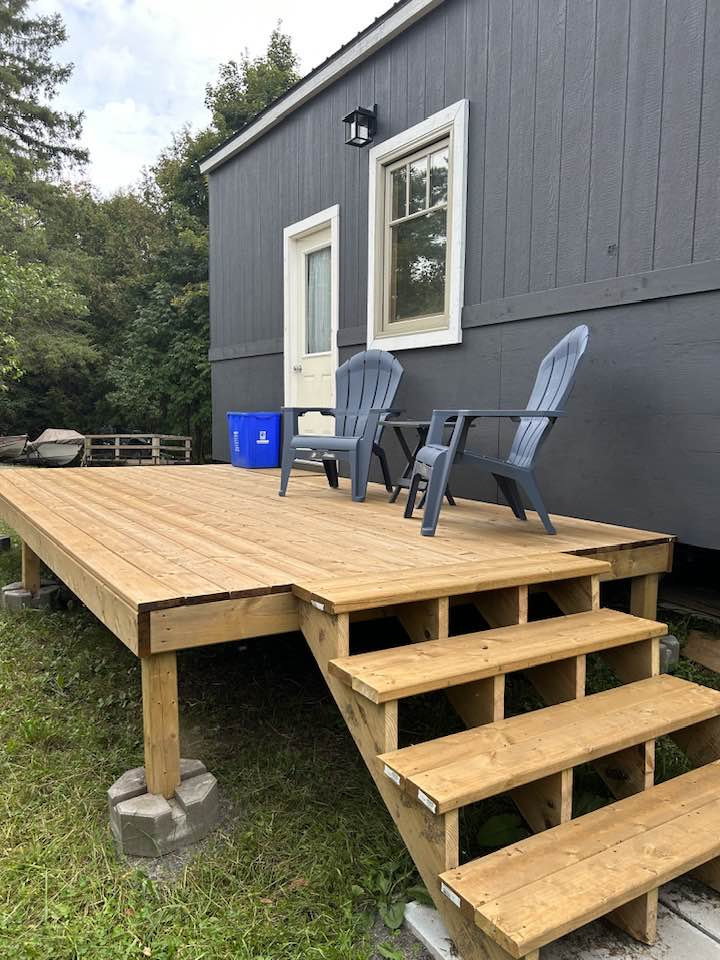
I live in a tiny house.
Not a camper. Not a shed. Not something I picked up on Facebook Marketplace.
A real home, built a few years ago by my father from a bare trailer bed, right here in Ompah.
And now, I’m not the only one.
There are two of us living full-time in tiny homes in Ompah. That might sound minor in a city. But here, it’s a shift, and a sign of something much bigger. It means this lifestyle is no longer just a fringe idea. It’s taking root.
We’ve proven it can be done. Now it’s time for the Township and the country to catch up.
A Lifestyle Choice, Yes, but Also a Necessary One
I didn’t move into this tiny home just to be different. I live this way because, like many Canadians, I was priced out of every other option. And soon, I’ll be building a new one of my own.
What started as a creative way to live affordably has evolved into something deeper. My home is energy-efficient, low-impact, and completely paid for. I own my freedom outright, and I’ve done it without needing six figures or a mortgage.
This isn’t just an “alternative lifestyle.” It’s proof of concept.
Expandable by Design
One of the most overlooked strengths of tiny homes is how adaptable they are. Just because you start small doesn’t mean you stay limited.
A second tiny house can be added later—on the same deck, connected with a breezeway, or even linked by a shared utility wall. It’s a kind of modular living that allows people to expand as their needs change, without abandoning affordability or simplicity.
In a place like North Frontenac, where land is available but traditional builds are expensive, this kind of flexible, phased approach to homebuilding could be a game-changer.
Ottawa’s Quiet Nod, and the Catch
Even the federal government is starting to acknowledge what people like me already know: small-footprint homes are a smart path forward. Through programs like the Rapid Housing Initiative and Housing Accelerator Fund, Ottawa has begun funding modular micro-homes to respond to Canada’s housing crisis.
On paper, it looks like a step in the right direction. But dig deeper and it feels more like containment than empowerment.
Most funding goes to a small group of pre-approved manufacturers building factory-style, prefabricated units. Companies like CABN and Nexus Modular produce high-efficiency homes through exclusive partnerships. Individual Canadians aren’t allowed into the process. You can’t build your own. You can’t apply for funding unless you go through a designated provider. In many cases, these homes are delivered to municipalities, not people.
It’s not housing freedom. It’s housing control. And it’s edging out the small, local builders and off-grid dreamers who could already be solving this problem if the rules didn’t shut us out.
North Frontenac Needs to Catch Up
Right now, zoning bylaws and outdated building codes make it almost impossible for most people to legally live in a tiny home here. There’s no formal path. No streamlined permitting. No recognition of the role tiny homes could play in solving the rural housing shortage, especially for young workers, seasonal staff, seniors, or people like me who simply want to live within their means.
Yet, we have land. We have skills. We have people with trailers, blueprints, and a dream to own something they can actually afford. What we don’t have is leadership willing to adapt to reality.
That’s why I’m not just writing this article. I’m going to lobby the Township of North Frontenac and engage the community to open the door to tiny house living as a legitimate, supported housing model.
A Simple Future Worth Fighting For
Imagine a rural Ontario where young people can afford to stay. Where retirees can downsize without leaving the woods. Where tradespeople, seasonal workers, and families can live simply, or where someone young can confidently start a family, without needing six figures or a mortgage to have a roof over their head.
It’s not a fantasy. It’s already starting, quietly, in places like Ompah.
But we can’t ignore what’s happening around us. In a recent article by Lucas Arender for The Peak, he described how the township of Fauquier-Strickland, just outside Timmins, voted to dissolve itself after failing to manage rising debt and a shrinking population. They considered selling their only snowplow for cash. By August 1, their municipal government will shut down entirely.
“Facing the prospect of a 300% property tax hike, a small town just outside of Timmins, Ontario, is throwing in the towel.”
That could happen here if we keep losing young families and making it harder to live affordably. But it doesn’t have to.
The tiny house I live in was a fun side project my dad built a few years ago. Now it’s my home. I started North Frontenac News Media right here in this tiny house, and I’ve written every article from this place.
Every photo I’ve shared on Patreon is from my actual home. It’s real. It’s local. And it works.
This isn’t the end of the road. It’s the beginning of a new one.
North Frontenac has a chance to embrace a future built on simplicity, independence, and community. We just have to choose it.
Sources
- Article by The Peak (independent student newspaper): https://www.readthepeak.com/stories/07-25-another-small-town-bites-the-dust
- Original Article by CTV’s Darren Macdonald: https://www.ctvnews.ca/northern-ontario/article/facing-300-tax-hike-northern-ont-community-to-dissolve-aug-1/