
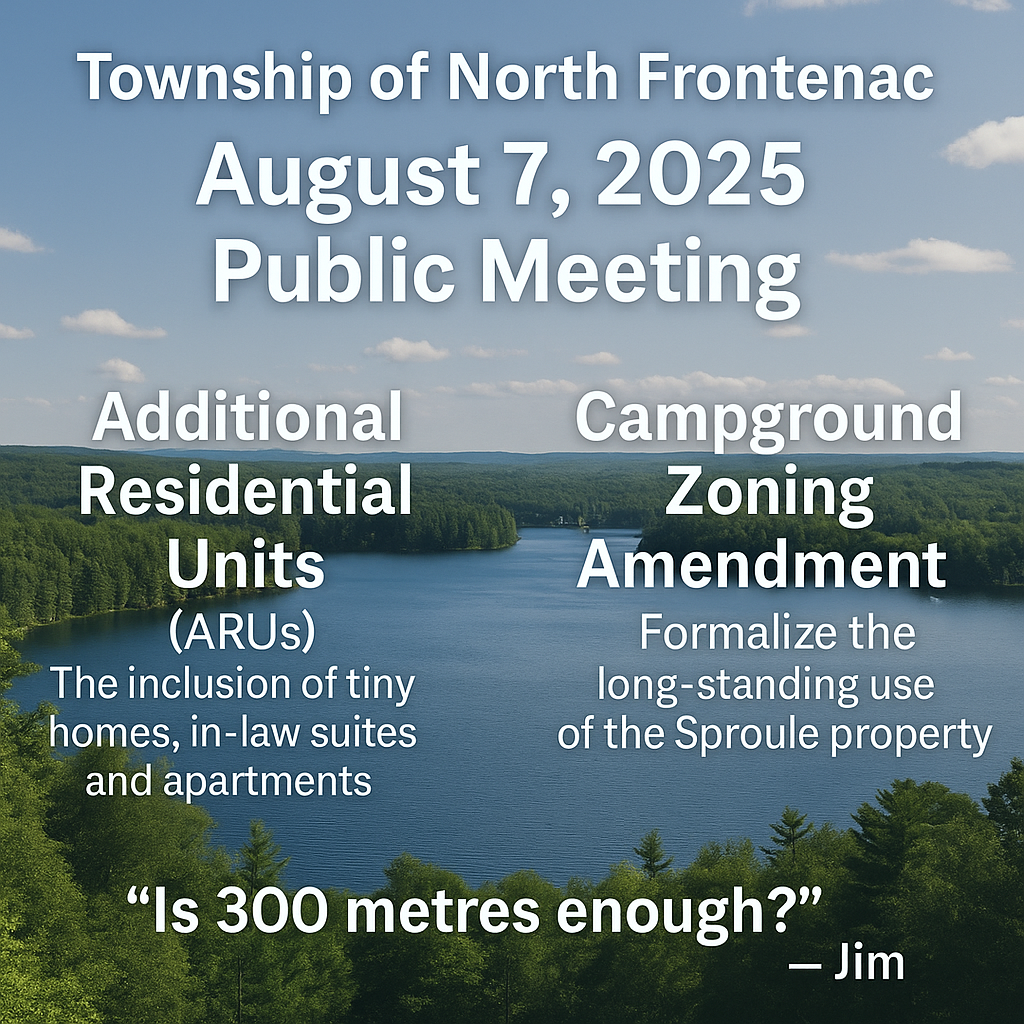
The Township of North Frontenac will hold a Public Meeting on Thursday, August 7, 2025, beginning at 4:00 p.m., with two agenda items that are already stirring thoughtful community debate. First on the docket is a proposed amendment to the Township’s Official Plan that would allow up to three dwellings per lot in rural and hamlet areas — including tiny homes, garden suites, and other Additional Residential Units (ARUs). The aim is to ease housing pressures while ensuring proper servicing and environmental safeguards, but it’s the fine print that has caught residents’ attention.
Marilyn Boston, Ron Higgins, and Jim Wilson have all submitted public letters raising important questions about lake protections, property rights, and how this policy might be enforced. Their concerns will be front and centre as Council receives public input, both in person and through Zoom.
The second half of the meeting, scheduled for 5:00 p.m., will focus on a site-specific Zoning By-law Amendment for the Sproule family’s long-standing campground on Struthadam Road. The Sproules are seeking to update the zoning to reflect current uses and plan for a future family succession, without changing the character of the property.
This Public Meeting is shaping up to be an important opportunity for residents to engage directly with decisions that could shape the future of housing in North Frontenac.
Official Plan Amendment: Additional Residential Units (ARUs)
Council will be reviewing draft policies that would allow property owners to build up to three dwellings per lot in North Frontenac’s Rural and Hamlet Settlement Areas. This includes detached tiny homes, in-law suites, and interior apartments. The Township is aiming to align its rules with recent changes to Ontario’s Planning Act, while also giving local residents more flexibility to address housing needs.
But with more homes comes more responsibility — especially when it comes to water. The proposed policies come with strict servicing standards to protect existing wells and septic systems. Any property adding ARUs would need to prove it has enough water capacity, meet drinking water quality tests, ensure neighbouring wells aren’t affected, and have septic capacity. These new standards are built on provincial guidelines but customized to fit North Frontenac’s rural context.
One thing that won’t change: ARUs will not be allowed within the Township’s designated Waterfront Areas, nor within 300 metres of lakes deemed “at capacity.” This provision is designed to protect the natural environment and preserve the character of North Frontenac’s lakes.
Residents like Marilyn Boston have already questioned whether enough lake capacity studies have been done to make informed decisions, while Ron Higgins is advocating for more flexibility on large rural waterfront lots that stretch well beyond the shoreline. Jim Wilson raised concerns that the proposed setbacks for lakes may not be enough to protect water quality in the long term.
Public Questions Reflect Small-Town Values
Several residents have already submitted thoughtful questions and concerns about the Township’s proposal to permit Additional Residential Units (ARUs). Their letters reflect a common sentiment across North Frontenac: this is not a subdivision, and it shouldn’t be treated like one.
One recurring concern is the proximity of ARUs to our lakes. Is a 300-metre setback really enough to safeguard water quality and preserve the quiet character of our waterfront areas? As Jim Wilson pointed out in his submission, once a second or third dwelling is built near a lake, it becomes permanent. The cumulative impact on the shoreline and water doesn’t fade away — it builds, quietly, over time.
Another issue being raised is enforcement. Residents are asking how the Township will prevent ARUs from quietly becoming short-term rental units, bringing commercial tourism pressures into residential zones. The intent behind ARUs is to support families, not to create loopholes for backdoor cottage businesses. But clear enforcement measures are still being asked for.
At the Council table, servicing standards remain a central point of discussion. Mayor Lichty has expressed interest in allowing multiple dwellings on a lot to share an existing well and septic system, provided that capacity testing confirms the systems can sustainably support the additional units. But this is not a free pass — if the current well or septic can’t accommodate the extra load, a new system would be required. The proposed servicing standards include detailed testing requirements to ensure that adding more homes won’t compromise water supply or impact neighbouring wells.
Most residents aren’t opposed to ARUs. Many see them as a necessary option for keeping families together and supporting affordable housing. But there’s a shared understanding that flexibility only works when it’s paired with accountability. We don’t walk our lakesides flanked by rows of trailers — and there’s a reason for that. North Frontenac’s beauty has been preserved because people here care enough to protect it.
Struthadam Road Zoning By-law Amendment Application #Z03/25 (Sproule Family)
At 5:00 p.m., the Public Meeting will shift to a site-specific Zoning By-law Amendment application for the Sproule family’s property on Struthadam Road — a small, family-run campground that has quietly operated since the 1950s. The property spans across two existing lots of record, divided by Struthadam Road, and has been part of the community fabric for generations.
The Sproules are seeking to formally sever each of these existing lots in half, creating four parcels. At the same time, they are proposing to rezone the property using site-specific Recreational Commercial Exception zones that will tie the inland and waterfront portions of each new lot together. This approach ensures that, despite the technical severances for estate planning, the campground can continue operating as a single, unified business.
It’s important to note: there is no new development proposed. The campsites, cabins, and overall land use will remain exactly as they are. Planning staff have recommended approval of the zoning amendment, provided that site plan agreements are registered on the new lots to manage any future development or changes down the road.
Both the Mississippi Valley Conservation Authority (MVCA) and the Ministry of Environment, Conservation, and Parks (MECP) have reviewed the application and raised no objections, on the condition that the existing septic systems are confirmed to be in good working order.
Struthadam Road itself is a rural backroad — lightly maintained and primarily accessed via River Road. But the Sproule family has consistently gone above and beyond in keeping their section of the road and campground in excellent condition.
I’ve driven my ATV through the Green Lake campground many times, and their care is obvious. This isn’t a commercial tourism hub. It’s a clean, quiet, family-run campground that has served local families and long-time seasonal guests for decades.
PSA — a reminder for anyone visiting: the speed limit through the Green Lake campground is 20 km/h. That sign isn’t a suggestion, it’s a safety measure. Kids play near the road, and slowing down keeps the dust down and keeps them safe.
Public Participation
Residents who wish to provide input on these matters can do so by attending the Public Meeting in person at Council Chambers or by registering to participate through Zoom. For those who want their voices on record, it’s important to know that submitting oral or written comments during the public meeting process is required to retain appeal rights to the Ontario Land Tribunal (OLT). Participation now ensures your voice carries weight in future decisions.
The deadline for written comments to be included in the August 7 Public Meeting agenda has passed for the ARU (Additional Residential Units) discussion. However, Council is still accepting written comments regarding the Sproule family’s Struthadam Road Zoning By-law Amendment application. These submissions can be sent to the township clerk either in person or via e-mail.
Residents are encouraged to stay engaged. The decisions being made now will shape how landowners can use their property, how North Frontenac supports housing flexibility, and how environmental protections are maintained moving forward.
NFNM will continue to provide updates and reporting as these matters unfold, including deadlines for future written submissions and meeting participation opportunities.