
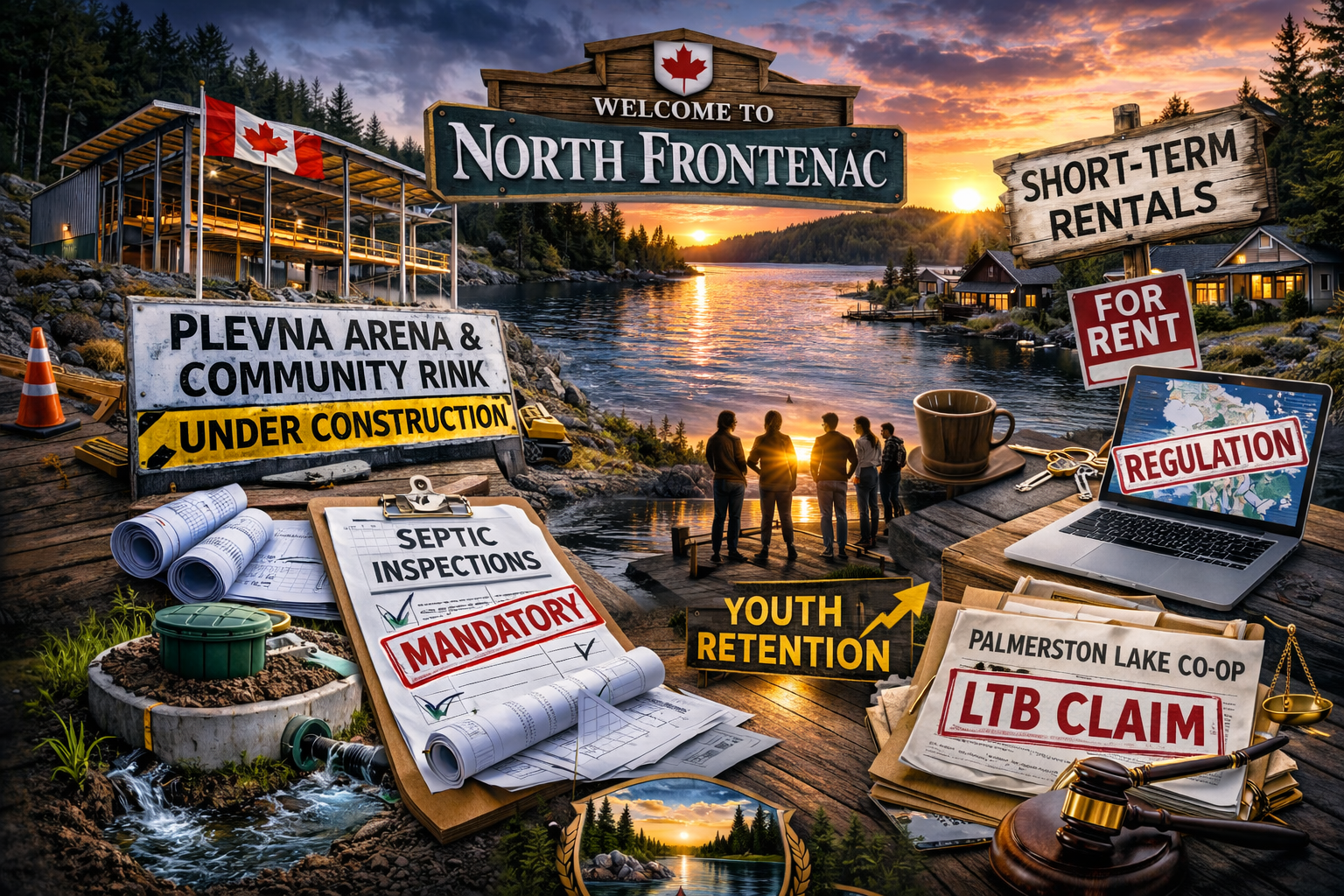
North Frontenac’s March 20 council agenda is not light reading. This is one of those meetings where several important files land at once, and each one points to a larger issue the township has been circling for months. The Plevna rink project is back in front of council with a budget problem. Short-term rentals are moving closer to a real regulatory response. The septic inspection debate is shifting from theory toward policy. Councillor Mike Hage is bringing forward a youth retention idea that touches directly on the township’s long-term future. And in closed session, council is set to discuss ongoing legal matters, including the Palmerston Lake co-op fight, which remains very much alive.
For residents trying to keep up, this is the kind of agenda that deserves a proper breakdown because the consequences will not stop at the council table. They will reach property owners, seasonal operators, taxpayers, younger residents thinking about whether there is any future for them here, and anyone watching how North Frontenac handles conflict when the pressure is on.
Plevna rink project
The biggest practical decision on this agenda is the Plevna rink project, but the public should be careful not to carry yesterday’s rumour war into tomorrow’s council debate. As laid out in NFNM’s separate reporting, the rink roof tender became surrounded by claims of corruption, favouritism, dirty staff, and a contract somehow being steered toward a preferred bidder. On the record now available, those claims do not hold up. The roof tender was publicly posted on Biddingo, an industry procurement platform used by public agencies, and the newer information indicating nine bids seriously weakens the idea that this was some hidden or closed process. What council is actually dealing with at this meeting is not proof of corruption. It is a funding decision on a project where the township did not have enough money set aside to cover the roof work as tendered.
That distinction is important because the phrase “over budget” can mislead people if it is used lazily. What this agenda is really showing is not that staff somehow should have known the exact roof cost in advance and failed. The township only knew how much money it had available. It could not know the true market cost of the roof work without going through a proper tender and getting real bids back. That is how procurement works. The bid process is what reveals price. The problem now is not that staff magically missed a number they should have already had. The problem is that the available funding did not match the price that came back through the tender.
What is now in front of council is how to respond to that gap. Staff are laying out three options: kill the roof portion of the project, approve up to $100,000 in additional Canada Community-Building Fund money while excluding soffit and fascia work, or approve up to $150,000 and include the soffit and fascia work as well. In plain terms, council now has to decide whether to pull back, patch the gap, or spend more to finish the project more completely.
That also helps separate this file from the confusion that has surrounded it. The rink roof tender is not the same thing as the earlier rink pad work. They are separate phases, with different scopes and different procurement questions. Once those lines get blurred, public discussion starts collapsing into assumptions that do not hold together. That confusion has already wasted public attention and reporting time that could have gone into other legitimate township files. What matters now is whether council can deal honestly with the actual question in front of it, which is how much more public money it is prepared to commit and what explanation it gives the public for that choice.
Once a project comes back at a price higher than the funds available, the public has a right to know how council responds under pressure. Does it scale back? Does it push ahead? Does it defend the original direction? This is the point where public confidence is either rebuilt through clear decision-making or strained further by confusion and mixed signals. After all the noise already surrounding the rink file, the public now deserves a straight answer on what council is prepared to fund and why.
Short-term rentals
The short-term rental file is one of the most important regulatory questions facing North Frontenac right now, and this meeting pushes it forward in a meaningful way. Council is being asked to receive the Environmental Task Force report on proposed short-term rental regulation and direct staff to prepare a future report laying out what it would actually take to build a new short-term rental bylaw, including costs, realistic time requirements, and bylaw components drawn from municipalities similar to North Frontenac.
That is not a final bylaw, but it is a serious next step. It tells the public this file is no longer sitting in the category of vague concerns and general frustration. It is moving toward the practical stage. What would enforcement look like? What would it cost? What rules would be included? How would North Frontenac define the problem, and how far would it be willing to go in regulating it?
The STR file sits at the intersection of housing, neighbourhood character, environmental pressure, and fairness. STRs have become one of those files where almost everyone agrees something is changing, but not everyone agrees on what should be done about it. This agenda does not settle the debate, but it does move the township closer to a position where it can no longer pretend the issue will sort itself out.
Septic inspection file
Another major item on this agenda is the septic inspection proposal at the time of property transfer. Staff are recommending that council approve Option 4 in principle, which would expand the current voluntary septic inspection program to include mandatory inspections for properties at the time of sale, with the Mississippi Rideau Septic System Office providing the service. Staff would then come back with more detail on cost, user fees, department responsibilities, implementation, draft bylaw provisions, exemption criteria for family transfers, and alternate inspection qualifications.
This is a significant policy step, even if the final details are not yet settled. It means council is being asked whether it wants to move beyond a voluntary model and into mandatory inspection at transfer. That has real consequences for sellers, buyers, affordability, environmental protection, and municipal oversight. It is exactly the kind of agenda item that can sound technical on paper while carrying serious implications in practice.
The public question here is not just whether septic health matters. Of course it does. The real question is how far the township is willing to go in turning that concern into a binding requirement. If council supports this direction, residents should expect a much bigger conversation to follow.
Mike Hage’s youth retention proposal
This agenda also includes something North Frontenac needs more of: a future-focused conversation. Councillor Mike Hage is bringing forward a report on youth entrepreneurship initiatives, incentives, and retention programs, with the recommendation that the initiative be forwarded to the Economic Development Task Force for deeper review and investigation.
This matters because rural decline is easy to talk about in broad terms. It is much harder to build policies that actually respond to it. If younger people cannot see a future here, the township loses energy, skills, families, and long-term stability. A place does not stay strong by simply hoping the next generation sticks around. It stays strong by creating reasons to stay, reasons to build, and reasons to believe there is room for a life here.
That is why this file deserves attention. It is an early test of whether council is prepared to treat youth retention as a real structural issue rather than a talking point. Sending it to the EDTF does not solve the problem, but it does show whether there is an appetite to start taking the issue seriously.
Closed session and the Palmerston Lake co-op fight
The heaviest item on the agenda may be one the public will not get to hear in full, understandably. Council is scheduled to go into closed session to discuss litigation or potential litigation, including the Ompah Palmerston Cottage Co-operative matter tied to 1099B Lafolia Lane.
Closed-session legal items are where the public often gets the least visibility and the greatest consequences. This file remains active, and the next hearing is approaching on April 10, 2026. That means North Frontenac is still dealing with the legal and planning fallout of one of the township’s most contentious land-use fights. Whatever is said behind closed doors, the public should understand that this is not old news. It is a live dispute with ongoing financial, planning, and political implications.
When a file reaches the tribunal level and remains on council’s closed-session list, residents should not treat it as background noise. It is a sign that the issue is still carrying weight, still costing time, and still shaping the township’s future whether people are following it closely or not.
The bigger picture
Taken together, this is not a routine agenda. It is a meeting built around public money, regulation, infrastructure, future planning, and legal exposure. The rink file asks whether council will spend more to rescue a project under pressure. The STR file asks whether North Frontenac is finally prepared to build a real regulatory response. The septic file asks whether voluntary oversight is giving way to mandatory rules. The youth retention proposal asks whether council can think beyond the next problem and start planning for the next generation. The Palmerston co-op discussion is a reminder that unresolved land-use fights do not disappear just because they slip into closed session.
This is the kind of agenda that answers a bigger question about North Frontenac itself. Is council reacting file by file, or is it starting to make decisions that reflect a clearer direction for the township?
By the time this meeting ends, residents may not have every answer, but they should have a much better idea of where council is prepared to spend, regulate, investigate, and defend. That alone makes this one worth watching.
References
- Regular Council Agenda, March 20, 2026.
- Plevna Rink Project - Budget Considerations, agenda pages 124-128.
- Environmental Task Force: Proposed Short Term Rental Regulation, agenda pages 79-111.
- Mandatory Septic Inspection Proposal at Time of Transfer, agenda pages 129-135.
- Councillor Hage: Youth Entrepreneurship Initiatives, Incentive & Retention Programs, agenda pages 75-78.
- Closed Session agenda item listing Ontario Land Tribunal File 25-001002, Ompah Palmerston Cottage Co-operative (Hall - 1099B Lafolia Lane), agenda page 159.