When public messaging masks legal realities, who protects the community trust?
“They are concerned that the information posted at EngageFrontenac.ca only includes information from the applicant and commenting agencies, and does not include opposition voices. Their submissions are only available by request to the township.” — Frontenac News, July 2025
This is where NFNM steps in.
Because what’s missing from the public record matters just as much as what’s there.
The township’s public portal, EngageFrontenac.ca, currently presents only the applicant’s documents and supportive agency comments. If you want to see dissenting submissions, you have to request them explicitly—assuming you even know they exist.
This curated transparency supports a polished narrative: a legal, professionally reviewed, family-oriented proposal backed by expert studies and government approvals. But outside that carefully constructed frame is a documented chorus of concern—and it deserves equal visibility.
NFNM’s job is to test narratives against records. That means examining what the zoning by-law actually permits, not just what’s promised. It means assessing the rights being legally granted—not only for current owners but for anyone who might follow. Investigative journalism doesn’t exist to undermine good intentions; it exists to illuminate how intentions translate into permanent policy.
The Language Gap
The applicants behind the “Ompah Palmerston Cottages Rural Cooperative” have consistently framed their project as a family retreat:
“This is not a resort or a development. This is a family retreat.” — Frontenac News, quoting the applicants
Yet, in a letter responding to NFNM, Craig Hall described their cooperative more formally:
“A cooperative is an alternative structure to forming a business or association… We are not forming a public use cooperative but an organization for our shareholders—who are also our family members.”
“Shareholders” is standard cooperative language, referring to those who legally own shares in the entity. Typically, as here, these individuals are family members. But the distinction matters, as co-operatives are structured to endure, adapt, and evolve. Even if messaging emphasizes informal family use, the zoning framework reflects permanent, broader possibilities.
What the Zoning Actually Permits
The proposed zoning by-law (CO-X1) clearly shows this built-in flexibility. If approved, it would permit:
Bed & Breakfasts, Live/Work Units, Offices, Personal Service Establishments, Private Schools, Places of Worship, Maple Syrup Production, Kennels, Home-Based Businesses
While the Halls have expressed no intention to pursue these uses, if CO-X1 is approved, these permissions become automatic—no matter who owns the property in the future, or their original intentions.
The Shoreline Development Contradiction
A submission to Council stated explicitly:
“We have no plan to develop the shoreline at the end of Gravel Point.”
Yet the zoning by-law explicitly permits:
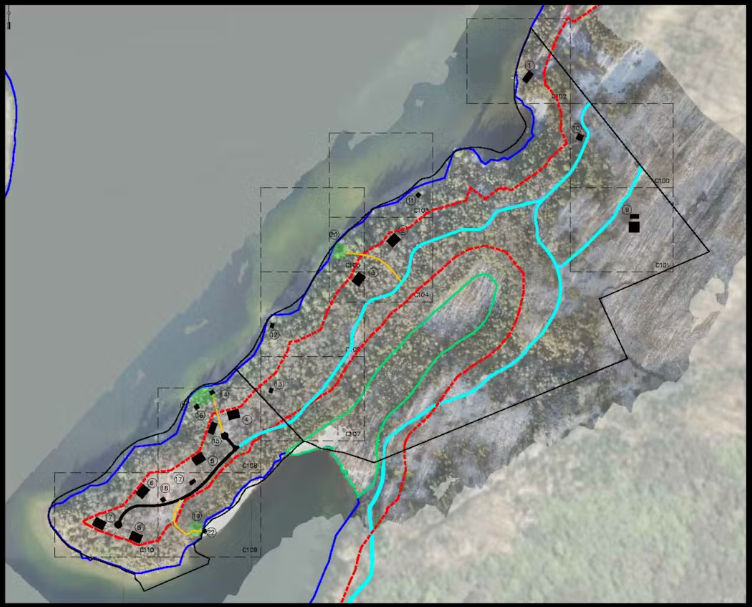
Four docks (up to 25m² each), Four waterfront activity areas (15m each), Four viewing platforms (including one with no water setback), Sleep cabins and accessory structures within 30 metres of the high-water mark
By definition, these permissions constitute shoreline development.
Whether the applicants agree with this definition or view it differently, the by-law sets a clear legal framework—one that authorizes significant and permanent shoreline change.
Setting Precedent
The Palmerston Lake Association and numerous residents have warned that CO-X1 zoning introduces a new precedent. It consolidates multiple dwellings, accessory uses, and shoreline development under a single shared title. Such a model bypasses safeguards typically applied to subdivisions or commercial ventures. And once approved, future proposals will point to this case as justification.
Craig Hall himself hinted at this possibility, writing to NFNM:
“I did not compare our attempt to change the zoning to the Lothlorien Co-op—it was actually the North Frontenac by-laws that inspired the desire to change to a cooperative zoning.”
Future applicants may simply argue: If it was allowed here, why not for us?
Trust and Public Concerns
The applicants further stated:
“The public is not good at understanding the law and therefore we rely on elected officials and staff… to balance the ‘real’ concerns…”
Respectfully, every concern voiced by the public is real. Whether grounded in science, emotion, lived experience, or precaution, these concerns reflect something crucial: public trust. Residents don’t require legal training to sense when something doesn’t feel right, particularly when the stakes involve shared lakes, roads, and ecosystems.
It is not the role of journalism to sway public opinion in any particular direction—that’s the applicant’s responsibility. NFNM’s role is simply to hold up a mirror.
We also strongly encourage our readers to visit FrontenacNews.ca online and explore their coverage of this application. Reporter Jeff Green notably concluded his piece with a critical call for broader public input:
“The PLA believes it is essential to have a second public meeting so that everyone can be heard,” concludes their July 4 statement.
We echo that sentiment wholeheartedly.
To the Halls
Please consider the legitimacy of these voices not because they always get it right, but because they’re your neighbours.
This isn’t hostility. It’s the sound of a community sincerely grappling with change. The concerns expressed may not always be technical or precise, but they are real in the most fundamental way: they come from people who share the lake, roads, and local environment. These individuals are not obstacles to your dream, but community members who care deeply—albeit differently—about what happens next.
Each voice represents a life as vivid and complex as your own. When people speak from that place, whether supporting or questioning, they contribute to something larger than any single proposal.
That’s not opposition; that’s community.
NFNM will continue to amplify these voices, because fairness demands that every perspective be heard clearly before lasting decisions are made.
Final Thought
This article is not about questioning intentions or character. It’s about examining what gets written into law, not just for the Halls, but for future choices that will shape our shared lakes, cottages, and landscapes.