
Donald Morton | North Frontenac News Media | Published March 27, 2026
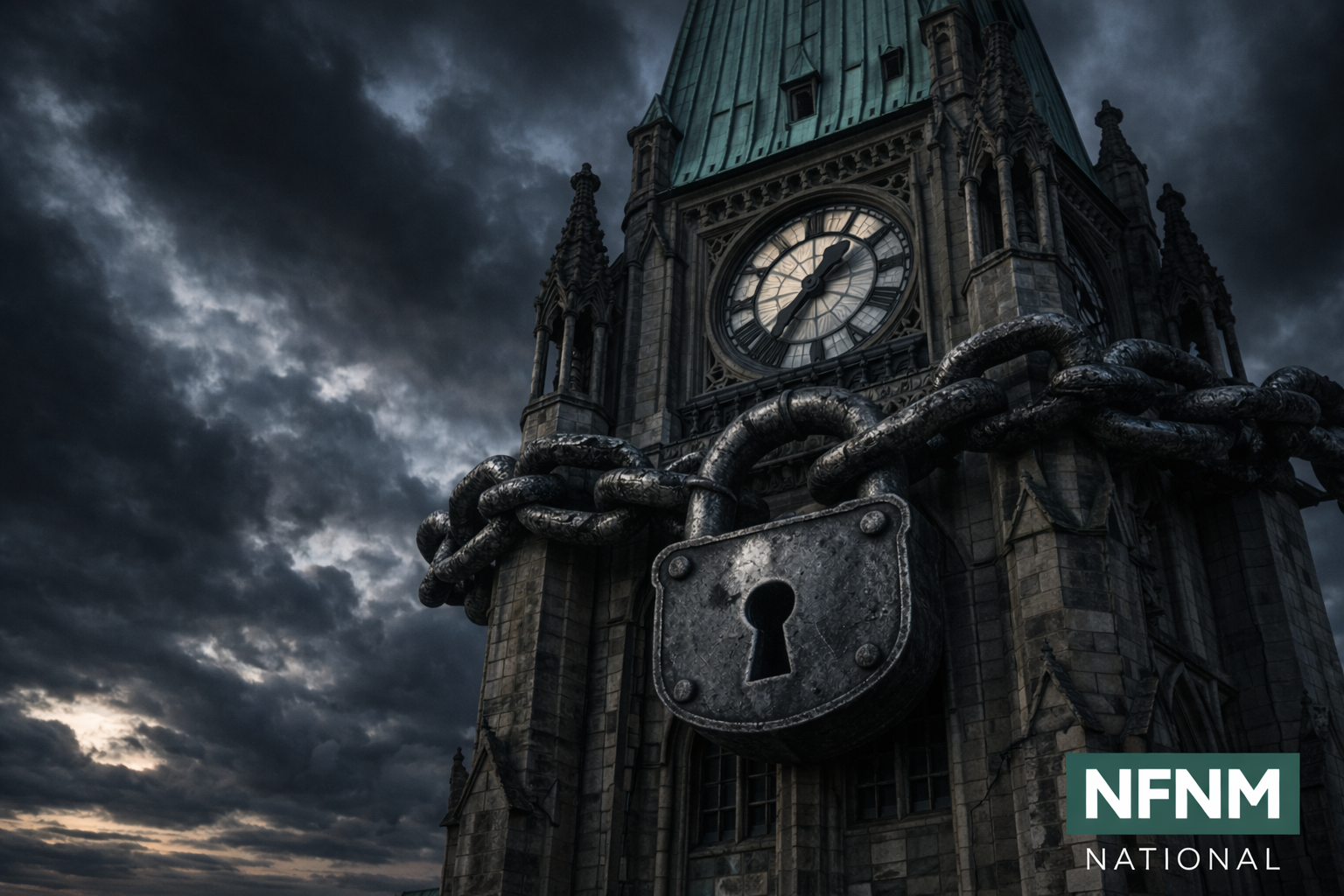
The House of Commons just handed the Canadian state the power to imprison citizens for up to ten years over speech – and stripped the fifty-six-year-old legal defence that protected religious expression from exactly that outcome. Bill C-9, the Combatting Hate Act, passed 186 to 137 on March 25. It now sits in the Senate. If it clears that chamber, every Canadian who holds a traditional religious conviction and says so out loud will be operating inside a Criminal Code that no longer promises them protection.
That is not commentary. That is what the bill does.
What the bill removes
Start with what disappeared. Since 1970, section 319(3)(b) of the Criminal Code has protected speech made “in good faith” expressing “an opinion on a religious subject or an opinion based on a belief in a religious text.” That defence has been part of Canadian criminal law for fifty-six years. It survived every government since Pierre Trudeau’s. Bill C-9 repeals it. The Bloc Quebecois demanded its removal as the price of supporting the bill. The Liberals agreed.
The bill also removes the longstanding requirement for the Attorney General to consent before hate propaganda charges can be laid. That safeguard existed for a reason: it prevented politically motivated or vexatious prosecutions from entering the criminal courts. It is gone. Any prosecutor in the country can now initiate a hate propaganda case without ministerial oversight.
These are not marginal adjustments. They are the removal of two structural limits on state power over speech. One protected the content of religious expression. The other protected citizens from prosecutorial overreach. Bill C-9 takes both away at the same time.
The problem the bill cannot solve
The government says this legislation protects vulnerable communities from escalating hate. The hate crimes are real. They doubled between 2020 and 2024. Liberal MP Anthony Housefather cited three synagogue shootings in Toronto within a single month as context for the bill’s introduction. Nobody serious disputes the problem.
The question is whether you can solve it by criminalizing the expression of beliefs that millions of Canadians hold – and that are, on certain fundamental questions, irreconcilable with each other.
Islam, Christianity, and Judaism do not agree on the nature of God, the path to salvation, the authority of scripture, the definition of marriage, or the moral status of certain human conduct. These are not minor differences. They are the deepest commitments human beings carry. A Catholic priest who teaches that marriage is between a man and a woman is stating Catholic doctrine. An imam who teaches that certain behaviours are prohibited under Islamic law is stating Islamic doctrine. An Orthodox rabbi who teaches from Leviticus is stating Jewish doctrine. None of them are doing it to be cruel. They are doing it because their faith requires it.
Bill C-9 does not distinguish between hatred and doctrine. It defines hatred as involving “detestation or vilification” – language critics say is weaker than the Supreme Court’s standard in Keegstra (1990), reaffirmed in Whatcott (2013), which required hatred “of an intense and extreme nature.” The word “involves” is not the word “requires.” Paul Marshall of the Hudson Institute has flagged this: the Court’s formulation was a ceiling. The bill’s formulation may function as a floor.
The government says practicing religion can never constitute a hate crime. But the government also just removed the only Criminal Code defence that said so explicitly. If the assurance is real, why strip the provision that enforced it?
The Neufeld warning
On February 20, 2026, the British Columbia Human Rights Tribunal ordered Barry Neufeld, a former school trustee in Chilliwack, to pay seven hundred and fifty thousand dollars. His offence was a series of public statements criticizing British Columbia’s SOGI curriculum. He called gender identity theory “biologically absurd.” He described teaching children about diverse gender identities as harmful. A tribunal found six of his publications constituted hate speech and twenty-four were discriminatory.
Neufeld was not charged with violence. He was not charged with incitement. He was fined three-quarters of a million dollars for expressing an opinion about a public policy – under provincial human rights law, which carries no prison time.
Bill C-9 operates in the same domain with criminal law powers. Not fines. Criminal records. Sentences up to ten years. Life imprisonment under the new standalone hate crime provision (s. 320.1001) where the underlying offence carries a maximum sentence of fourteen years or more. And it operates without the Attorney General’s consent requirement, without the religious expression defence, and with a definition of hatred that may be broader than what the Supreme Court has previously upheld.
The Neufeld case is the trajectory. Bill C-9 is the acceleration.
The coalition that should not exist
The bill’s opponents do not share a politics. They share a fear.
The Canadian Civil Liberties Association says C-9’s “vague language could be used to criminalize peaceful protest and silence unpopular expression.” The BCCLA led a joint letter signed by thirty-seven organizations – including the Arab Canadian Lawyers Association, the Black Legal Action Centre, and Independent Jewish Voices – warning that the bill “risks suppressing protected dissent, worsening systemic inequities, and undermining Canada’s constitutional commitments to freedom of expression.” The Canadian Bar Association found the definition of hatred “confusing and potentially obscuring rather than clarifying.” The Canadian Labour Congress warned the intimidation provisions could criminalize legal strike action, making “certain legal job actions a criminal offense punishable by up to 10 years in prison.”
The Canadian Conference of Catholic Bishops, more than 350 Muslim organizations, Orthodox Jewish leaders, the Church of Jesus Christ of Latter-day Saints, multiple evangelical denominations, and the Catholic Civil Rights League all oppose the bill. The Canadian Constitution Foundation calls it “a direct threat to the Charter right to freedom of expression.” The Canadian Centre for Policy Alternatives warned the intimidation provisions create “bubble zones” that could extend to Indigenous land defenders, Palestinian solidarity protesters, and environmental activists.
Every opposition party voted no. The Conservatives, the NDP, and the Greens. This bill passed on the strength of two parties – the Liberals and the Bloc – against the stated position of every other party, the national bar association, the national labour congress, the national civil liberties body, and hundreds of religious organizations spanning every major faith in the country.
When civil liberties lawyers, trade unionists, Catholic bishops, Muslim councils, progressive policy institutes, and Conservative MPs all arrive at the same conclusion, the responsible question is not whether they are all wrong. The responsible question is what the bill does that unites them.
The state has no business here
Canada was built on the principle that the state stays neutral on matters of belief. The Supreme Court has said so plainly: public authority cannot favour one belief over another, or belief over non-belief. That neutrality is what lets a diverse country function. It is the reason a mosque can stand next to a church next to a synagogue and all three can teach what they teach without asking permission from Ottawa.
Bill C-9 violates that principle – not by establishing a religion, but by using the Criminal Code to enforce one side of a religious and cultural dispute. The bill’s practical effect is to enshrine one set of acceptable beliefs about gender, identity, and group relations into criminal law, while exposing religious and traditional expressions that conflict with those beliefs to prosecution. That is the state picking winners in a theological argument. It should not do that. Not because the losing side is always right, but because the state has no competence to adjudicate questions of faith, and no business punishing citizens for answering them.
The tradition of free expression and ordered liberty that Canada inherited is the same tradition that protects everyone – including minorities, including vulnerable communities – because it constrains the power of the state to silence dissent. The moment you weaken that constraint for one group’s beliefs, you weaken it for all.
The Senate is the last gate
Bill C-9 is in the Senate. The government has moved to fast-track it. Senate study is expected to begin after the Easter recess, around April 14. Religious organizations are mobilizing call and email campaigns directed at individual senators. The Canadian Constitution Foundation’s public posture is that of an organization preparing a constitutional challenge.
Three questions will determine what happens. Whether the Senate amends the bill – the religious defence removal, the AG consent removal, and the definition of hatred are all points where amendments are constitutionally appropriate. Whether a Charter challenge is launched. And whether the definition of hatred, built on the word “involves” rather than “requires,” survives judicial scrutiny.
Canadians have until April 14 to make their views known to the people who hold the last vote before this becomes law. The Senate exists for moments like this one. Whether it acts like it is up to the senators – and up to the Canadians who contact them.
NFNM made the editorial decision not to seek comment from Justice Minister Sean Fraser prior to publication. Fraser’s position on Bill C-9 is extensively documented in the parliamentary and media record – in Hansard, in committee testimony, and in ministerial press statements – and this article engages with that position directly throughout.
NFNM has covered Bill C-9 since its introduction. For earlier analysis of the bill’s origins and the local council vote that preceded it, see Neutral Ground, Not a Battlefield and Mayor Gerry Lichty Attacks Our Canadian Identity and Free Speech.
Sources
- LEGISinfo – Bill C-9 (45-1)
- Justice Canada – Bill C-9 overview
- Justice Canada – Charter Statement for C-9
- CBC – Contentious anti-hate legislation passes House of Commons
- CBC – Liberals back Bloc’s proposal to remove religious exemption
- Globe and Mail – Anti-hate bill that provoked bitter debate over religious freedom
- CCLA – Bill C-9 threatens the rights of every Canadian
- BCCLA – Joint civil society letter on Bill C-9
- Canadian Constitution Foundation – Withdraw Bill C-9
- Canadian Bar Association – Submission on Bill C-9
- Canadian Labour Congress – Protecting Fundamental Rights
- Catholic Register – Bill C-9 advances to Senate
- Hudson Institute – Paul Marshall on Canada’s Bill C-9
- The Hub – Why Bill C-9 is controversial
- CCPA – The Combatting Hate Act is part of a wave of anti-protest legislation
- CBC – Barry Neufeld ordered to pay $750K
- CBC – Barry Neufeld to fight $750K penalty