NFNM’s First National Watchdog Dispatch
By Donald Morton Jr. | North Frontenac News Media | NFNM | Thursday October 2 2025
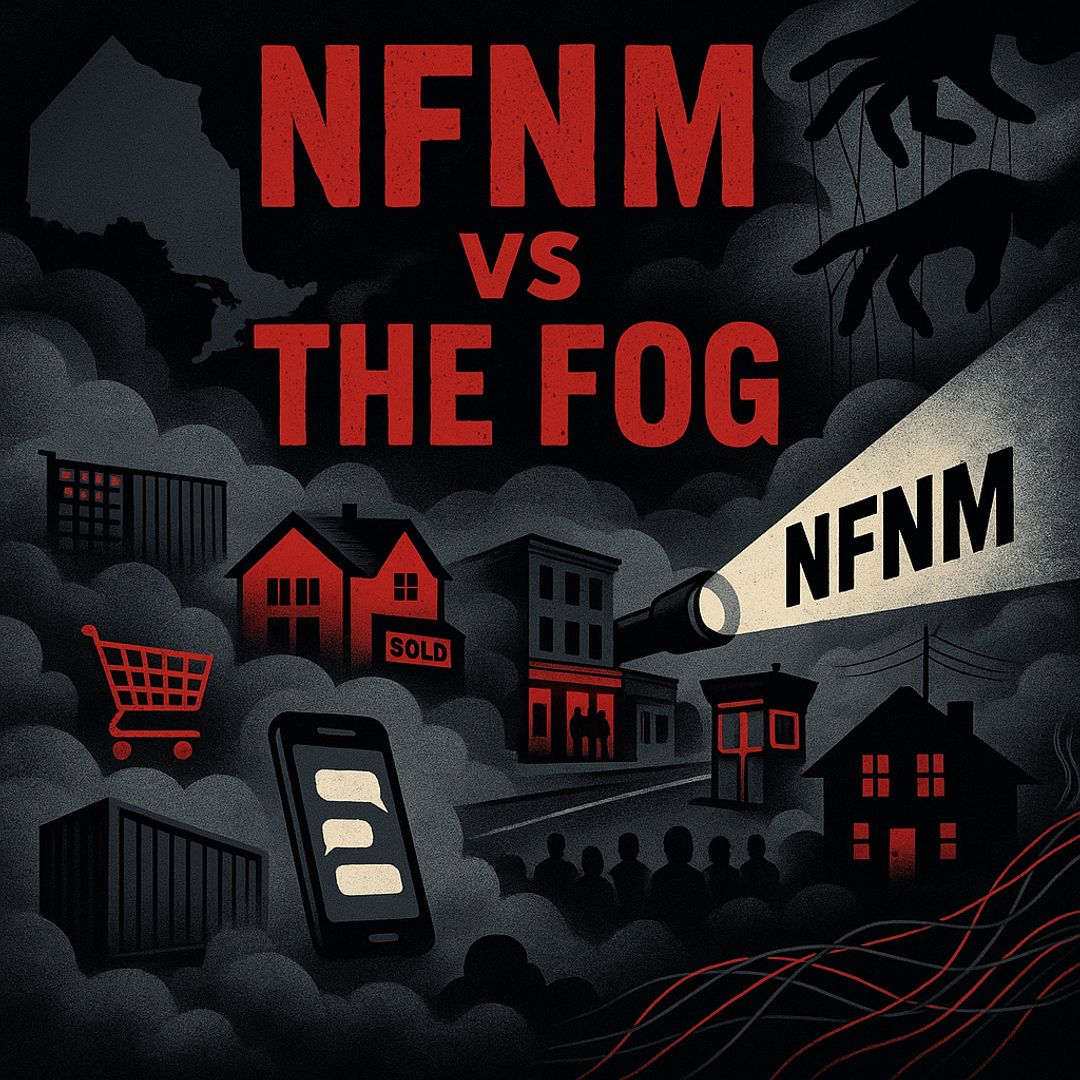
We’re opening with the seams of the country: grocery price-rigging and choke-point control; a housing machine that profits from scarcity; group homes and shelters where traffickers recruit; a border that shifts faster than the press lines; and a culture war—gender policy front and centre—where paid optics and foreign amplification turn real grievances into leverage. This isn’t theory. It’s the operating environment.
A decade ago, Russia’s Valery Gerasimov argued that non-military tools—money, lawfare, information operations, criminal proxies—can do more damage than firepower. Call the broader concept “new-generation” or “total” war: pressure everywhere at once until a society is exhausted and pliable. You don’t have to believe every actor is coordinated to see the outline. Look at what actually happened here.
Start with food. A staple-price conspiracy went to court and ended with a record fine. The federal competition watchdog spells it out: Canada’s grocery market is concentrated, fenced in by restrictive property controls, and starved of new entrants. When a few hands hold the pipes—financing, distribution, real estate—you don’t need to own every shelf to tax every family. Organized crime understands pipes. So do elites who like their margins predictable.
Move to housing. CMHC’s math hasn’t budged: Canada needs millions more homes by 2030 to claw affordability back to early-2000s levels. We aren’t building at that pace. Inside the system, the rulebook itself is under scrutiny—whether commission and cooperation policies dampen competition and keep transaction costs fat. Combine scarcity with weak transparency around ownership and assignments and you get a market that rewards engineering the shortage.
Now the border. Ottawa’s 2023 expansion of the Safe Third Country Agreement drove land crossings down and pushed claims to airports and inland offices. That’s displacement, not disappearance. Meanwhile, most marine containers clear on risk scores with only a small fraction physically opened, concentrated at four ports that handle almost all containerized imports. CBSA’s own reporting shows that among the shipments it does pull for exam, only ~0.7% hit on the intended contravention—proof of how fine the net is and how much freight moves on trust, paperwork, and analytics. The model is built for speed; criminals are built to exploit seams. Security briefings on both sides of the border warn that any port of entry—south or north—will be probed. Believe the briefings, not the pressers.
The ugliest seam is the one Canada avoids saying out loud. Kids in care are a target. Ontario’s Ombudsman documented a 13-year-old Indigenous girl vanishing repeatedly under “supervision.” The same office has probed agencies parking youth in hotels and motels—the very places predators work. Federal numbers match what front-line units live: sex trafficking overwhelmingly targets women and girls, many of them minors. Justice Canada’s own guidance names group homes among the recruiting grounds. If that doesn’t qualify as systemic failure, the phrase means nothing.
Then the information front. Gender-policy rallies and counter-rallies are real. They’re also perfect wedge events for manipulators—domestic and foreign—who know how cheap it is to hijack a narrative. The U.S. Senate’s work on the Internet Research Agency documented the tactic set: push both sides of a fracture to make the fracture wider. Canada’s cyber agency and the foreign-interference inquiry say the quiet part in official language: AI-boosted disinformation is an existential threat to the democratic process. Meanwhile, there’s a legal market for optics. Firms sell “crowds for hire” and “incentivized activism.” You can argue about who paid for which march. You can’t argue that buying the picture is difficult.
All of that is the national frame. Here’s the local cut.
At a Tim Hortons counter in Picton, Prince Edward County, a teen employee was pressed over text to enter a cash-for-marriage arrangement so a manager’s brother could stay in Canada—“totally legal,” “everyone does it,” and a second supervisor backing the plan. She refused, called it illegal, and quit. NFNM investigated, reviewed the screenshots, and documented the exchange exactly as shown. Prince Edward County OPP detachment (Picton) have opened an investigation into marriage fraud.
This is how leverage works in low-wage Canada. A marriage primarily for status is misrepresentation under the Immigration and Refugee Protection Act; paying for it or pressuring someone to arrange it is counselling misrepresentation. When the target is seventeen and dependent on shifts, references, housing—or a tied work permit—the “ask” reads like a threat. The program rules on paper say no coercion. The back-room conversation says otherwise.
The same seam runs into real estate. NFNM has received information alleging that a prominent area realtor arranged or benefited from unpermitted renovation work by unauthorized or temporary foreign workers on a property, then marketed the listing as if the upgrades were ordinary, permitted features. If proven, that’s not clever staging. It’s a chain of violations: potential immigration exposure for the labour, code and insurance exposure for the work, and misrepresentation for the sale.
Put the pieces together and the pattern is plain: collusion dressed up as “market realities,” a housing file that mistakes announcements for homes, a border that rewards agility over honesty, a protection system that can’t protect, and a public square tuned for outrage—then monetized. If rules are meant to protect Canadians, they must matter in the rooms where power is cheap: a back office in Picton, a group-home hallway at midnight, a rushed walk-through before an offer. This dispatch is the baseline—the national map and the local proof. NFNM will keep dragging documents into daylight. Institutions can show they work, or show they don’t. Either way, the record will belong to the people who live with the consequences