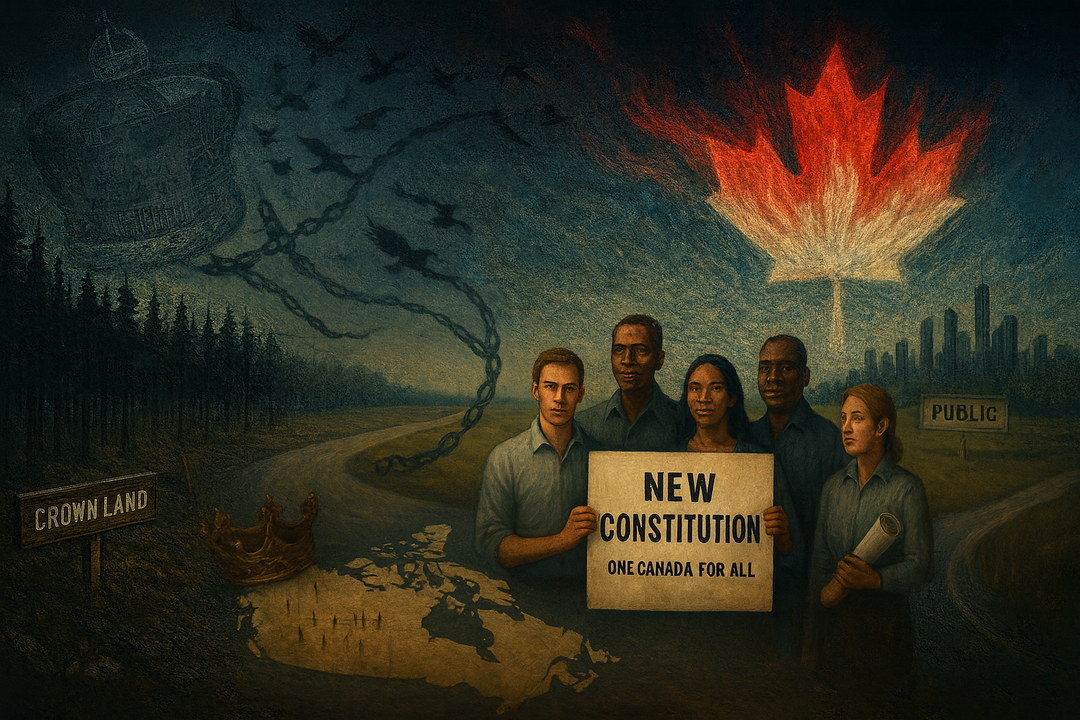
What does it mean to own land in Canada? And why does the answer matter?
These questions have moved from academic margins into the centre of national conversation—and North Frontenac, a rural Ontario township, sits on the front edge of that debate.
This is Part 1 of a series examining the AOO Treaty, Crown Land, Indigenous sovereignty, and what “Canada” actually means as a legal and political entity. The conversation cannot stay in Ottawa. It lives in townships, conservation authorities, and municipal councils across the country. It surfaces when planning amendments are proposed, when water rights are disputed, and when a community decides who gets to decide what happens next.
The AOO: What It Is and Why It Matters
The AOO Treaty—also known as the Algonquin-Anishinaabek-Odawa Treaty—is a historic agreement between the Crown and Indigenous nations in Ontario. It recognizes territorial rights, harvesting rights, and governance relationships that predate the current legal structure of Canada by centuries.
For many residents of North Frontenac, the AOO had little visibility until recently. But the treaty’s application to water, land use, and resource management is now intersecting with municipal planning in direct ways.
What makes the AOO significant is this: it establishes that Indigenous nations have rights and governance authority in territories that are now called Ontario. Those rights were not erased by Confederation, by provincial legislation, or by municipal incorporation. They persist.
When a township approves a zoning amendment, or a conservation authority permits shoreline development, or a municipality issues a business license, those decisions may be occurring on territory where another government—an Indigenous nation—holds concurrent or superior rights.
This is not abstract. It becomes concrete the moment someone asks: On whose authority are we deciding this?
Crown Land and Legal Ownership
To understand the AOO, we need to step back and understand Crown Land—and what “ownership” actually means in Canada.
In Ontario, the Crown (the provincial government) holds vast tracts of land. In North Frontenac, much of this Crown Land sits in conservation areas, forest reserves, and public waterways. On a legal map, “Crown Land” means the land is held in trust by the government on behalf of the public.
But “on behalf of the public” is doing heavy lifting. Which public? The Canadian public? Ontario residents? Indigenous nations with treaty rights? The answer changes depending on which law you consult and which political actor is speaking.
This ambiguity is not accidental. It has been baked into Canadian law since Confederation, and it has created persistent legal tension.
Here’s the core problem: Canada’s founding assumption was that Crown Land could be distributed, regulated, and developed according to the Crown’s will. Provincial governments could subdivide it, issue timber licenses, permit mining, and pass zoning bylaws. Municipalities, operating under provincial authority, could then regulate land use at the local level.
This entire framework assumed Indigenous land rights had been extinguished or could be ignored. They were not, and they cannot be.
Indigenous Sovereignty and Concurrent Rights
The AOO Treaty does not say Indigenous nations “own” land in the way private property owners own homes. Instead, it recognizes Indigenous governance and harvesting rights that operate parallel to—and sometimes superior to—Crown authority.
This is the concept of concurrent rights. Two sovereigns can hold legitimate authority over the same territory. A harvester might have the right to hunt on territory that is simultaneously Crown Land and also subject to an Indigenous nation’s governance. A developer might need permits from the municipality and also from an Indigenous authority.
This creates practical complexity. If you are proposing a major development in North Frontenac, you may need approval from the Township, the Conservation Authority, the Ministry of Environment, and potentially also consultation with or approval from an Indigenous nation with treaty rights to the territory.
That has not been the standard practice. Most municipalities have operated as if Crown Land means Crown Land means they can regulate it as they see fit. Indigenous consultation, when it happens, has often been treated as a courtesy, not a legal requirement.
But the law does not support that reading. And that gap between practice and law is where tension accumulates.
Residential Schools and the Foundation of the Conversation
The national conversation about Indigenous land rights gained momentum after the discovery of unmarked graves at residential schools across Canada. Those discoveries reopened questions that Canadian law had tried to suppress: Who were these children? What happened to their territories? What did their nations lose?
Residential schools were not accidents. They were a policy instrument. The goal, explicitly stated by Canadian officials, was cultural erasure—to remove Indigenous identity and integrate Indigenous children into Canadian settler society. Part of that policy was the separation of Indigenous nations from their territories.
As nations were dispossessed, their children were institutionalized. When they returned (if they returned), the land was already transferred or regulated under Canadian law. The legal framework had shifted beneath their feet.
Understanding this history is not optional context for the AOO conversation. It is foundational. The treaty rights that persist today exist in part because they survived that policy of erasure. The concurrent rights Indigenous nations hold today are the remainder of what was not successfully taken.
What This Means for North Frontenac
In North Frontenac, this history intersects with present decisions about housing, lake protection, resource use, and zoning.
When the township considers proposals for additional residential units, shoreline development, or conservation easements, those decisions are occurring on territory where Indigenous nations hold rights. If those decisions are made without consulting those nations, or without recognizing their governance authority, the decisions may be technically unauthorized under Canadian law—even if they appear authorized under provincial and municipal law.
This is not a hypothetical. Several municipalities across Ontario are now navigating these questions in real time, as legal challenges emerge and as Indigenous nations assert rights that had been previously unrecognized.
North Frontenac will likely face these questions more directly in coming months and years. The AOO Treaty is not going away. Indigenous nations are increasingly asserting their rights. And the gap between what municipalities assume they can do and what law actually permits is narrowing.
The Larger Question
This series began with a question: What does it mean to own land in Canada?
The incomplete answer is: It depends on which law you consult, which history you acknowledge, and which sovereign authority you recognize.
A private owner holds title granted under Canadian law. But that title may operate on territory where Indigenous nations hold concurrent or superior governance rights. The Crown holds vast territories in trust, but that trust obligation includes duties to Indigenous nations with treaty rights. Municipalities regulate land use, but only within authority delegated from provinces, and that delegated authority does not override Crown duties or Indigenous rights.
This is not chaos. It is complexity. And complexity is what you get when one legal system tries to operate on top of another legal system that was never truly extinguished.
In Part 2, we will examine specific applications of this framework—how the AOO shapes conservation decisions, how Indigenous governance intersects with municipal planning, and what “consultation” actually means in law versus practice.
For now, the key insight is this: The question of who owns Canada is not settled. And the answer to that question determines who gets to decide what happens next.