What the AOO File Means in Plain English
Most people hear the words “land claim” and picture a remote legal dispute far away from normal life. The Algonquins of Ontario file is not that. In plain English, it is a negotiation over a large part of eastern Ontario involving land, money, rights, and political authority in an area that includes more than 1.2 million people and reaches into the capital itself. Ontario’s own description says the claim covers 36,000 square kilometres and includes Parliament Hill. The province also says the AOO position is that their Aboriginal rights and title were never extinguished and that they maintain continuing ownership of the Ontario portions of the Ottawa and Mattawa River watersheds and their natural resources. That is not a symbolic file. It is a live political file.
The land and money package makes that even clearer. Ontario’s own Agreement-in-Principle summary says the proposed framework includes $300 million and approximately 117,500 acres of provincial Crown land to Algonquin ownership. It also lays out arrangements tied to harvesting, forestry, parks, heritage, taxation, and governance structures that would continue after the settlement. The public was given a softer version about recognition and respect. The actual structure is land, capital, and protected rights attached to a permanent agreement.
The Claim Reaches Parliament Hill
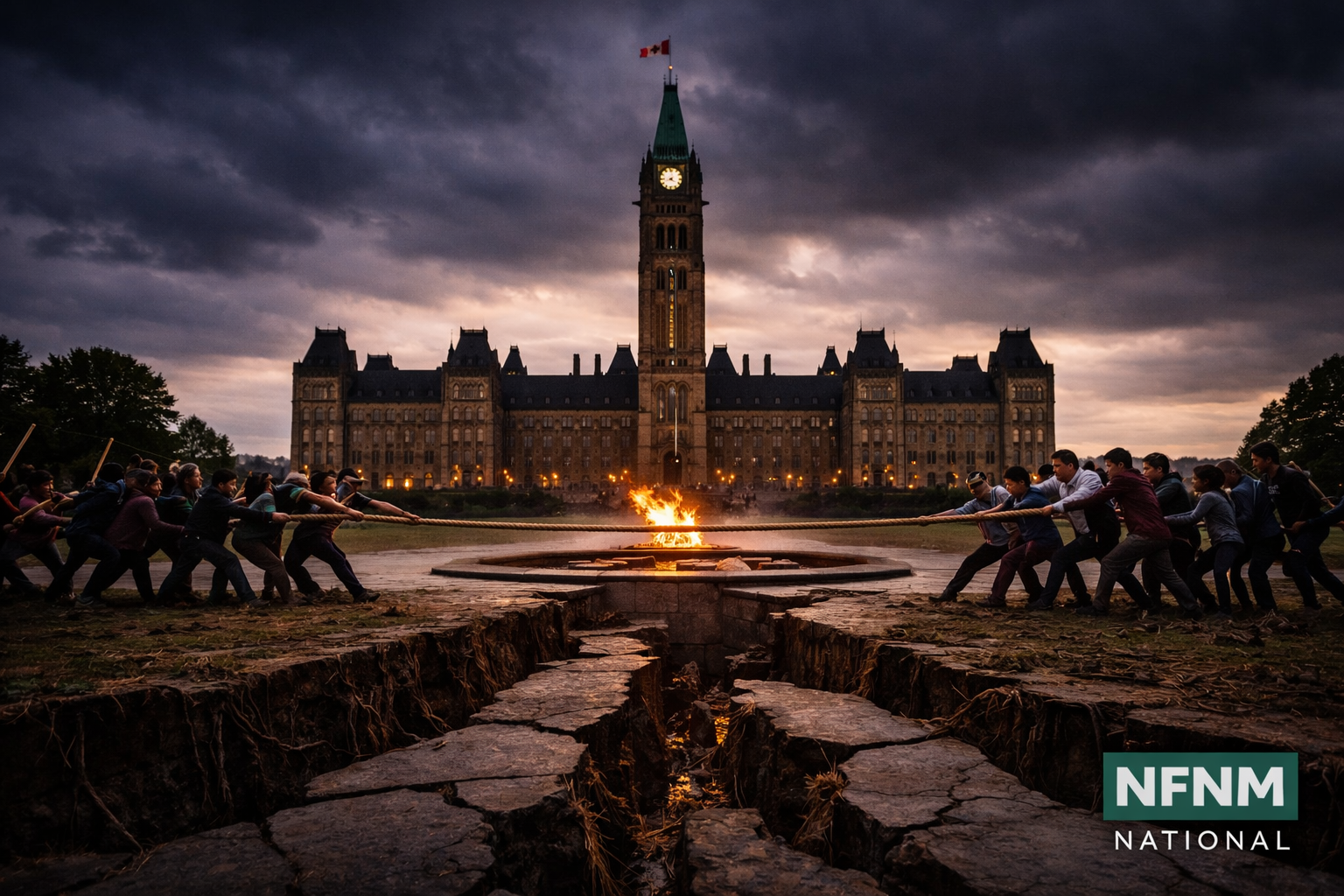
Ontario says Parliament Hill is inside the claim area. The federal government has moved in the same direction with its own language. In June 2024, Ottawa announced an agreement for a dedicated Algonquin space within the Parliamentary Precinct and described that precinct as being on the “traditional and unceded territory of the Algonquin.” In the same release, Grand Chief Savanna McGregor said that seeing “our own space in the heart of our territory means everything.” In plain English, the Canadian government is now publicly describing the seat of its own authority as existing inside the territorial framing of another nation, while building a permanent space for that nation into the same precinct.
That would already be controversial on its own. The problem gets sharper once the overlap issue is added back in. The AOO position has not been universally accepted by other Indigenous governments in the region. APTN reported that Kebaowek, Timiskaming, and Wolf Lake identified roughly 346,000 hectares of overlap territory with the AOO claim and were considering legal action. APTN also reported that Kitigan Zibi filed an Aboriginal title claim over Parliament Hill lands. The public was sold the idea that these processes produce clarity. The actual record shows competing claims, competing maps, and competing statements of who really holds title and authority.
Ontario Chiefs Are Saying This Out Loud
One of the weakest habits in this debate is pretending the public language from chiefs and Indigenous political bodies is mostly ceremonial. It is not.
In March 2025, the Anishinabek Nation said treaties “recognize our sovereignty” and said “First Nations did not surrender their land, but rather agreed to share it.” In June 2025, Anishinabek leadership said “a citizenship declaration asserts sovereignty and described the right to decide who belongs in their communities according to our own Anishinaabe laws.” The same release rejected the imposition of authority of a foreign government over those citizenship decisions. That is not heritage language. It is own-government language. It is separate-law language. It is prior-authority language.
The language around land and resources is just as direct. In May 2025, Grand Council Chief Linda Debassige said “the Anishinabek have never ceded ultimate title to the colonial entity known as Ontario or any other colonial entity.” In the same statement, she said, “Our lands and resources are not for the province to sell, exploit, or regulate away.” In another 2025 statement, she said “the Anishinabek would continue to assert our jurisdiction” and described them as the “ultimate rights holders for resources”. That is the language now sitting on the public record in Ontario: sovereignty, title, jurisdiction, and final authority.
Nishnawbe Aski Nation has used similar wording. In 2023, NAN stated: “We have never consented to another order of government within our territories, and we will defend our inherent rights and jurisdiction.” In another NAN statement, the organization described recognition of rights-bearing groups within NAN territory as “an attack on our inherent and Treaty rights.” Those statements describe another order of government as something that requires consent and describe territorial jurisdiction as something to be defended.
The Numbers Do Not Add Up
Statistics Canada says Indigenous people made up 5.0% of Canada’s population in 2021. In Ontario, Indigenous Services Canada says the Indigenous population was 406,585, or 2.9% of the province. Those are the baseline numbers for the rest of this discussion.
The land side is larger than most people realize, and it is often blurred together in public debate. Crown-Indigenous Relations says modern treaties now cover over 40% of Canada’s land mass. The broader treaty coverage figure is one measure. The recognized ownership figure is another. Canada’s total area is about 9.98 million square kilometres, which means 600,000 square kilometres works out to roughly 6% of the national land area. Even stated carefully, the scale is large beside a national Indigenous population share of 5.0%.
Ontario’s picture is different in percentage terms but sharper in political effect. The AOO claim covers 36,000 square kilometres and reaches directly into the capital region, including Parliament Hill. That means the question is not just how much land is involved. It is where the land is, what institutions sit on it, and what kind of authority is being recognized inside that space.
The money is also national in scale. Indigenous Services Canada told Parliament that its 2024-25 Main Estimates were about $21.0 billion, with 87% flowing through transfer payments. Crown-Indigenous Relations reported another $8.6 billion in transfer payments and $1.1 billion in operating expenditures in its own Main Estimates. Finance Canada’s 2023-24 annual financial report said the federal government recorded about $16.4 billion in expenses related to Indigenous contingent liabilities. Those are not side numbers. They show land claims, settlements, rights negotiations, and legal exposure have become major fiscal files.
The issue is not whether one line item is bigger than another. The issue is that vast sums of public money are moving through this system year after year while the same problems remain. The country is carrying major settlement exposure, major transfer flows, and major institutional commitments, and the bill keeps growing. That alone is a public issue before anyone even gets to outcomes.
The child welfare numbers show how little comfort there is in the spending story. Statistics Canada reported that Indigenous children were 7.7% of children under 15 in 2021 but 53.8% of children in foster care. The Ontario Human Rights Commission has also reported systemic overrepresentation of Indigenous children in Ontario child welfare. After decades of spending, settlements, special structures, and expanded rights language, one of the most basic outcome measures still looks like a continuing crisis.
The Accountability Problem
The money question is not just how much is being spent. It is how much of the system can be clearly measured, clearly tracked, and clearly defended in public. That is where the Auditor General’s record becomes hard to ignore.
Over the years, the Auditor General has repeatedly found that departments working in Indigenous files often cannot show that major spending is producing the outcomes claimed for it. In 2024, the Auditor General found that Indigenous Services Canada and CMHC had made little progress on housing in First Nations communities despite billions in spending, with 80% of identified housing needs still unmet and only seven years left before the 2030 target. In 2022, the Auditor General found Indigenous Services Canada was spending 3.5 times more on emergency response and recovery than on prevention and preparedness, while still not knowing whether First Nations were receiving services comparable to those offered to similar non-Indigenous communities. That same audit said many indicators tracked spending rather than results and explicitly stated that spending is not a good measure because it does not mean results are being achieved. Earlier audits found similar failures in employment, training, and basic service outcomes.
The pattern continued. In 2025, the Auditor General found Indigenous Services Canada had poorly managed the Indian Act registration process, with complex applications taking almost 16 months on average. Auditor General Karen Hogan also said that despite nearly doubling Indigenous Services Canada spending on programs over the previous five years, progress remained unsatisfactory on more than half of the recommendations tied to longstanding issues affecting First Nations communities. That record does not suggest a system that is lean, transparent, and tightly tied to results. It suggests a system that keeps growing while repeatedly struggling to prove performance.
The sovereignty question has the same fiscal weakness built into it. Canada’s own self-government policy is built around ongoing fiscal arrangements that support Indigenous governments and the delivery of services to their members, usually through multi-year agreements. Federal transition material says these fiscal arrangements are the ongoing funding relationship between Canada and the Indigenous government, and Ottawa reported more than $2 billion in fiscal transfer payments to self-governing Indigenous signatories in 2023-24. Federal own-source revenue policy also shows how dependent these arrangements remain on external support. In 2012-13, 19 self-governing groups received $265 million in transfers while own-source revenue offsets were only $4 million, roughly 1.5% of those transfers.
That brings the arithmetic back into view. In Ontario, Indigenous people are 2.9% of the population. A tax base of that size does not obviously support a full stand-alone sovereign order without ongoing outside fiscal support. The issue is not whether Indigenous governments can run institutions. Many already do. The issue is whether the public is being sold a story about sovereignty and separate authority while the financial model underneath still depends heavily on the larger Canadian tax base being asked to surrender land, legitimacy, and money at the same time.
The Overlap Problem
The AOO file is usually sold as a process that creates justice and certainty. The overlap record tells a different story.
Multiple Indigenous governments have challenged or rejected parts of the broader territorial picture around the AOO file. That means the public is not just looking at one claim moving toward resolution. It is looking at a structure where several governments can assert different rights over the same land, including land tied to the capital. Some groups reject the AOO claim outright. Some claim overlap. Some advance their own title arguments over the same region. The result is not clarity. It is a framework of layered disputes that the broader public is expected to fund, accept, and rarely question.
That is one of the least discussed parts of the entire issue. The public is told these arrangements are about resolution, but the record often shows expanding recognition alongside unresolved competition. The state keeps adding language, structure, money, and legitimacy to the process while the boundaries of authority remain disputed even among the parties who say they hold the rights.
One Country or Competing Sovereignties
Canada is a country with established borders, a Parliament, a legal order, and a public interest that applies to everyone living here. That is the framework ordinary people inherit, pay into, and rely on. A country cannot remain whole if its citizens are trained to see that framework as illegitimate, temporary, or morally suspect. The claim that modern Canadians are living on “stolen land” as a present-tense political fact is not a harmless slogan. It chips away at the legitimacy of the country itself. A serious public response begins by rejecting that premise, defending one shared civic foundation, and refusing the slow fracture of Canada into competing sovereignties, competing jurisdictions, and permanent constitutional confusion.