
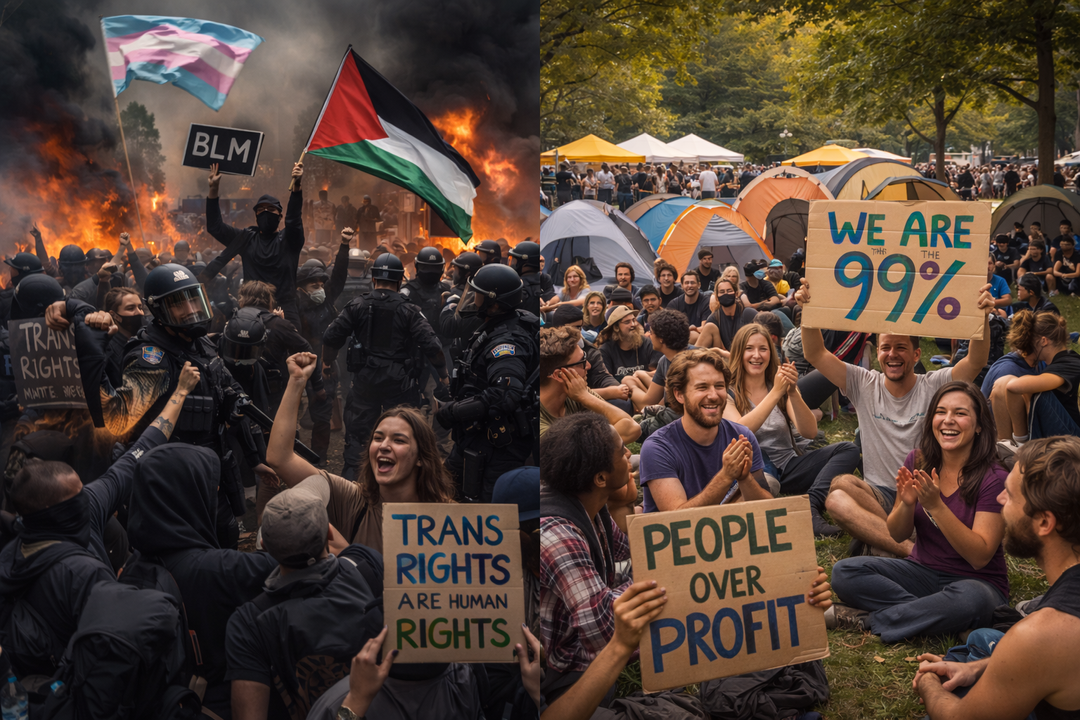
I still remember what downtown Toronto felt like when people gathered with a message and meant it.
There’s a difference between a crowd that comes to be heard, and a protest environment that turns into a stage for something else. You can feel it in the body before you can explain it on paper. One has a steady heartbeat. The other has a fuse.
Occupy Toronto taught me what a peaceful mass movement looks like when the people inside it actively protect the tone.
The camp wasn’t perfect. Nothing made of humans ever is. There were disagreements, big ideas, personal struggles, and long nights that dragged into longer mornings. But the atmosphere had an anchor. People showed up to talk about systems. About money. About incentives. About power. About the quiet ways a country can change shape without most people noticing.
And in that environment, the word “woke” still made sense.
Back then, “woke” didn’t mean a tribe. It didn’t mean a scoreboard. It didn’t mean a purity test. It pointed to an inner click, the moment someone realized that the world runs on structure, and that structure can be studied. It meant paying attention to how decisions are made, who benefits, who carries the cost, and how language can be used to hide reality.
It was less of a slogan and more of a posture. Eyes open. Mind open. No need to scream, because the point was to see.
Occupy had visuals that matched that spirit.
A tent city beside stone and stained glass, Saint James Church. Handwritten cardboard signs that looked like they were made at kitchen tables. People sharing food. People sharing blankets. A circle forming on the grass, then another circle beside it. Conversations that moved slowly, like they mattered. The occasional speaker raising their voice, not to threaten, but to reach the back of the crowd.
It looked like citizens trying to understand their own country.
That memory matters to me because it sits in sharp contrast to what happened the year before, during the G20 summit in Toronto on June 26–27, 2010.
I wasn’t in a tent city then. I was watching my own city get turned into a set.
Most people who showed up were there to march, hold signs, and make their point. Then a smaller, harder element moved through downtown using black bloc tactics. Windows got smashed. Storefronts got damaged. Police vehicles were set on fire. The images spread fast, and those images became the story.
Once that happens, everything downstream changes.
Property damage triggers a defensive police posture. Police lines tighten. Streets get sealed. Crowd control becomes the priority, not dialogue. In that climate, peaceful demonstrators and police officers can end up reacting to each other instead of reading the room clearly. The public sees one chaotic picture. Everyone involved feels threatened. The centre collapses, and the fringe becomes the headline.
The official record later showed just how far it went. More than 1,000 people were arrested during the G20 security operation, the largest mass arrest in Canadian history. Years later, Toronto police agreed to a major class-action settlement for people detained without justification, including people caught in “kettles.” Multiple reviews documented serious failures in planning and response, and serious lines being crossed after the streets had already been set on fire.
That sequence is important. Violence and property damage did not stay contained to the few. It changed the posture of the entire operation. It changed the public mood. It changed what the cameras captured. It changed what people remembered.
It also created a pattern that keeps repeating.
When a movement stays disciplined, it keeps the moral centre. It forces the system to answer the actual message. When violence enters the frame, even in pockets, it gives every institution involved a reason to harden up. It also hands every media outlet the easiest footage to run. A small number of bad actors can flip the entire narrative, and once that narrative flips, cause and effect does the rest.
That’s why the question of escalation matters so much.
Sometimes escalation comes from genuine radicals acting on their own beliefs. Sometimes it comes from political agitators looking for conflict, attention, or disruption. Sometimes people allege a different layer, the idea of “paid protesters” or organized provocateurs embedded to steer a crowd into optics that serve someone else’s agenda. Those claims are hard to prove in real time, and easy for people to toss around loosely, so they need to be treated carefully.
But even without proving who paid whom, the effect is easy to see.
A peaceful crowd can be turned into a threat in the public imagination, simply by a few minutes of footage. Once that happens, innocent people can get swept up. Police can overreach. Fear becomes the fuel. And when the dust settles, the memory that sticks is rarely the original message. It’s the broken glass. It’s the smoke. It’s the sirens.
That’s what Toronto’s G20 taught me.
Occupy taught me something else.
Occupy worked as long as people guarded the tone, because the goal was understanding. The camp stayed calm because participants insisted on it. The focus stayed on systems and incentives. Escalation offered no payoff, because disruption wasn’t the point. The point was to make the invisible visible, and to do it in a way ordinary people could recognize as honest.
That contrast also explains something about “woke.”
In the Occupy era, “woke” still pointed toward awareness of systems and power. It described noticing how narratives are manufactured, how money shapes politics, and how institutions protect themselves. It had a plain meaning: stay awake to how things work.
Over time, that meaning didn’t just drift. It got redirected.
The modern playbook became familiar: provoke, escalate, capture the image, and let reaction do the rest. That playbook did not stay in the streets. It moved into media, politics, and online spaces. Language followed it. Labels replaced explanation. Awareness gave way to accusation. Words became a way to sort people into camps instead of a way to describe reality.
And in that environment, “woke” stopped being a signal of insight and turned into a weapon.
Today it gets dragged into culture-war fights, including gender identity debates and performative “inclusivity” messaging that often produces the opposite result in real communities. The label is thrown like a rock. It lands where it lands. People feel attacked, so they harden. The conversation turns into a loyalty test. The details disappear. The human beings disappear.
A word that once meant “pay attention to systems” becomes a way to divide neighbours.
That’s the real loss.
Because the original instinct behind it was not cruelty. It was the instinct to look behind the curtain and tell the truth about what you saw. It was the instinct to ask why things feel unfair even when the slogans say they’re fair. It was the instinct to notice when power is being protected, when the rules are being bent, and when ordinary people are being managed instead of respected.
Occupy, at its best, had that spirit. It looked like people trying to understand the machinery of society without burning the whole town down to make a point.
The G20 weekend showed what happens when the machinery of a protest gets hijacked. The cameras lock onto the worst moments. The response escalates. The public memory calcifies around chaos. The centre gets erased.
The same thing can happen to words.
When a word becomes a tool for sorting and shaming, it stops illuminating systems and starts blinding people to each other. When that shift takes hold, the word becomes less about waking up and more about picking sides.
That’s how “woke” changed.
And once that change happened, the word itself stopped being a description and became a trigger.