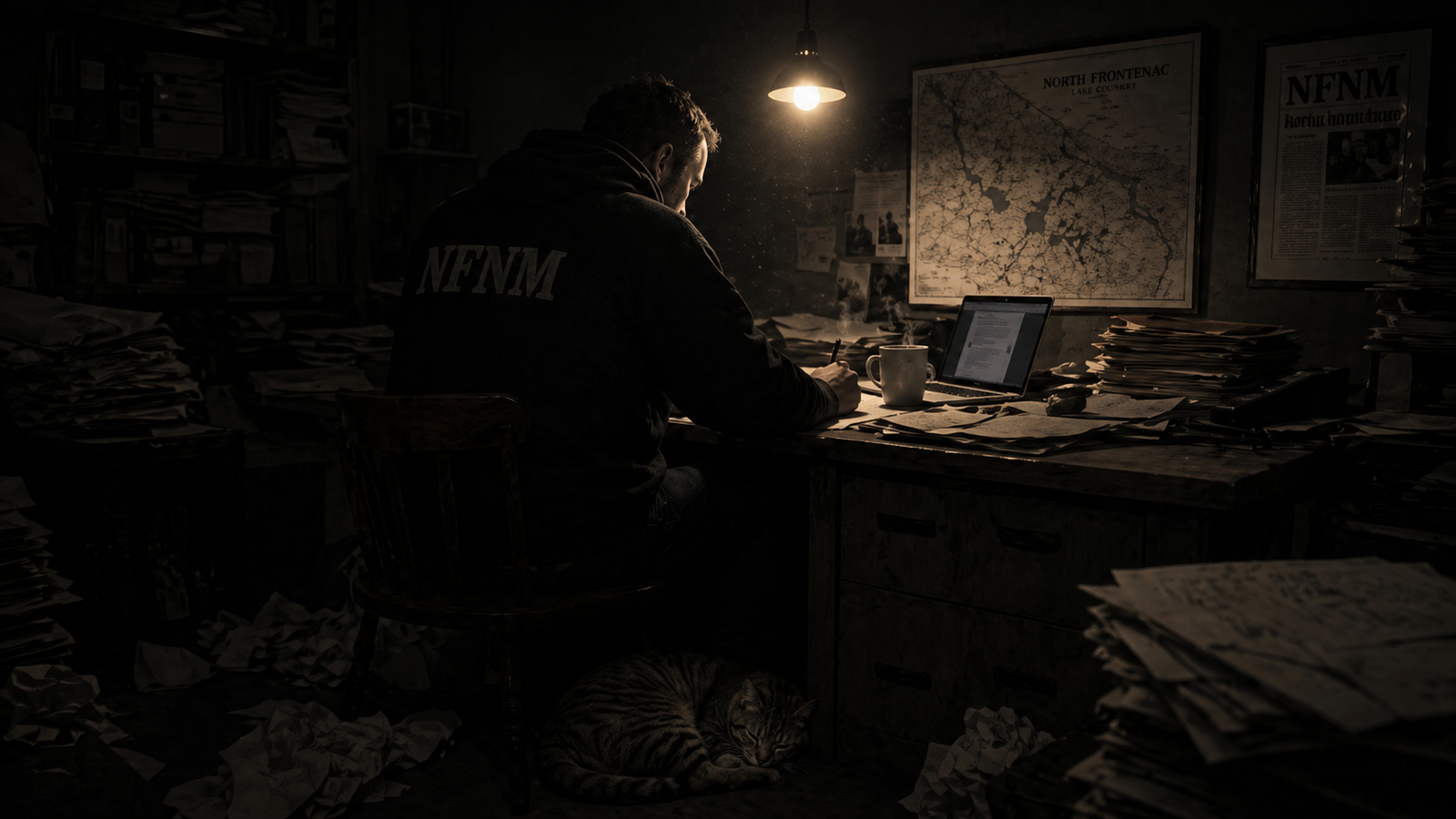
It has been a while since I wrote to you in this voice, the desk voice, the one that sits beside the reporting and talks about what the last stretch of work has actually been like and where I think we go next.
I want to be honest with you about that stretch. It has been heavy. There was a season where I was cut off from the largest community space this town uses to talk to itself, and that did not happen by accident. The volume of records work has been unusual: requests filed, responses chased, deadlines tracked, fees argued. Some weeks the records workload alone is a full-time job, and that is before a single article gets written. Doing this kind of journalism inside a small community has a personal cost that is hard to describe to anyone who has not done it. People you knew before the byline existed look at you differently. Some doors close. Some open. You learn quickly which is which.
None of that is a request for sympathy. I am writing it down so you do not read the quiet from the desk as the work having paused. It did not. It went underground for a while, into records and timelines and the slow work of cross-referencing one document against another. Hours of quiet sorting that nobody sees and that have to happen anyway. What you are about to see in the coming weeks is what came out of that quiet stretch.
What this year taught me
I want to share one view I have landed on this year, and I want to be clear that it is a view, not a finding. You are free to land somewhere different. That is the whole point of writing it down.
I have come to believe there is something inherently wrong with elected officials being trained on how to govern.
Hear me out, because that sentence sounds bigger than it is.
Municipal democracy in a place like ours is supposed to work in a particular way. We elect people from our own community. We pick them because we know them, or because someone we trust knows them, or because they showed up at a meeting once and said the thing nobody else was willing to say. We elect a person, with a personality, with a lived experience of this place. We elect their judgment. We elect what they would do if they were sitting in that chair and a hard call landed in front of them.
Then they take the seat, and somewhere in the early months a different process begins. There are training programs. There are procedural orientations and policy frameworks handed down from a higher tier of government, or from a consultant, or from a staff member whose job is to keep the institution stable. Slowly, and usually with the best of intentions, the person we elected gets reshaped. Their hands get tied by procedures they did not run on. The instinct that won them the seat starts to look, from the inside, like a liability.
We voted for change, and the change did not arrive. The person we elected did not betray us. The system around them is simply designed to absorb new arrivals and return them to the average.
None of this is to say training is malicious or that procedure has no value. The point is that the autonomy we voted for is real, and when we let it dissolve quietly under the weight of “this is how it is done,” we lose something we cannot easily get back. The community gets a watered-down version of the person it chose, and over time it stops believing its own choice can change anything.
That is the thing I want every reader of this site to think about for a minute. Set aside the question of any particular person, and ask the bigger one. What are we, as a community, actually electing for?
Where we go from here
NFNM is not stepping back. The opposite. The reporting pivot I started this spring is real and it is continuing. The records work is going to surface in articles you can read and verify against the documents. The accountability tools that exist in this province for a reason are going to start being used, the way they were designed to be used. Some of that will move forward this week.
I am not naming targets here. That is not how this works. When something is ready to publish, it will arrive with the documents attached and the right of reply already extended. That is the standard, and the standard does not change because the work is harder.
What I am asking from you is this. Read the next few pieces with care. If something we publish prompts a question, send it. If you have a record I should see, send that too. If you disagree with a thesis I lay out (like the one I just laid out about training), tell me. NFNM is better when readers push back than when readers nod along.
This is not a one-person project. It cannot be. Change in a small community is something a community decides to embrace, together, in small ordinary acts. Showing up to a meeting. Reading the agenda before you walk in. Asking the question nobody else wants to ask, in a tone that keeps the room civil. And underneath all of it, a quiet decision that the place you live is worth the discomfort of paying real attention to it.
I have spent a long time inside the difficulty of this year. I am not the same writer who started it. I think that is okay. I think growth out of a hard stretch is the only kind of growth that actually sticks. I am taking the reins on this next phase with a clearer head than I had a season ago, and I am hopeful in the way a person becomes hopeful after something tries hard to break them and does not.
Thank you for being here, and for reading, and for holding the line with me on the idea that a small community deserves the same quality of attention that a big one gets.
The next chapter starts now. I am glad you are in it.
Donald Morton North Frontenac News Media