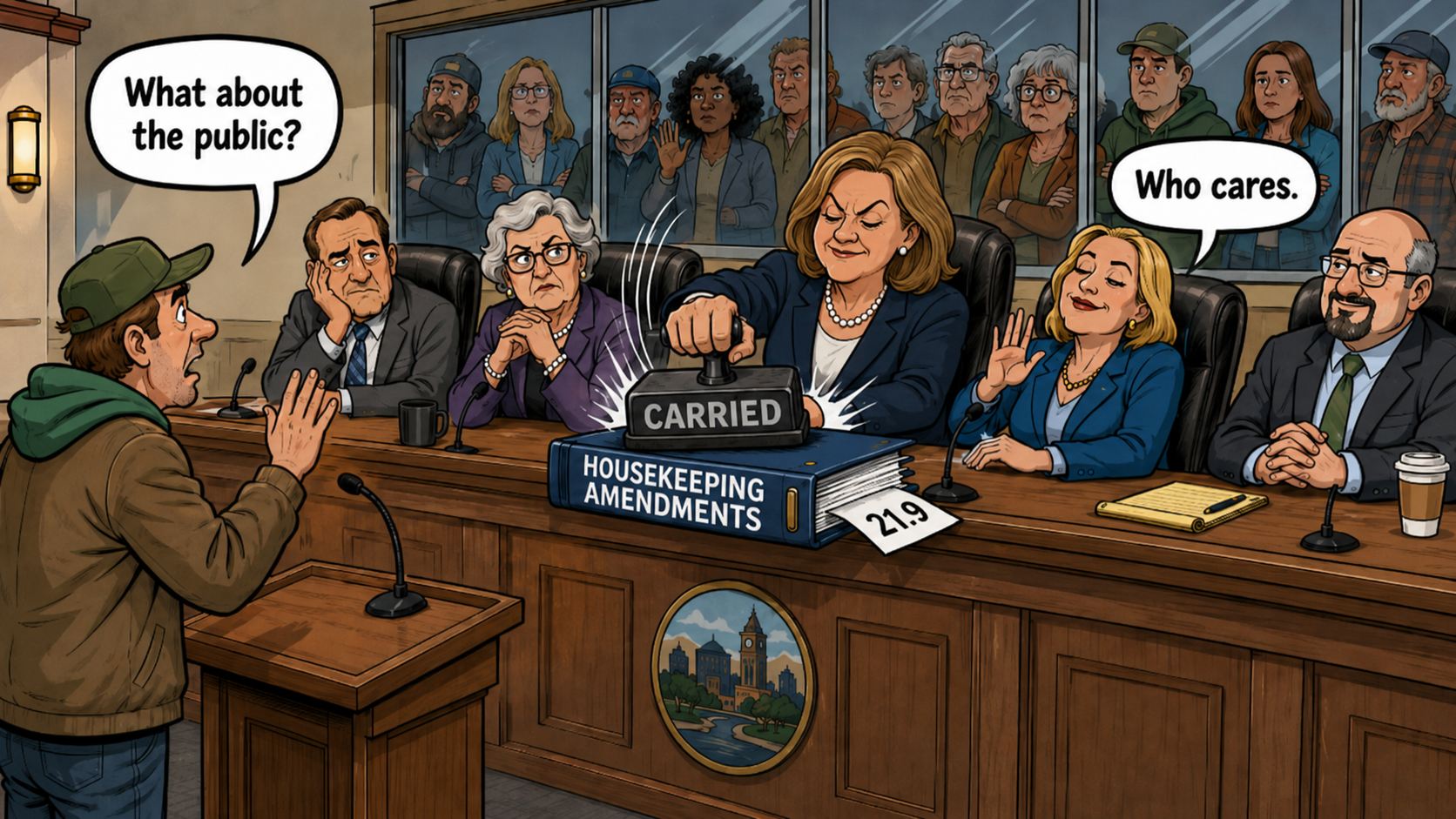
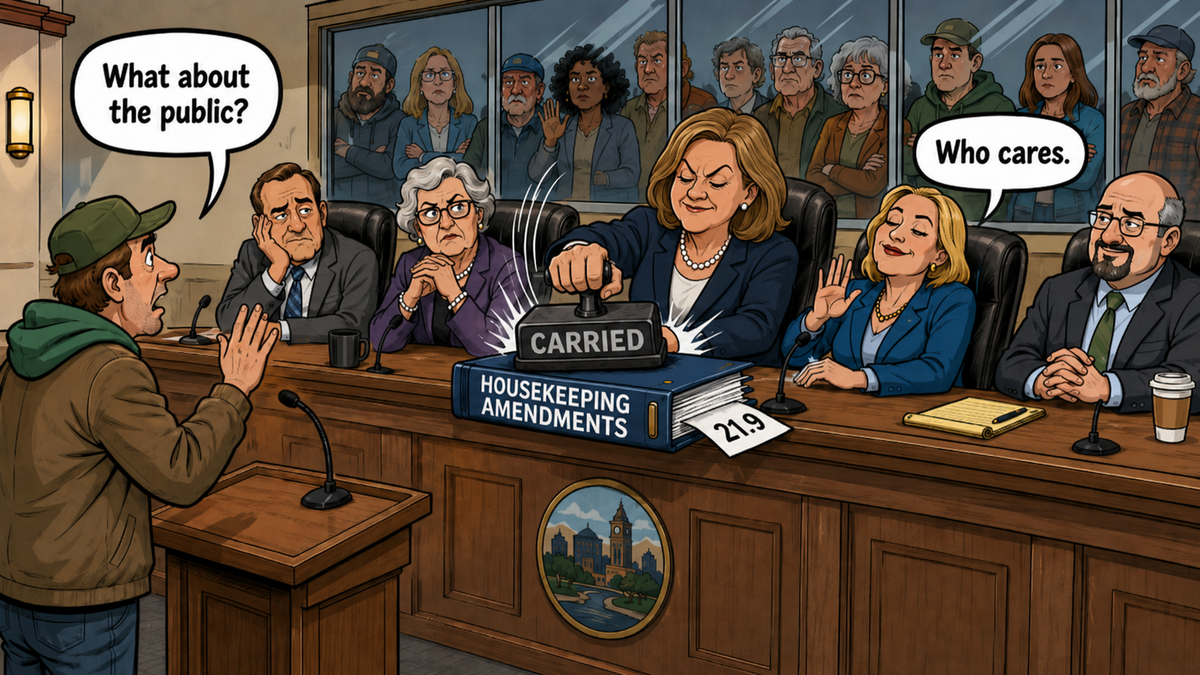
There is an old trick for getting a thing past people who would object to it if they saw it on its own. You staple it to fifteen other things, most of them dull, a few of them sensible, and you ask for one vote on the whole stack. A councillor who dislikes one item now has to vote against the spelling fixes and the committee renamings to register that dislike. Most will not. The objectionable thing rides through on the back of the housekeeping, and the minutes record a clean result.
That is the shape of what happened to Frontenac County's rulebook this spring, and the public-facing record will never show it.
On February 3, the County's Governance Review Committee took up fifteen separate amendments to its procedural by-law, the document that governs how council meets, votes, and conducts its business. The amendments were moved as a single motion. Not one at a time. One vote, all or nothing. It carried three to one. The lone nay belonged to Judy Greenwood-Speers, the Mayor of Frontenac Islands, who sits on county council and asked for a recorded vote so her objection would survive on the permanent record.
Then the package went to a 21-day public comment window and came back to regular council on April 15, where the County's new procedural by-law was enacted, repealing and replacing the 2022 version in its entirety. It passed through three readings that day. At that public meeting the record showed no dissent at all. The one councillor who voted against it had cast her no weeks earlier, in committee, in a room most residents never watch.
What was in the stack
Most of the by-law really was housekeeping, and it is only fair to say so. It swapped "defer" for "postpone," corrected a health-unit name, fixed spelling. Nobody loses sleep over that, and nobody should. If that had been the whole package, there would be no story and no reason to slow anything down.
The problem is not that housekeeping existed. The problem is what was folded in beside it. The same fifteen-in-one motion carried changes that move actual authority. One amendment strips the Deputy Warden of the chair role on the Committee of the Whole. Another bans recording or transmitting devices in closed session. Another deletes the guaranteed minimum number of meetings the Accessibility Advisory Committee was promised. These are not spelling fixes. They are decisions a council might want to argue about one by one, on the record, so residents could see who stood where. Stapled to the dull majority of the stack, they were never going to get that airing. The wrong here is not that the County did housekeeping. It is that a contestable change rode through inside the housekeeping, unexamined, because pulling it out would have meant voting against everything else too.
The one worth slowing down for is section 21.9. It hands the Clerk, together with the CAO and the Warden, the power to amend by-laws that council has already passed, without bringing the change back to a council vote. The list of permitted reasons includes one that should make any resident sit up: to amend a passed by-law "to more fully represent the intention of Council."
Read that again. Three officers, no council vote, can adjust the wording of a law already on the books to better reflect what they understand council meant. The County captions this new power as "Minor Administrative Amendments," and most of what it covers is exactly that: clerical fixes, spelling, numbering, and the correction of obvious errors. It is the breadth of the final clause, the power to "make a correction... to more fully represent the intention of Council," that invites the wider reading. The County has written itself a quiet tool that could be used to edit its own laws after the fact.
The objection that got rushed
Greenwood-Speers did not object to the bundling. Her complaint was a different one, and it is worth keeping the two straight.
She objected that the County pushes by-laws through all three readings in one sitting, which leaves the public no real chance to weigh in before a thing becomes law. By her account that is not a small procedural quibble. It is the difference between a public that can speak and a public that is told after the fact.
"It actually eliminates any opportunity for the public to... be consulted or provide feedback," she told the committee, asking council to slow the process down. "The public is the one that's being completely cut out of it." She added that unless a matter was genuinely time-sensitive, slowing it down "is in the best interest for democracy," and warned against turning significant reports into what should never be an ambush, where residents get no chance to comment "not just in a rushed method."
She also reached for a sharper word, and she did it from her own experience. Running all three readings together in one sitting, she told the committee, "is not democratic in any way, shape, or form. It is used, unfortunately, as an abusive process, and it occurred too frequently in our local township, and it's been changed." Greenwood-Speers is the Mayor of Frontenac Islands, so the local township she meant was her own, and by her account she had helped end the practice there. That is her word on the record, "abusive," about the practice she was being asked to vote for, from a mayor describing a fix she says she already made next door.
The chair's answer
She got an answer. After Greenwood-Speers and others pressed that the public was being shut out, Mayor Gerry Lichty, the North Frontenac mayor who sits on the County's Governance Review Committee, defended the pace by treating consultation as the problem.
The agenda is public, he said, and residents who care will find it. "If it's contentious enough, the public is on the phone. The agenda went out at one o'clock yesterday and by three o'clock it was all over Facebook." Scheduling formal presentations is cumbersome and limited by design, he argued, because a committee can only sit through so many speakers before the value drops off. Set against that, slowing the process to invite comment was, to his mind, motion without purpose. "We're just delaying, delaying, delaying," he said, and his prescription was the opposite of hers: "Don't have this bureaucratic structure, just get it through. That's what the public wants." The status quo, he concluded, needed no fixing: "I think it's just fine the way it is." Councillor Fred Fowler agreed the calendar sometimes forces the County's hand: "To Gerry's point, some of the things are time sensitive."
A posted agenda, though, is not the same as an informed public. What carried that item to where people could see it was not the act of posting it on the County portal. It was someone reading it, reporting it, and passing it along, the word of mouth that puts a contentious line in front of residents who would never open a committee agenda on their own.
So there it is, in two voices, on one recording. One member says the public is "being completely cut out." Another hears the request to let the public in and calls it "delaying, delaying, delaying," and says the way the County does things is "just fine." A resident can read both lines and decide which one describes a council that wants to be heard from.
Not a one-off
If this were a single committee meeting in one county, it would be a small story. It is not a single meeting.
NFNM has been on this beat since January 16, when North Frontenac council carried South Frontenac's "Defend Local Autonomy" package as one bundled vote. We wrote then that a bundled vote "blurs the meaning of the decision, and it hands control of the narrative to whoever wrote the package." Arthur Hannigan put the practice plainly: "The practice of bundling controversial policy proposals together with more broadly acceptable ideas is a growing concern in municipal governance." It works, he said, by "sheltering" a contentious item "behind ideas that are easier to support," at "the expense of transparency, public trust, and responsible decision-making." Former North Frontenac mayor Ron Higgins made the records point: bundled items should be separated so each councillor's differing views are transparent and archived.
The same move surfaced again at the township level, and this time a councillor named it. On May 21, North Frontenac's Vernon Hermer challenged how the township's April 10 by-law came to restrict Public Forum participation and bar journalists from asking questions. "Someone, some unknown person or persons decided to ride along on that motion and amend an unrelated bylaw, which certainly can't be done," he told council. NFNM reported his full objection at the time, including the two limits he says a housekeeping amendment cannot cross: it cannot change a by-law's intent or purpose, and it cannot restrict public participation. Both, he said, had happened.
Mayor Gerry Lichty saw it differently, telling Hermer they were really talking about one by-law with two amendments inside it, not a bundle of unrelated changes. Hermer disagreed, arguing the two changes reached into different bodies of law and belonged in different conversations. That dispute, over what counts as "unrelated," is the whole argument in miniature.
Here is the rhyme worth noticing. Hermer says you cannot amend a by-law to change its intent or purpose. The County's new section 21.9 hands its Clerk power to amend a passed by-law "to more fully represent the intention of Council." One councillor calls the move impermissible in his township. One county wrote it into its rulebook in the same season.
The habit scales up. The federal omnibus bill is the same trick in a larger room: fold a contentious measure into a must-pass bill so a no vote reads as a no on the whole thing.
Put the moves side by side and a shape comes into focus. Bundle the contentious with the dull so a no costs too much. Run all three readings in one sitting so the law is passed before most residents know it exists, and the request to be consulted gets called delay. Each has a tidy procedural defence, and you heard one offered for each in that committee room. Taken together they describe a way of conducting public business that narrows, at every step, the public's chance to object. That is governing past people rather than with them, and Hannigan and NFNM's own January position named the same risk before this County vote ever happened.
What the record will say
A year from now, anyone who pulls the County's new procedural by-law will find a list of amendments enacted April 15 with no recorded opposition. The single no vote lives in a committee recording from February, in a room most residents never open. The clean line on the public record is exactly the product bundling is built to manufacture. The harder a council makes it to vote against one thing without voting against fifteen, the tidier its minutes look, and the less those minutes tell you about what anybody actually wanted.
Greenwood-Speers asked for the recorded vote so her no would be there for someone to find. NFNM found it.