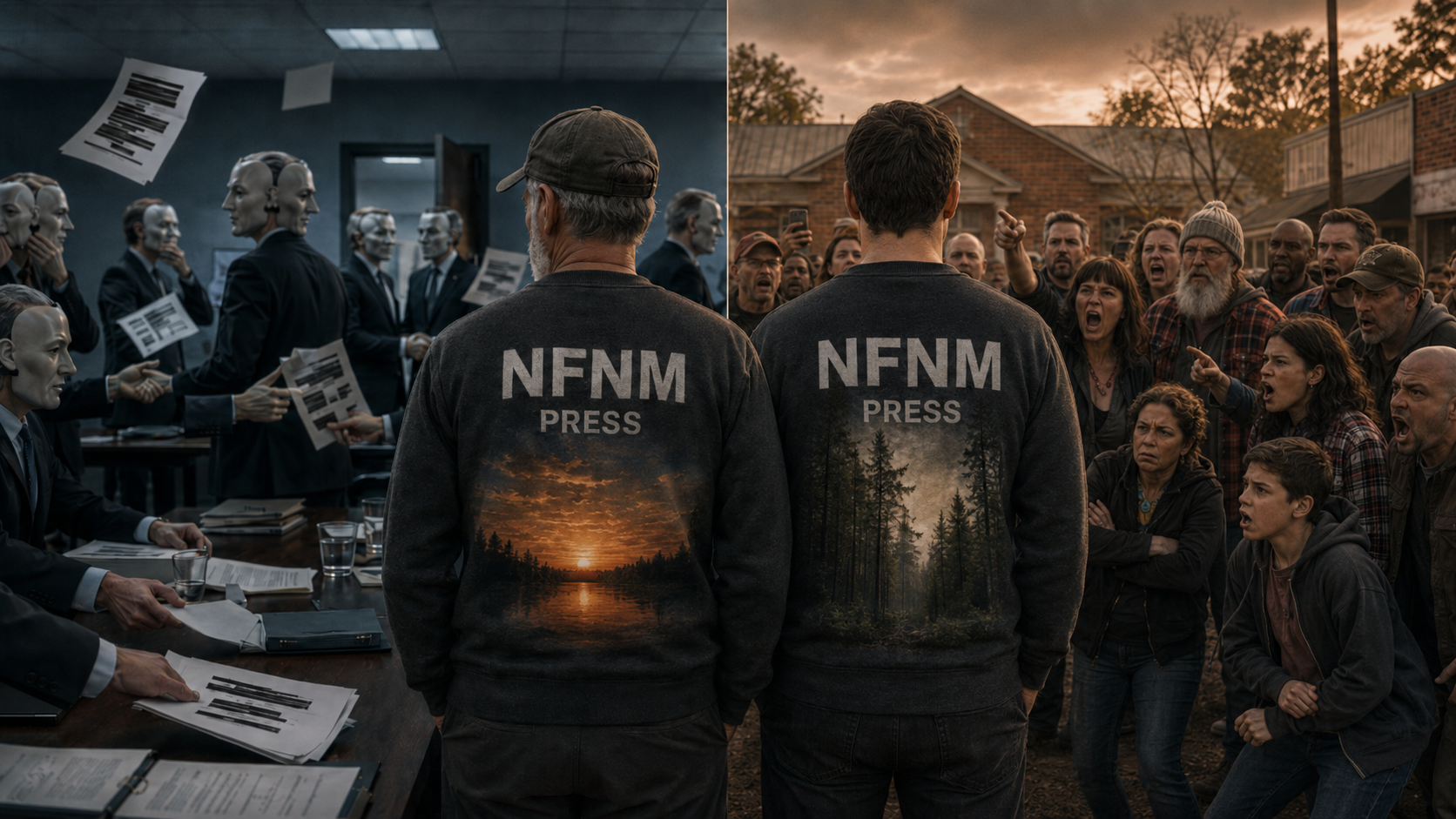
Editor's note. This is a paired opinion piece by two writers. Part I, "I Almost Walked Away," is by Art Hannigan and is published exactly as he submitted it, in his own words, unedited by NFNM. Part II, "A Different Road to the Same Wall," is by NFNM publisher Donald Morton, who is also the subject of the events he describes. NFNM's editor reviewed and cleared Part II under the newsroom's conflict-of-interest guard. The two accounts are deliberately kept separate. The opinions in each are the author's own.
Both authors are declared candidates in the 2026 North Frontenac municipal election. North Frontenac News Media does not endorse candidates.
Two Roads to the Same Wall
Two people poured themselves into this township. One was worn down by its institutions, the other by its people. Same result. Their accounts run separately, below.
Part I. I Almost Walked Away
What a year of trying to help taught me about this community, and why I have not given up yet.
By Art Hannigan
I want to tell you something I have not said in print before.
There were weeks this past year when I was ready to stop. Not step back. Stop entirely. Walk away from the candidacy, set down the files, and let North Frontenac work out its own future without me in it.
I am not writing this to generate sympathy. I am writing it because the feeling I had is something a lot of people in this community share, and nobody is saying it out loud.
The feeling is this: I tried. I did the work. I followed the rules. And nothing moved.
Why I Started
I got involved because I care about this place. That is the whole reason. Not ambition. Not anger. Not a score to settle.
I live here. My neighbours live here. The decisions this council makes affect the roads we drive, the services we can access, the money that comes out of our pockets in taxes, and the quality of what we get back for it.
I come from a background that taught me how to find things that do not add up. How to read a document carefully. How to ask a question and listen for what is missing from the answer. I thought those skills could be useful to a rural township that deserves better governance than it has been getting.
So I did the reading. I attended the meetings. I watched the public recordings. I filed the requests. I wrote the letters. I followed every proper channel available to me.
What I found was not what I expected. What happened next was worse.
What I Found
I am not going to lay out a legal case in this article. That is not what this piece is for, and it is not what you need from me right now.
What I will tell you is what I experienced as a citizen trying to understand what my municipality had done on my behalf.
I asked questions and received answers that raised more questions. I looked for documents I was told existed and could not find them where I was directed to look. I was given explanations that did not hold up when I checked.
Here is the part that took me the longest to name clearly. The answers I received were not always outright false. Some of them were carefully true. Accurate enough to satisfy a casual reader, incomplete enough to steer you away from what you actually needed to know.
That is a harder thing to deal with than a flat lie. A flat lie can be disproven. Partial truth is designed to feel like the whole story. You walk away satisfied, and only later, when you pull the next thread, do you realize you were pointed in the wrong direction by something that was technically correct.
I observed instances where the council accepted information from parties with a direct interest in the outcome without seeking independent verification. I watched an administration that seemed more interested in managing the inquiry than answering it.
The truth was being treated like a wound to be covered, not a problem to be fixed.
None of that is normal. None of it should be acceptable to the people who pay for this government.
What It Does to a Person
Here is what no one tells you about civic engagement at the local level.
It is lonely. There is no team. There is no institution behind you. There is you, your time, your files, and your willingness to keep going when every signal you receive tells you the people in charge would prefer you stopped.
A former friend and I worked on this together. We both reached the same wall. He reached it before I did, and watching someone with his experience and integrity arrive at that level of exhaustion told me something important: this is not a personal failing. This is what the system does to people who push on it. What it also does, if you let it, is use the bonds between people as leverage. A friendship that becomes a tool for managing an inconvenient investigation does not survive the investigation. Ours did not.
It delays. It deflects. It buries the question in process until the person asking runs out of energy.
I am not accusing anyone of bad faith in this article. I am describing a pattern I observed. Whether that pattern is the result of deliberate obstruction or simple institutional inertia, the effect on the citizen is the same.
You start to wonder why you are doing this.
I lost count of the nights I sat with the files and asked myself what exactly I thought was going to change, and who exactly was going to thank me for trying.
This Is Not Only a North Frontenac Problem
I want to be careful here, because I do not want to sound like someone reaching for a conspiracy to explain a local frustration. So let me stay with what I have observed and what the public record shows.
Freedom of information requests filed across Ontario dropped 27 percent in 2020. That is not opinion. That is from the Information and Privacy Commissioner's own annual statistics. COVID created the opening. The habit of delay that formed during that period did not fully reverse when the emergency ended.
In March 2026, the Ontario government introduced amendments to FIPPA that would remove the Premier, all cabinet ministers, parliamentary assistants, and their political staff from freedom of information law entirely. The changes would apply retroactively. The province's own Information and Privacy Commissioner responded publicly, stating that for nearly forty years Ontarians have had the right to access government records at the highest levels, and that this proposal would diminish that right in ways that are likely to be permanent if passed.
A court had ordered Premier Ford to release records from his personal cellphone used for government business. The government's response was to propose a law making that order irrelevant going forward.
This is not a rural problem. It is not a North Frontenac problem. It is a pattern running from the township level to Queen's Park, and the direction of travel is the same at every level: less access, longer delays, broader exemptions, and narrower windows for the public to see what is being done in its name.
What I experienced trying to get answers from a small township council is the same experience journalists are having trying to get answers from the provincial government. The scale differs. The method does not.
I have been watching this for five years. The acceleration since 2020 is not subtle. Protocols that once provided for public disclosure are being quietly revised. Timelines for responses are being extended. Exemptions are being broadened. Each change is small enough to seem administrative. Together, they add up to a different kind of government than the one we thought we had.
Whether that is coordinated or simply the natural instinct of institutions protecting themselves when oversight weakens, I cannot say with certainty. What I can say is that it is happening, and it is happening at every level I have looked at.
The Community Problem
The harder truth, the one that nearly finished me, is not what the administration did. It is what the community did not do.
People here are busy. They are dealing with their own lives, their properties, their families, their businesses. Municipal governance is not top of mind when the firewood needs cutting and the roof needs patching.
I understand that. I live the same life.
But there is a point where apathy becomes its own kind of answer. When no one shows up to ask the question, the people who benefit from the question not being asked win by default.
I watched that happen this year. I watched issues that directly affect every ratepayer in this township pass without a single voice from the public gallery. I watched decisions get made in a room that felt very far from the people those decisions will cost.
That distance is not natural. It is cultivated. And it does not happen overnight.
The policies being adopted now, at every level, will be harder to reverse the longer they are in place. Exemptions that exist for one term become precedent for the next. Timelines that stretch once get stretched again. Councils that are not asked hard questions stop expecting them.
There is a window here. It will not stay open.
What I Am Asking
I cannot fix this alone. One candidate, one writer, one resident with a file folder does not move a municipality. What moves a municipality is a community that pays attention in numbers large enough that ignoring it becomes politically costly.
I am asking you to pay attention.
Not to me. Not to this article. To your municipality. To what is being done in your name, with your money, by people you elected.
Attend a meeting. Watch a recording. Read an agenda before the vote instead of after. Ask one question at the microphone. Tell a neighbour what you found.
You do not have to run for office. You do not have to spend a year in the files. You just have to show up often enough that the people making decisions remember you are watching.
That is all accountability requires at the most basic level. Presence. Sustained presence, from enough people, over enough time.
North Frontenac is worth the effort. The people here are worth the effort. I would not still be doing this if I did not believe that.
But the effort has a cost, and right now too few people are sharing it. That is not a permanent condition. It is a choice, renewed or abandoned, every time someone decides whether to pay attention or look away.
The policies coming down the line will not wait for the community to get ready. They are already moving.
Art Hannigan is a resident of Snow Road Station, a contributor to the North Frontenac News Media, and a candidate for North Frontenac Council. The opinions expressed here are his own.
Sources referenced: Information and Privacy Commissioner of Ontario, 2020 Annual Report; IPC Statement on Proposed FIPPA Changes, March 25, 2026; The Trillium, March 26, 2026; Global News, March 13, 2026 and April 6, 2026.
Disclosure: Art Hannigan is a participant in municipal matters that overlap with NFNM's own reporting on Frontenac Municipal Services Corporation governance, including the access-to-information requests at the centre of that reporting. His conclusions here are his own and are not NFNM findings.
Editor's note: Part I was written before the Ontario legislature passed Bill 97 (Plan to Protect Ontario Act, 2026) on third reading, 57 to 33, on April 23, 2026, with Royal Assent following. The FIPPA amendments the author describes as proposed are now law. NFNM has reported the vote and its effect separately.
Part II. A Different Road to the Same Wall
By Donald Morton, Publisher, North Frontenac News Media
Art wrote his piece on his own, and I am setting mine down beside it. Two different stories. They end in the same place.
Art's wall was built out of process. Records that did not arrive, and answers that were carefully true. He was worn down by an institution.
Mine was built out of people.
I have lived in a lot of places in this country, and I have never been treated the way I am treated here. Doing this work in the open, with my own name on it, has made me a target in my own community. The cost has not been abstract and it has not been occasional. In my experience it has been the worst bullying I have faced anywhere in Canada, and I am done pretending it is not happening.
I am a journalist, and I am a candidate. I was blocked from the Township of North Frontenac's own official Facebook page, and from the Mayor's page. I had to send formal legal demands to be unblocked from both. Sit with what that means. The public body I cover, and the man who runs it, locked me out of the channels where they speak to the very people I am asking for a vote.
The same Mayor stood up and told residents the township's website is its primary way of reaching them, while time-sensitive notices were going up on the Facebook page I was locked out of. When I reported that, the answer was not an answer. It was a written accusation that I was the problem, and a claim that he had been blocked from me, which never happened. NFNM has never blocked Mayor Lichty from anything. Anyone can read us at nfnm.tv without so much as an account.
And it is not only the official channels. The Ompah hall has banned me from its Facebook page too. When I complained, the township told me the hall is its own entity, not theirs to touch. But that hall runs on tax dollars. The township pays its internet, half its heating, its cleaning, and puts thousands of dollars a year into its capital reserve. It is physically attached to the township's own fire hall and shares its heat. You do not get to take the public's money to keep your lights on and your water hot, and then call yourself a private club the moment a candidate you do not like asks to be let back in. You cannot be a separate entity for accountability and a public one for funding. Pick one.
That is what being shut out looks like when it is run by nobody and everybody at once. Conversations stop when I walk up. Rooms I used to belong to make it clear I am not welcome. I report across this whole county and across the country, and it is only here, at home, that doing the job turns you into an outcast.
It got worse the day I became a candidate. The largest community pages in this region are not the public squares they present themselves as. They are run by a small circle of unelected administrators who decide which posts, which links, and which candidates the rest of us are allowed to see. I have watched my own posts disappear while the people running against me posted freely. That is not moderation. That is a handful of people deciding, from behind a curtain, who in this community is allowed to be heard. And I am not the first candidate it has been done to.
It is not only the gatekeepers. I have people running for the same council seats I am, sending me private messages to tell me I am a zero, a bad journalist, that I do not matter in this community. I will not name them here. I do not have to. I am telling you it is happening, and I kept the messages.
It has gone past my work, too. People in this community have gone digging into my private life and reached toward my family, not to answer anything I have reported, but to make me into someone you should not listen to. That is the move when the facts will not do the job. You do not rebut the journalist. You try to make the town stop trusting the man.
They have threatened, more than once, to report my own home to the building inspector. Nobody who says it suddenly cares about the building code. They say it to remind me they can reach into my life and make it harder whenever they choose. These are the same circles that block me from the pages where this town talks to itself. Shut him out first. If that does not work, find something to hold over him.
And then I hear this place sold as a wonderful place to raise children, usually by people who have never had to test what it does to someone who asks an uncomfortable question out loud. A community is not its lake and its trees. It is how it treats the people inside it. Measured that way, I have seen a North Frontenac that no brochure will ever show you.
Art and I came at this from opposite directions. He filed the requests and read the by-laws. I published what I found and stood in the open where everyone could see me. The institution wore him down with paper. The community wore me down in person. Same exhaustion, same wall at the end of it.
None of what I have written here is loose talk. Every word of it is backed by facts, by evidence, and by witnesses, and I will stand behind all of it in front of anyone who cares to ask.
I am still here. But I am done being quiet about what it costs, and I am done carrying it alone while the people handing it out tell themselves they are protecting something good.
Donald Morton is the publisher of North Frontenac News Media and a candidate for North Frontenac Council. The opinions expressed here are his own.