Donald Morton is NFNM's publisher. The facts below are sourced and checkable; the argument is his own.
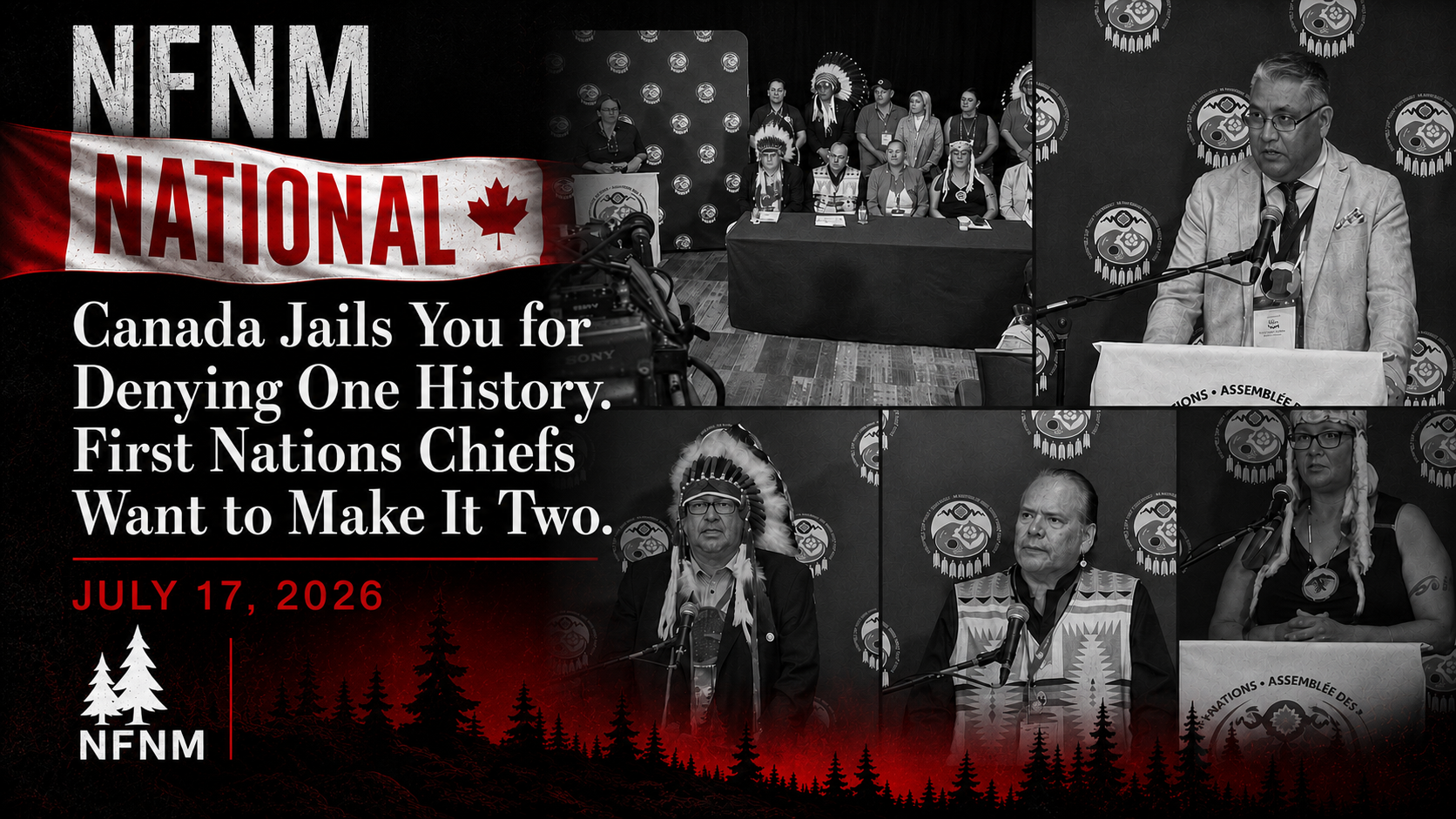
The Assembly of First Nations met in Ottawa this month, on Ottawa Valley land never signed over by treaty. Out of everything it could have called urgent across its July 14 to 16 gathering, it passed just one emergency resolution: a demand that Parliament make it a crime to deny the residential school system, and treat that denial as hate speech.
There is, right now, exactly one part of history that Canadian law makes it a crime to deny. It is the Holocaust. The law came in 2022 and carries up to two years in prison for deliberately stirring up hatred against Jewish people by condoning, denying or playing down the Holocaust (section 319(2.1) of the Criminal Code). Nothing else is behind that wall: not the Armenian genocide, not the Ukrainian famine that killed millions under Stalin, not the residential school system here at home.
The July resolution asks Parliament to make it two. It calls it an emergency that Canadians are still free to deny what happened in the schools. But the graver danger is the fix. Every version now on the table would hand the government a power it has used exactly once: prison for what a person says about the past.
The resolution did not leave that vague. It gave Parliament two routes. One is to reopen Bill C-9, the Combatting Hate Act, which passed in June without any denial clause, and add one. The other is a brand-new law making it a crime to publicly excuse, deny, justify or play down the residential school system. Chief David Monias of Pimicikamak Cree Nation moved the resolution, and the room agreed to it. It also asks for a complaints body where Survivors and families could report denial. Both routes are already drafted, and this piece takes both apart.
Three different proposals are on the table, and people keep mixing them up. Telling them apart is the whole argument.
The first already exists. That 2022 Holocaust law has sat on the books for four years and has never been tested at the Supreme Court. It was not even its own bill. It got bundled into a budget bill, a backdoor that drew objections at the time from the Canadian Bar Association, the country's lawyers' group, and from Senator Paula Simons.
The second is an amendment the Senate already voted down, the one the resolution's first route would bring back. Nunavut Senator Nancy Karetak-Lindell, who survived a residential school herself, wrote a proposed law almost photocopied from the Holocaust one. It would make it a crime to stir up hatred against Indigenous Peoples by condoning, denying or playing down the residential school system, with the same exceptions and the same two-year-maximum prison term. On June 3 the Senate voted it down, 41 to 32, with two senators taking no side. The bill it was attached to passed the next day without it. Most of the coverage called that a defeat for survivors. The July resolution is the answer.
The third is still alive, and the resolution's brand-new-law route points straight at it. New Democrat MP Leah Gazan has a private bill, C-254, sitting at the very first step in Parliament. Like the others, it would make it a crime to condone, deny or play down the residential school system. Then it adds two more triggers: justifying the system, and promoting hatred "by misrepresenting facts relating to it."
That last trigger is the whole problem. This bill would punish you for getting the history wrong, not for stirring up hatred with it. That is a different kind of law altogether, and Canada has been down this road before.
In 1992, the country's highest court threw out an old law that made it a crime to spread false news. The man fighting it was a Holocaust denier named Ernst Zundel, about as ugly a defendant as you could find, and the court sided with him anyway (R. v. Zundel). The judges ruled that even a deliberate lie is still covered by the Charter's free-speech guarantee, and that a law turning on whether a claim about history is true or false was too vague and too broad for a free country to allow.
Two years earlier, the same court had upheld a different law, the one making it a crime to deliberately stir up hatred against a group (R. v. Keegstra). The line between those two rulings is the hinge this whole debate turns on, and both sides accept it. A law against stirring up hatred of a group is allowed. A law that punishes you for getting a fact wrong is not. The amendment the Senate rejected stayed on the allowed side, because it said nothing about misrepresenting facts. Gazan's bill puts that true-or-false test back in, aimed at a different chapter of history: the very thing the court already struck down. The chamber stopped the cautious version. The reckless one is still standing.
The demand is still on the table. What has the government done about it? Written a cheque, not a law. The federal minister for Crown-Indigenous Relations, Rebecca Alty, put $5 million toward fighting denial and set no timeline for changing the Criminal Code, saying the government had not done the homework such a change would need. That leaves both routes open and neither taken: a grant and a study in place of a new speech crime, and a demand that only grows louder.
Who is asking for this, and why? Waving them off would be dishonest. They are not hiding their reasons, and their case deserves to be stated at full strength.
Gazan's argument is simple: treat both histories the same. "There is already a section in the Criminal Code related to Holocaust denialism," she told Broadview Magazine. "All my bill does is add residential school denialism to that section, using the same criteria." She believes in academic freedom, she says, but draws a line between honest inquiry and incitement. Sean Carleton, a historian at the University of Manitoba, puts the parallel plainly: "You can't downplay, minimize, twist or distort facts about the Holocaust because that's engaging in antisemitism," and the same logic, he argues, extends to what he calls a documented genocide against Indigenous peoples. His target, he says, is the "high-profile people who are publishing books and making money" from bad-faith denial, not ordinary curiosity.
Chief David Monias, who moved the resolution, put it in the language of reconciliation: it cannot hold, he argued, while the truth of the schools can be questioned or erased. Karetak-Lindell, who wrote the rejected amendment, makes the same point: her version simply mirrored the Holocaust law, and the truth would always be a full defence. After the June vote, the Assembly of First Nations called the outcome "regressive and a setback for survivors and for reconciliation." Linda Debassige, the elected Grand Council Chief of the Anishinabek Nation, who testified to the Senate committee, asked in a written statement: "What message does it send when we are willing to criminalize other forms of hate, yet hesitate when that hate is directed at First Nations peoples?"
These are serious people making a serious case, and the record behind them is not in doubt. The residential school system was real, and its harm was real. Church and government together ran institutions that took at least 150,000 First Nations, Inuit and Metis children from their families. Thousands of those children died. The Truth and Reconciliation Commission has named more than 4,000 of them and believes the true number is 6,000 or higher, lost to disease, hunger, neglect and abuse. In 2022 the House of Commons agreed, without a single member objecting, to call what happened a genocide. None of that is in dispute here. What is in dispute is the tool.
The strongest objection does not rank one history above another. It says reaching for the criminal law to settle a fight about history is the wrong move, whichever history is involved. And the people making that case are not who the easy story assumes. Aaron Pete, a hereditary chief of the Chawathil First Nation, wrote in a widely shared essay that the path forward is not to criminalize speech, questions or debate, and that a law like this would make a criminal of him for conversations he means to keep having. The Canadian Civil Liberties Association, the country's main civil-rights group, makes the same point from a different angle: laws like this hand the government a tool that, in its words, "gets used against Indigenous peoples, racialized communities, protestors, and dissidents." The case against jailing people for denial is largely being made on behalf of the very people the law claims to protect. This fight does not run between Indigenous and settler Canada. It runs straight through Indigenous opinion itself.
The tool also fails on its own terms. Making denial a crime does not change a denier's mind. It hands him a courtroom, a press gallery and a martyr's crown he could never have earned on the argument alone. And by scaring off the teachers, historians and Survivors who need room to speak plainly, it can endanger the very communities it claims to protect.
There is a deeper reason still. The government cannot be the official judge of what is true about the past, because the moment it takes that job it must pick whose history to enforce under threat of prison. Our own law already sees this in the freedom of belief. Canada's highest court has held that the freedom to believe includes the freedom to believe in nothing at all (R. v. Big M Drug Mart, 1985). A free country does not force you to believe, and it does not jail you for not believing. History is no different, and prison is the wrong answer to an argument about what is true.
Which brings it back to this month, and to what the assembly actually did. The Assembly of First Nations is an advocacy group, not a government. A vote on a convention floor changes no law by itself. What it does is ask the one body that can criminalize speech to do exactly that, and the principle that answers does not depend on who is asking. Free speech protects the few from the many. It shields the person standing alone precisely because that person has no other shield. It stops any crowd, and any campaign no matter how right its cause, from putting its version of history above question on pain of prison. No lobby, no assembly, and no Parliament gets to turn an opinion about history into a crime and still call this a free country.
The Senate settled nothing, and the assembly's vote is the proof. Karetak-Lindell has signalled she means to bring her amendment back, Gazan's bill is still alive, and the demand now carries the full weight of the Assembly of First Nations, the national body that speaks for First Nations across Canada. It will come back, and it will come back broader.
The assembly called the Senate's refusal a step backward. The real step backward runs the other way: a free country that settles an argument about its own history by threatening people with prison. A country moves forward by letting its people argue, even when they are wrong, and answering them with better facts, not with a cell.
One question will not go away. Once the government can jail you for denying one chapter of history, someone must decide which chapter earns that protection next, and which after that. Make the list two instead of one and nothing on principle stops it at three, or four. Who holds that pen?