
By Donald Morton
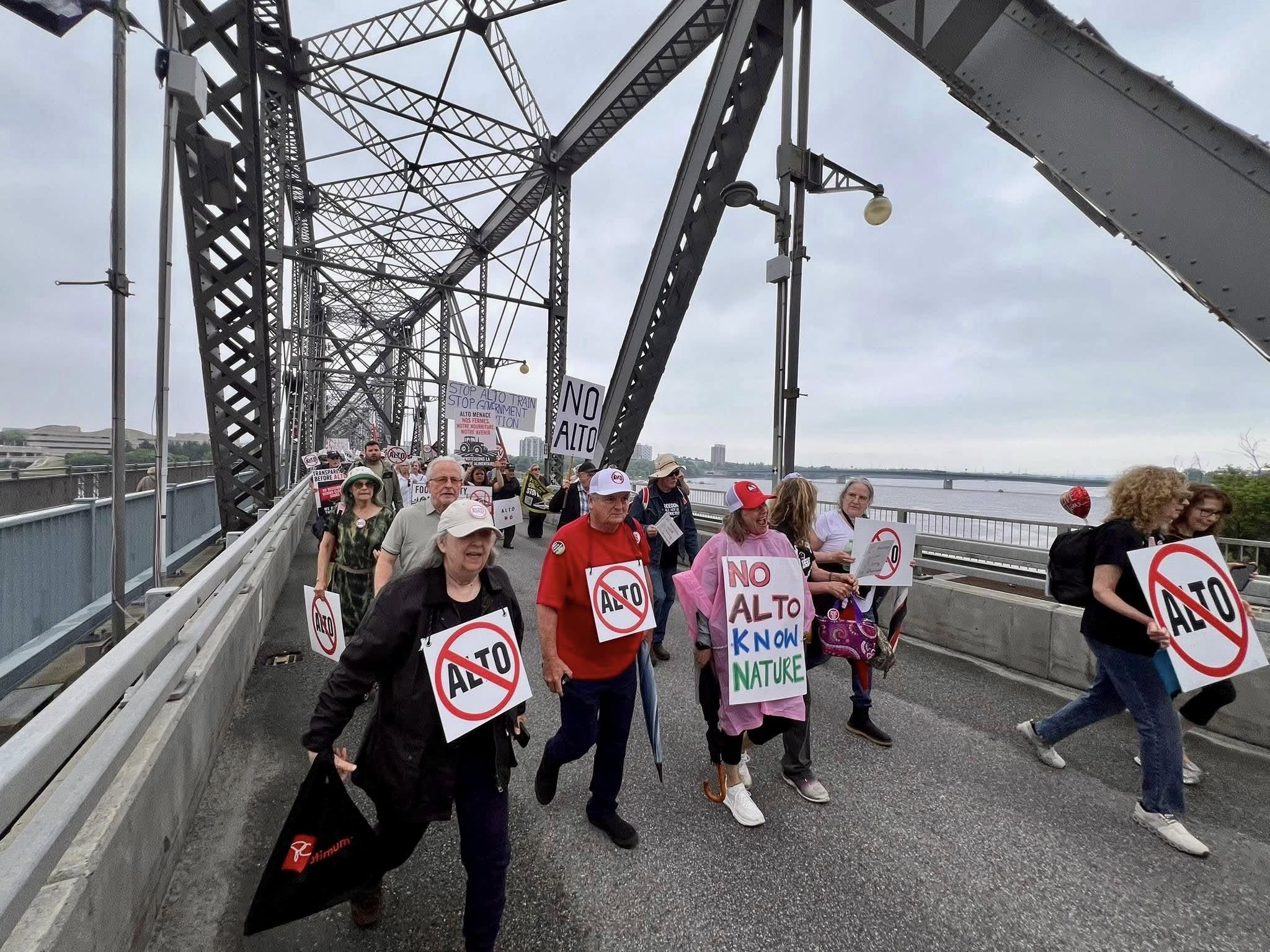
They came at it from two sides. One contingent had ridden in from Quebec. The other had boarded a chartered bus at Herb's Travel Plaza, near Vankleek Hill. Before the march, the two met on the Alexandra Bridge, where it crosses the Ottawa River, and walked the rest of the way to Parliament together.
That was the image the day's organizers wanted, and it is the one the local organizers carried home. "The image of Québec and Ontario [residents] joining forces at the bridge and everyone walking together to Parliament was something I will never forget," said Kristin Muller of St-Eugène, a local organizer, speaking to The Review. Isabel Deslauriers, also of St-Eugène, took part in the march. "I believe the demonstration was successful because it showed that all types of stakeholders are opposed to the project," she told the same paper: "farmers, residents, business owners, environmentalists, first generation landowners, multi generational families, rural and urban citizens."
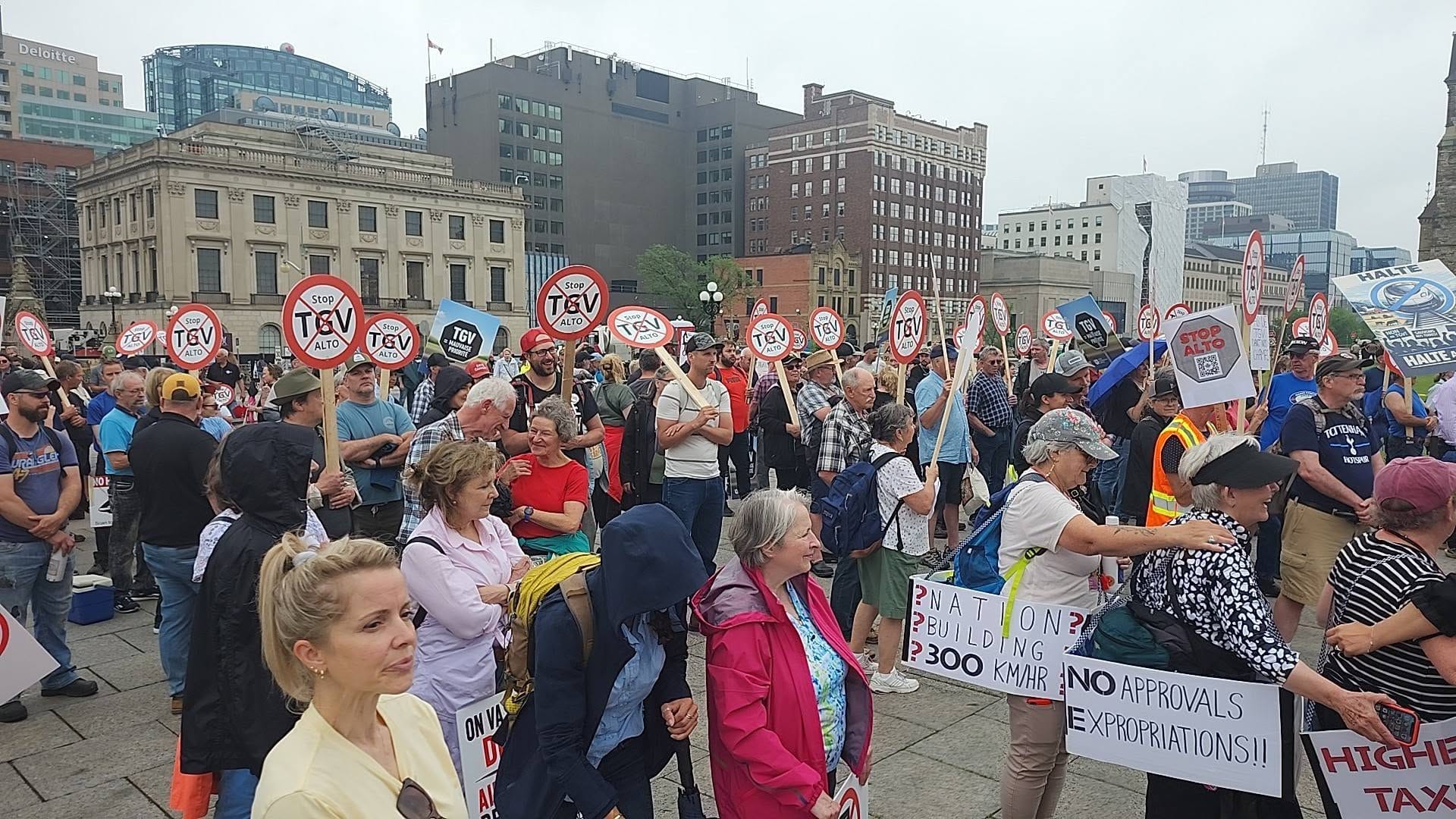
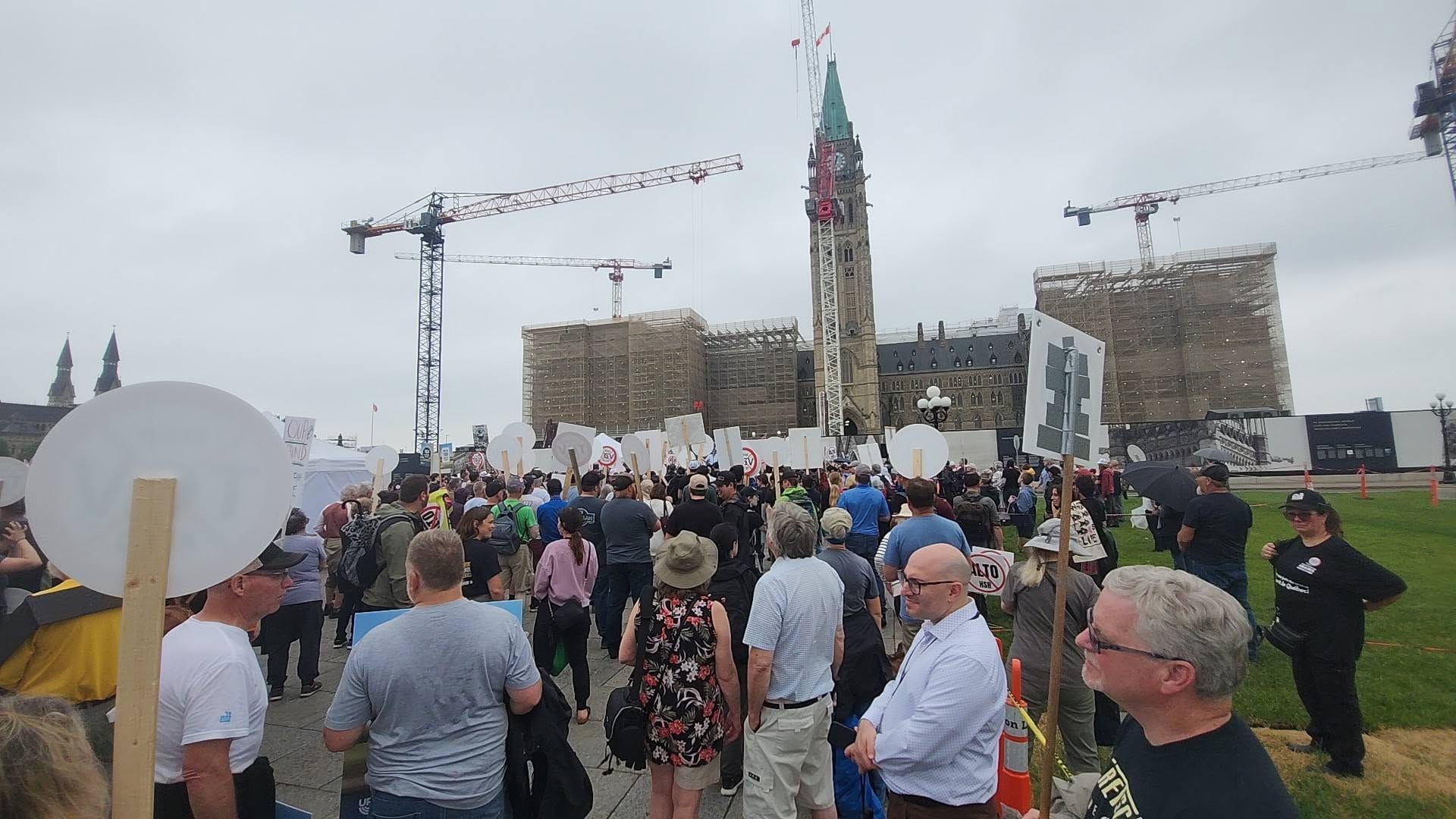
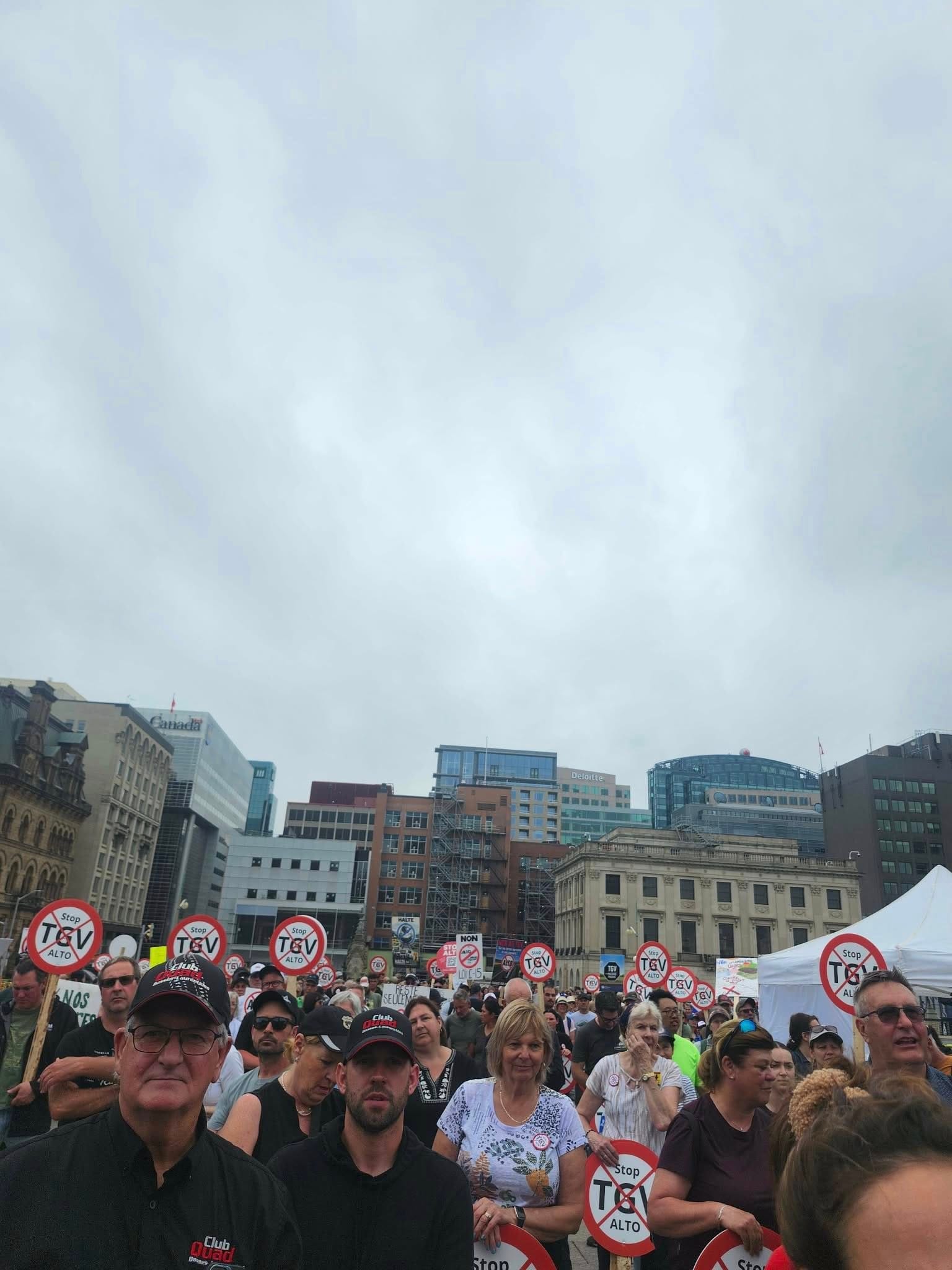
It rained on them. By the time the marchers reached Parliament Hill it was around noon, and several hundred of them, by some accounts close to a thousand, stood in the wet with signs and chanted two words at the building that decides their future. No Alto. The signs were about a train, the federal high-speed rail line meant to run from Toronto to Quebec City at 300 km/hr, but the case the marchers carried was about land, cost, and a fear of going unheard. A farmer who leaves the land in June, in the growing season, to stand in the rain in another city has made the wager that the cost of the day away is worth less than the cost of being unseen. Once the chants stop echoing off the stone, what survives of a day like this is only what someone wrote down. So here is what was said, and who said it.
The word they kept saying was expropriation
The Quebec contingent carried a memory the Ontario side could only borrow. In 1969 the federal government seized a vast stretch of farmland north of Montreal to build Mirabel airport, displacing thousands of people who, by historical accounts and Radio-Canada's anniversary coverage, watched the runways consume a fraction of what had been taken and the rest sit fallow for decades.
Sylvain Éthier, a Mirabel farmer, was one of them. "I was nine years old when I started to hear the word expropriation," he told BNN Bloomberg. "Now more than 50 years later, we don't want to live through all this again. The government destroyed homes and family farms, we don't want to re-live that history." If they come to his door, he said, they will stay outside.
Also at the protest was the next generation, with no Mirabel memory of its own but the same fear about the future. Anthony Lalonde is seventeen and farms with his family in St-Placide, Quebec. "I am the seventh generation working on my family farm and the train is not good for the next generations," he told BNN Bloomberg. "It can destroy agriculture."
The mechanical complaint underneath the fear is plain to anyone who has farmed split land. A high-speed corridor has no level crossings, so a field the rails pass through becomes two pieces that no longer touch, and a tractor that once crossed a road now drives kilometres around to reach the far half of the same farm. Lise Beauchamp, a dairy farmer from Mirabel, laid the unanswered question in front of the Globe and Mail. "There are fences on each side of that train. Alto was never clear what access they will build to go from one side of the train to the other," she said.
The Ontario side, and the road that stops nowhere near them
For the eastern-Ontario marchers, the grievance was sharper for being lopsided. The proposed line through their townships is a southern option that would carry no station for the communities it cuts through. The benefit goes elsewhere. The corridor stays.
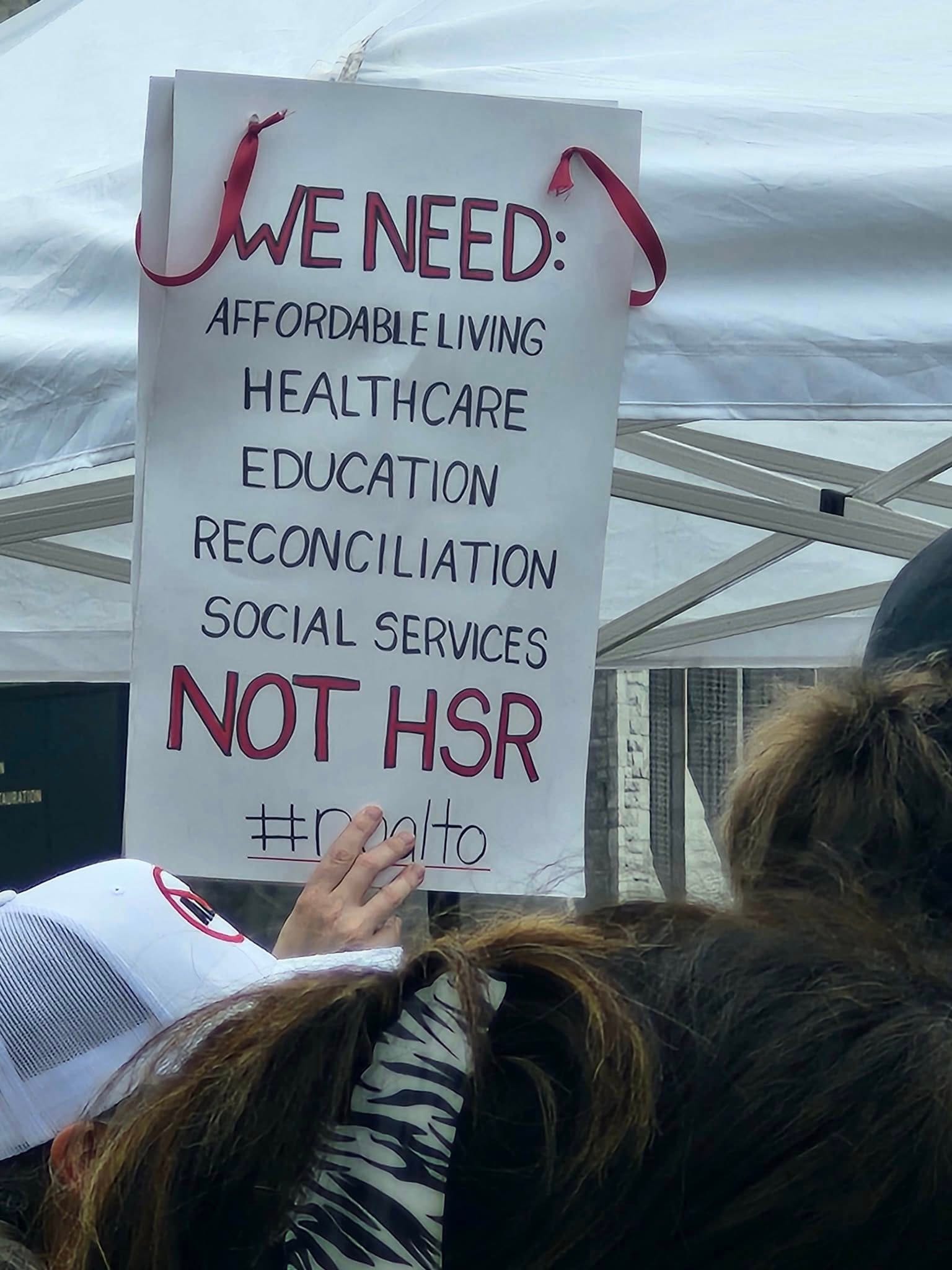
Stephan Wolf, who farms at Hammond, said the answers never come. "Since the beginning of the project, we have a lack of information from Alto," he told CP24. "Every question we ask, they never have any answers." Brigitte Bérubé, a property owner near Dalkeith, named the part of all this that does not photograph. "Honestly, this not knowing, can you imagine the stress levels in our communities?" she told the Globe and Mail. "It's really brutal." Never clear, never any answers: that refrain threads through nearly every account of the day.
Karen Black came from Centreville, in Stone Mills township between Napanee and Kingston, just west of Frontenac. "It's dividing communities to the north, to the south," she told CP24. "It's $90 billion. It's hard for me to understand when the 401 doesn't work and VIA Rail doesn't work, how an elite high-speed rail, breaking up all the communities in rural Ontario and Quebec is going to help matters."
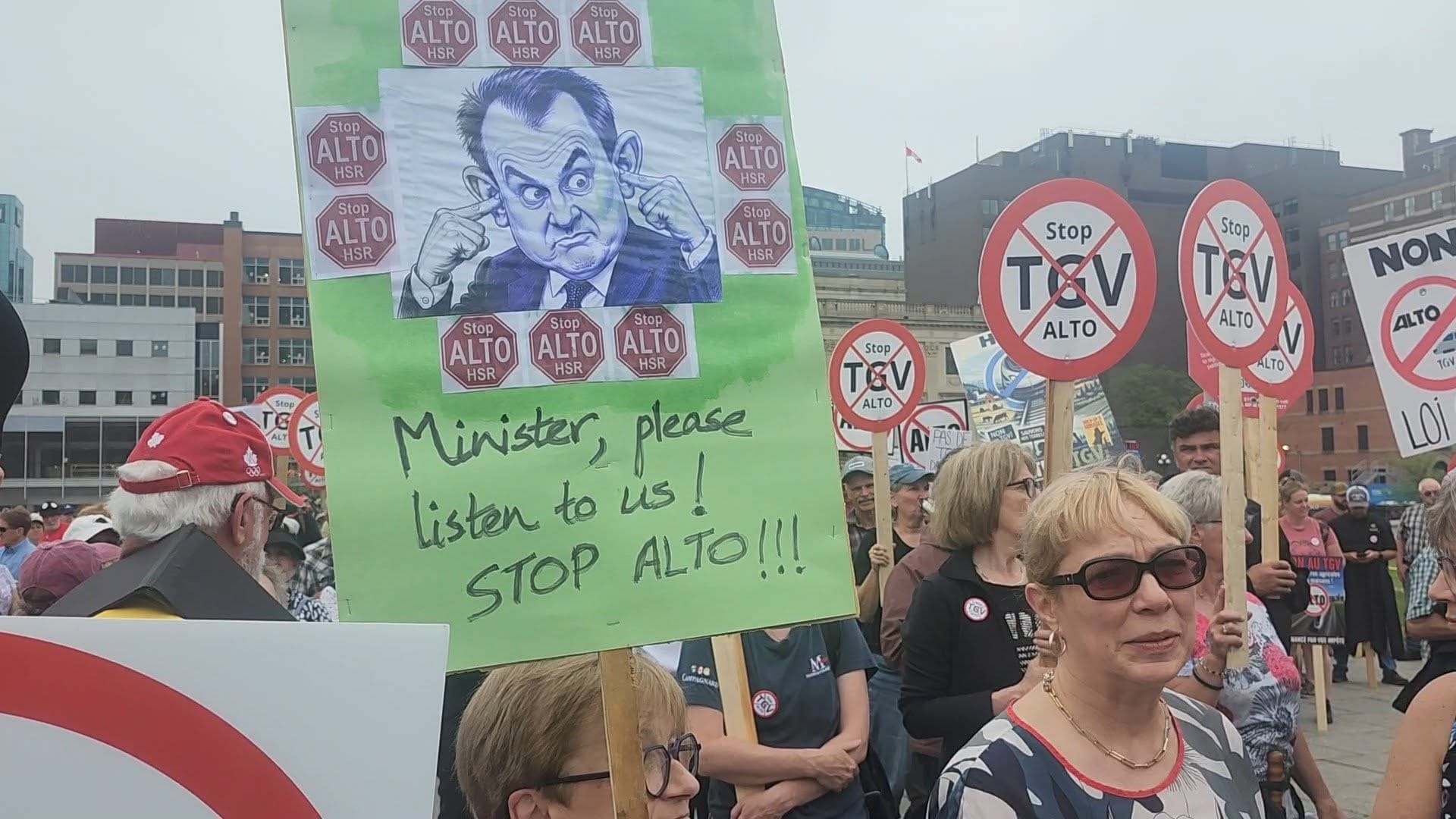
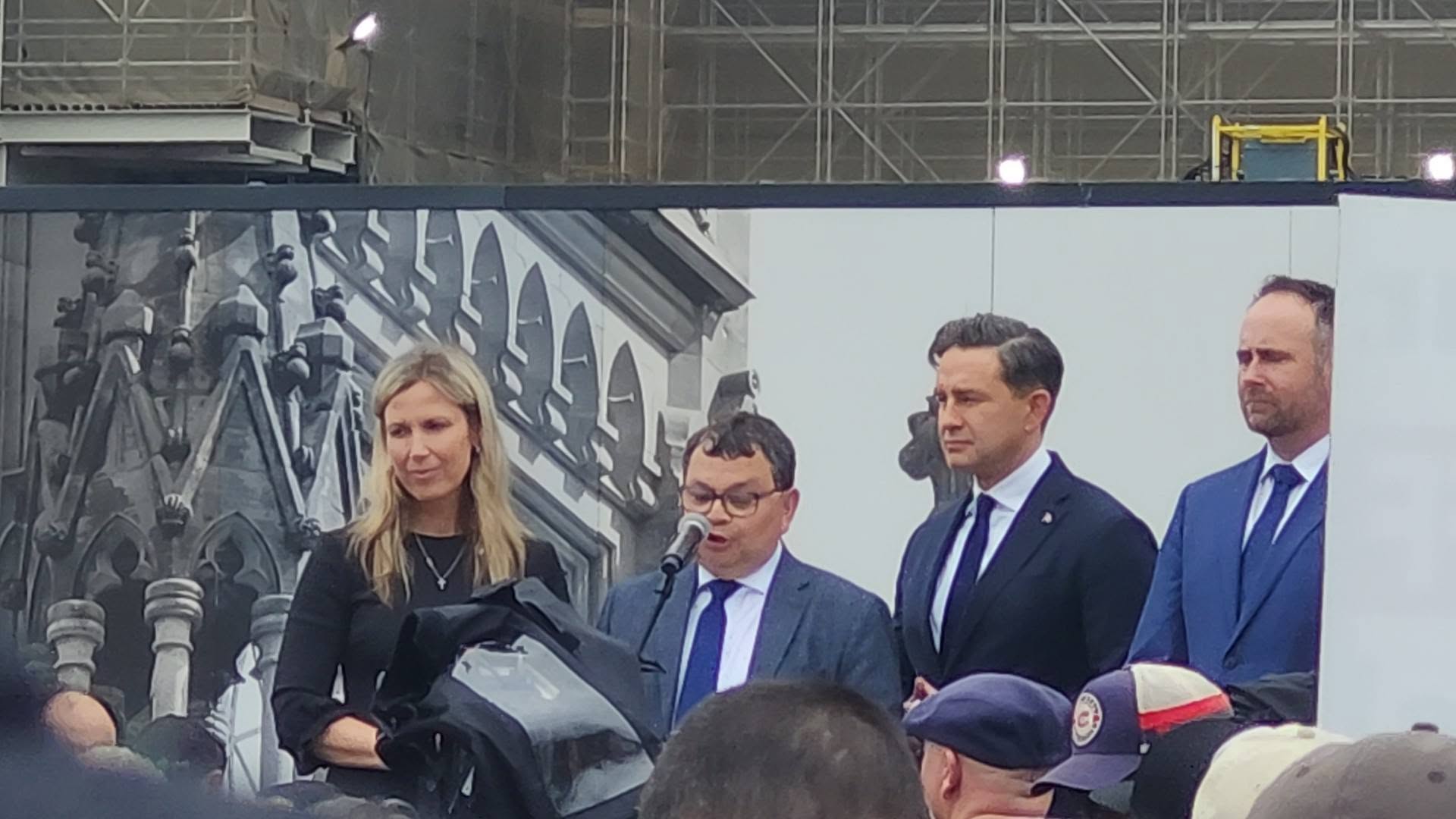
Her figure is the top of the range Alto itself publishes for the project, a planning estimate that runs from sixty billion to ninety billion dollars. It is also the number the opposition has chosen to put on its signs, and the one Conservative leader Pierre Poilievre reached for when he came out to meet the crowd. He promised a Conservative government would cancel what he called the "Liberal white elephant" and let farmers keep their land.
The local member of Parliament was there too. Scott Reid, who holds the Lanark-Frontenac riding, has spent months gathering signatures against the line, and one of his e-petitions closed last month with more than seventeen thousand names on it. He read his constituents into the public account and translated the abstraction into a household bill. "These petitioners are concerned that their land will be expropriated and their lives destroyed by this project that is going to pass through their communities," he said, and once the land is taken, "they and their children will then be sent the tax bill for their share of a project so expensive that it will cost $9,000 for every family of four nationwide." The line passes through their communities. It does not stop in them. And the existing VIA Rail service through Kingston and Smiths Falls, the trains Frontenac-area travellers already use, is part of what opponents fear could be hollowed out as riders are pulled toward the faster line.
The other side was not silent
The people who want the train built were not on the lawn, but they were not quiet either. Martin Imbleau, the chief executive of Alto, has answered the protests with a wager about the future. "If we were to delay the project or not do it, when we will wake up in 2046, all Canadians, all Quebecers ... most Ontarians will say we should have done it in 2026," he told panow. "The time to do it is now."
Steven MacKinnon, the federal transport minister, calls Alto "a formidable, nation-building project that includes Quebec," and told BNN Bloomberg that without Quebec there is no project at all. The train has defenders in the places it would actually serve: the mayors of Montreal and Quebec City both pushed back this month against a Parti Québécois pledge to pull Quebec out, with Quebec City's Bruno Marchand arguing the country is "already behind enough as it is." A nation-building case and a stranded-farmer case can both be true.

Even among the opponents the position was not seamless. Robert Charron, a Mirabel municipal councillor who came to the Hill, said the government treats the farmers as though they are against the modern world. "We're not against having a better transport system," he told BNN Bloomberg. "But not the way they're doing it." Charron speaks for the opposition on a split council. His own mayor, Roxanne Therrien, would take the high-speed train if it came with a station at Mirabel. The town is divided about the line, the way the country is.
That division is the whole story of a peaceful protest. The people on the grass have no vote inside the chamber. What they have is a single day, a set of words, and the hope that someone is writing them down. The buses went back toward Vankleek Hill and St-Eugène and Mirabel, toward fields that needed tending and a decision that had not been made. The marchers had stood at the centre of the country and said the thing out loud, together, across a river that usually keeps them apart. Whether it changes the route of a railway is not theirs to decide. Whether anyone remembers they were there depends entirely on what gets carried forward from a single wet Wednesday in June, after the chanting stops and the record is all that is left.