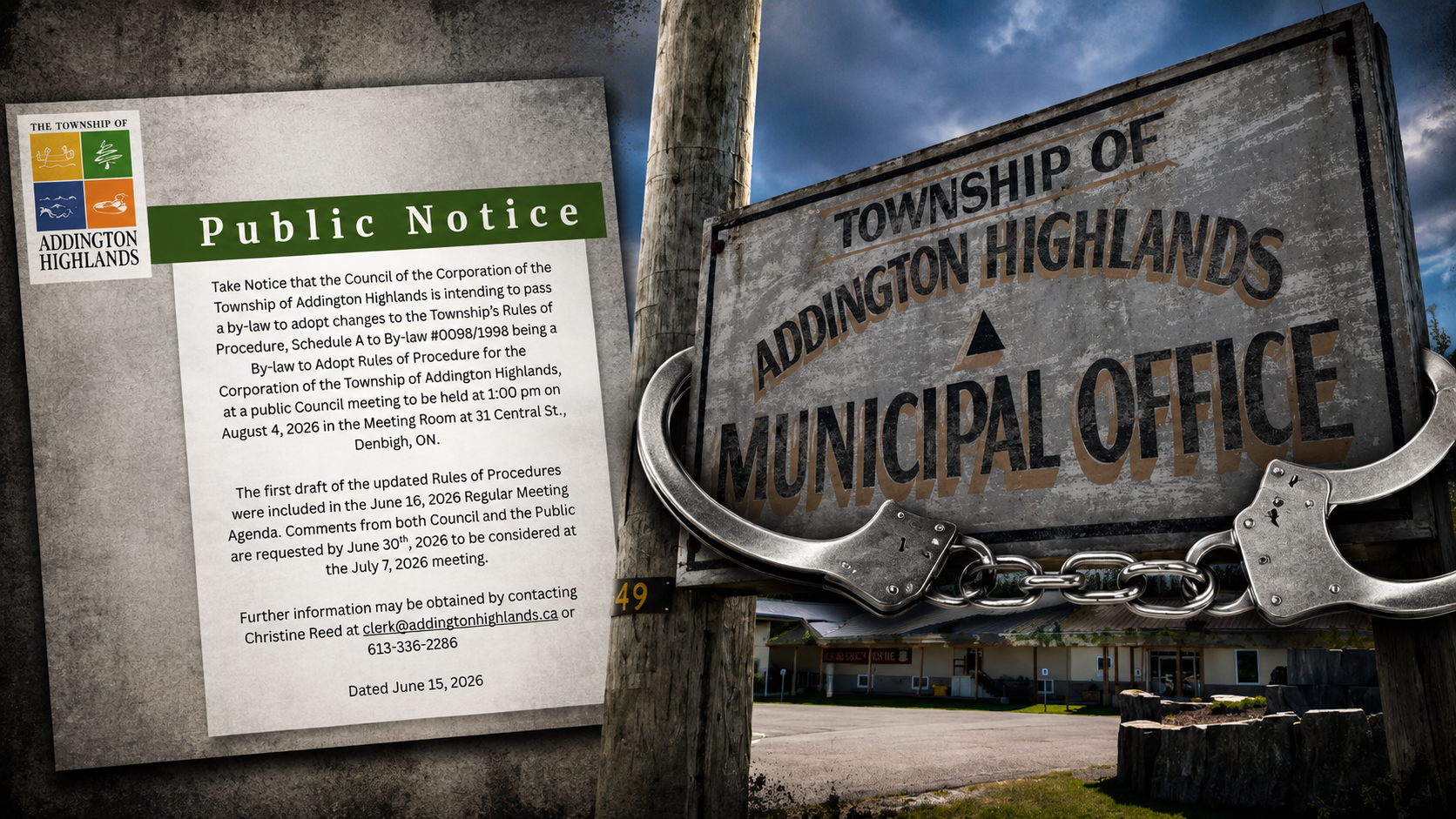
That warning, and a plan to make committee appointments behind closed doors, copy a public-participation rollback North Frontenac has already built. Public comment closes June 30.
Addington Highlands council wants its chair to read residents a warning, at the start of every public meeting, that they "may be subject to legal action" for what they say. That warning is one piece of a 56-page draft rulebook the township has opened for public comment, with a deadline of June 30.
The draft would replace rules that have governed council since 1998, and much of it is routine. But the parts that are not routine push in one direction: more control and power over constituents, less that the public can say at council, and less that it can watch. NFNM has spent the past year watching a council one township over do exactly the same thing, which is what turns a small township's draft rulebook into everyone's business.
Take the warning first, because residents will hear it out loud. Addington Highlands already opens its meetings with a recording notice. It livestreams on YouTube, and tells attendees that by being there they consent to being recorded. What the draft adds to that routine notice is a threat. The chair would read anyone present a warning, at the start of every meeting, that they "may be subject to legal action" for their comments, and a notice posted in the lobby would state flatly that "no protection is afforded to Councillors, Staff or the Public for comments made during Meetings which are subsequently challenged in a court of law." That is a heavy thing to tell a resident before they step up to a microphone, and it is not how the law works. What is said at a municipal council meeting carries a libel defence called qualified privilege. The Ontario Court of Appeal confirmed in Gutowski v. Clayton (2014) that a councillor's statements in council are protected by it, defeated only where a speaker acts out of malice. That defence, together with fair comment, is what shields good-faith speech on matters of public interest. A blanket notice that there is "no protection" at all is simply wrong, and it lands in the one room where residents are supposed to be free to question how they are governed.
Then there is what the public will not get to see. The draft has council appoint every non-elected volunteer to its committees and boards "in Closed Session," behind closed doors, even though picking citizen volunteers does not fit cleanly into the short list of reasons the Municipal Act lets a council shut the public out. Deciding who sits on the bodies that advise council on recreation, economic development and the rest is exactly the kind of decision residents have an interest in watching. Under this draft, they would be shown the result and not the choosing.
The over-controlling nature of the draft also reaches the livestream. Addington Highlands streams its meetings on YouTube, which for a township split between Flinton and Denbigh is how many people follow their council at all. The policy would let the Chair or the Clerk "direct the termination or interruption of live streaming" at any time, including when they decide the debate is "misleading" or "potentially inappropriate to be published." There is no definition of those words and no way for a resident to appeal the call. The meeting stays legally open, because the minutes remain the official record. What gets switched off is the public's ability to watch it happen, sacrificing transparency for optics, the behaviour of a coward.
Two smaller changes round out the picture. The draft routes "all news releases of a policy nature" through the Reeve, and it bars staff from speaking publicly about, or criticizing, any council decision. Together they leave one authorized voice on township policy and a public that learns less about how its decisions get made. There are multiple modern-day examples one can look at that take this style of authoritarian governance a step further. I do not need to name them here, but my forefathers fought for us to not have to experience this style of governance.
None of this is unique to Addington Highlands, and that is the part most troubling. North Frontenac is not even the template. This is a pattern being implemented across Canada. Where Addington Highlands' chair today reads only the recording notice, North Frontenac's chair, Gerry Lichty, already reads the next sentence too, the one Addington Highlands now wants to add. North Frontenac tells the room that by attending, "you are consenting to your image, voice and comments being recorded," and that members of the public "may be subject to legal action if their actions result in inappropriate" or "unacceptable" behaviour or comments. Addington Highlands is not breaking new ground. It is copying, almost to the word, a script the council next door already reads aloud.
North Frontenac went further than a warning. On April 10, 2026, Mayor Gerald Lichty moved By-law 2026-23, which rewrote the public-forum rules so that residents addressing council could make statements but could no longer ask questions. About two minutes after it passed, the new rule was applied to the first member of the public recognized under it, who happened to be the publisher of this outlet and a journalist on the live floor asking questions in the name of public interest reporting, an action protected under the Charter. Questions were out. Statements and comments only. North Frontenac and Lichty reversed their decision twice in the last year under NFNM's watch. NFNM will stand up for the people and will die on the hill of transparency. Test me.
It is not only North Frontenac. In South Frontenac, the shutdown has played out loud and on the record. At a June 10, 2025 council meeting over a furnace one neighbour called "a public nuisance," the Frontenac News reported, Mayor Ron Vandewal told one resident her five minutes were up, then refused to let another resident, Steve Leonard, speak at all, because Leonard had raised the matter at an earlier meeting. "You cannot speak. This meeting is cancelled," Vandewal said. Leonard is now a declared candidate for South Frontenac mayor, running on a promise of "open council meetings" and "private property rights." This is not an endorsement of Leonard, and any councillor, mayor, or candidate is welcome to contact NFNM's editor and have a conversation. Engaging with the media instead of just Facebook is worth its weight and a sign of a healthy candidate/elected official. North Frontenac and Lichty actively try to suppress NFNM's reporting and even punish the entire community over his beef and animosity towards reporters who do not strictly write positive good news. I am not your PR outlet. I work for the people and report for the public interest.
The same instinct runs straight through the comment box. Addington Highlands posted its public-comment notice on Facebook, asked for "comments from both Council and the Public," and then limited who can comment on the post. North Frontenac and its mayor went the whole way and blocked/banned NFNM and its publisher personally from the township Facebook page. Multiple councillors followed until NFNM sent a legal notice demanding that he/they/the township unblock Donald Morton and NFNM. We have on protected sources that Lichty acknowledged in writing that he had "unblocked Morton and NFNM but altered his account to prohibit comments" and said he had asked Facebook to remove his account, demonstrating a complete lack of education on how to even use Facebook. You do not send Facebook a message to delete your account. You just do it. Also, Facebook does not have a customer service number to reach or message, more lies from our mayor in NF. Even the area's representative at Queen's Park, Lanark-Frontenac-Kingston MPP John Jordan, runs a public Facebook page where, post after post, he has limited who can comment. From a township notice, to a mayor's page, to a sitting MPP, the answer to a public that wants to talk back is the same: turn the comments off and control who can see it and what they see.
If that reads like a pattern, it is one NFNM has been documenting in North Frontenac for over a year, in reporting on the question ban, on the mayor's conduct toward this outlet, and on a council that stopped answering NFNM's questions about its own transparency. Addington Highlands is where the same instinct now surfaces one township over, written into a draft by-law before the public has had its say. We have been saying for months that a rollback like this does not stay put. Here it is, not staying put.
Disclosure: this article is about Addington Highlands, but it leans on North Frontenac as the clearest documented case of the same pattern, and NFNM is not a neutral party to that case. NFNM's publisher, Donald Morton, is a self-declared candidate for Mayor of North Frontenac in the October 2026 election, is a member of the public, and an established journalist to whom North Frontenac's question ban was first applied, and is in an ongoing IC dispute with Mayor Lichty over access. Readers should weigh all of that. Everything stated above is drawn from public meetings, public records, and the officials' own written words.
If anyone named here believes a fact in this article is wrong, NFNM will hear it and publish a correction; if an official wishes to respond, we will run their reply in full as its own article. We will also update this story if the township revises the draft before the August vote. NFNM does not send out pre-publication right-of-reply letters, as it invites manipulation and corruption. I only offer response and correction opportunity.
Residents of Addington Highlands who want to be heard before council takes up the draft on July 7 can send comments to Clerk Christine Reed at [email protected] or 613-336-2286, by June 30. Council is scheduled to adopt the new rules at its meeting on August 4, at 1 p.m., in Denbigh.
Until then, it is still the public's turn to speak. SPEAK UP!
-NFNM