AI Is in Our Civic Conversation Now. Here Is How to Tell Honest Use from Laundered Authority. And a Notice from NFNM to the People Doing the Laundering.
A neighbor's guide to spotting AI in North Frontenac civic posts, why it matters in a township where two thousand neighbors actually cast ballots, and a standing notice from this newsroom.
By Donald Morton, NFNM
If you have been reading the various North Frontenac Facebook pages for the last six months the way I have, you have already seen some posts pop up here and there. The cadence is confident in a way that does not quite match how the person talks at the hall, or at the Dump, or sitting across the table in North of 7's Restaurant. Something is off.
What is off is that you are reading a chatbot. Not every post, and not every person is in question. I analyze civic figures. The general public's use of AI is a different conversation. Today's piece is the framework: what honest use looks like, what abuse by concealment looks like, what abuse by fear looks like when a politician asks for policy on a tool they have not learned, and what kind of journalism NFNM is going to do about it for as long as it keeps happening.
Honest use looks like disclosure, every time
The standard for responsible use is already being modeled by the people you would expect. The pattern is simple. If a tool wrote any meaningful part of what you are posting, you say so. You name the tool. You let your reader weigh the words against the source.
Ron Higgins, the page administrator of the North Frontenac 2026 Election Information Hub and a former North Frontenac Mayor, has done this in plain sight. When he wanted to lay out the campaigning rules for the pre-nomination period, he wrote, "I asked ChatGPT to explain the rules around campaigning pre-nomination. Here's what it said:" and posted the response. Three seconds of disclosure. Now everyone reading knows the framework came from a model and that any errors in it are the model's, not Ron's.
Abuse by concealment is what laundered authority looks like
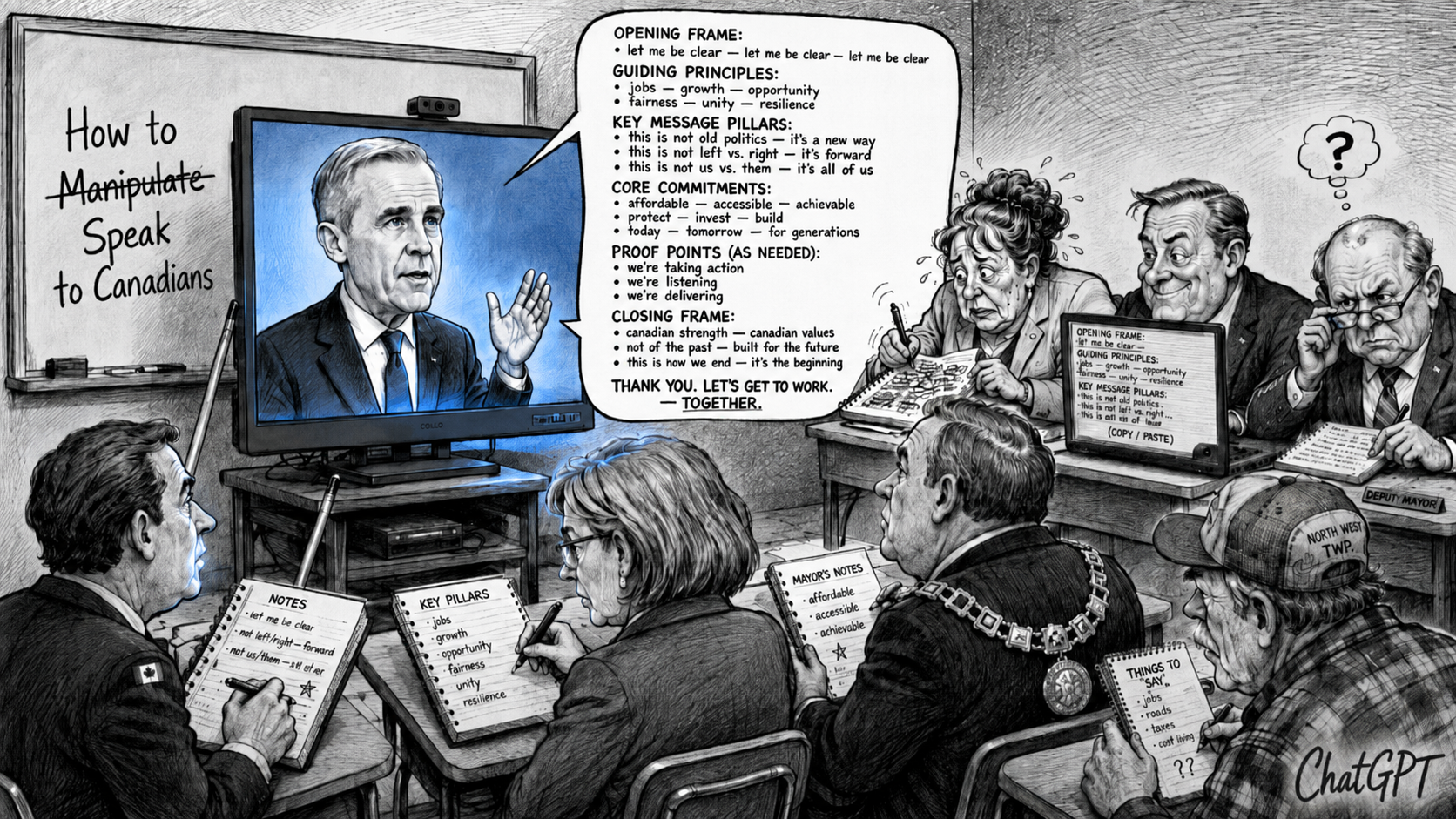
The first kind of abuse is laundering. The fingerprint is unmistakable once you have seen it. A long-winded post, with absolutely no formatting, unstructured paragraphs, dramatic "this is not 'x' it's 'y'" statements, all inside what is supposed to be a Facebook comment. The four-topic argument that takes a messy local question and slots it into a tidy quartet of sections. Anaphora is used extensively by people who have never even seen that word before.
Two more markers are worth naming because they are everywhere now and most readers do not yet have a name for them. The first is the em-dash — that long horizontal line that connects clauses where a comma or a period would do. Em-dashes show up in AI-generated prose at rates that would embarrass a copy editor, because they make text feel rhythmically polished. People typing on phones do not naturally reach for em-dashes; people in Facebook comment boxes reach for them even less. If a casual political post is full of them, you are probably reading a chatbot that generated the content faster than it takes you to read it.
The second is the rule of three. Three points. Three examples. Three sub-headings. Three sentences in a row that all start the same way. People use rule of three; rhetoricians have used it forever, and you will notice this article uses it in places too. The chatbot's tell is the frequency, applied so consistently across a poster's whole feed that the rhythm itself becomes the fingerprint.
If you want to see every marker named above appear in one performance, look at the Prime Minister's speech at the World Economic Forum. The cadence was not his. The structure was not his. The rule of three was the architecture of nearly every paragraph. Mark Carney himself struggled to read the words off the teleprompter, because the prose was not the rhythm of his voice, and the most damning AI tell of all is when the human delivering the speech cannot quite manage the model's sentences. This pattern is in the House of Commons too, all you have to do is watch an important topic being debated. MPs and ministers will stand and recite AI speeches and get standing ovations congratulating one another. And our local government is beginning to copy it. Once you have seen it at the top, you start to see it everywhere, including in our council comment threads and candidate public engagement.
None of these markers by itself proves a chatbot wrote a post. Together they form a fingerprint that is hard to fake and harder to deny.
The marker that matters most for civic accountability is manufactured regulatory authority. This is when a candidate posts a detailed breakdown of a complex municipal matter, formatted as personal civic analysis, with no source attribution to the by-law text, the staff who interpret it, the lawyer they consulted, or the chatbot they pasted the question into. Real people who actually know this material in our township, the clerks and the planners and the lawyers and the former mayors, do not write that way. They cite. They hedge. They say "I think this is right but check with the clerk." Manufactured authority skips all of that. The chatbot supplies the authority. The poster supplies the byline. The reader gets a stranger.
Then there is the third move, which is policy made out of fear of the thing
Fear. In our township the fear face has a name on it, and a council seat behind it, and the politician in question has been honest enough about his position that the honesty itself becomes the journalism.
On April 10, 2026, during the social-media review item on the Regular Council agenda, Deputy Mayor Roy Huetl asked from his seat whether North Frontenac has a policy for AI use. He said more municipalities are creating policies and that it is something we need. CAO Klatt replied that the County of Frontenac is looking into it and that North Frontenac will follow. The exchange was brief. The room moved on. I did not move on.
I sent Deputy Mayor Huetl four follow-up questions the next morning. This is his reply in his own words:
First off, I just want to state that I am not an expert in the field of AI, but I am interested to learn more. The question I raised in Council regarding an AI policy was prompted by recent conversations with various constituents. In the meeting, when discussing the social media sites, I thought it was an appropriate time to ask the question. To date, I have only searched for information related to my previous workplace - York Region. However, I noticed that a general search also shows many municipalities in the province have AI policies in place. Since the County of Frontenac is already in the process of developing a policy, I believe we could use their research and design in the formation of one for North Frontenac.
Read what is in that reply. A sitting deputy mayor, asked to defend his call for policy on a tool, says he is not an expert in the tool. The push did not come from his understanding of it. It came from constituent conversations and a general impression that other municipalities have something. The plan is to copy the County's policy when the County finishes drafting it. Deputy Mayor Huetl is being honest, on the record, with attribution, and that honesty is to his credit. It is also a textbook portrait of the third move. Not malice. Not laundering. Fear. A disease this council has suffered from for four years.
The appropriate response to a tool you do not yet understand is not a policy. It is reading. It is talking to the people who use it. It is criticism, where criticism is warranted, and guidance, where guidance helps. Policy is the move you make when you have skipped all of those steps and gone straight to control. When the politician who has not used the tool well asks for the tool to be governed, the result is constraint on the people who do use it well, written by the people who do not.
Why this matters here, more than almost anywhere
North Frontenac is a township of 6,195 registered voters, year-round residents plus the non-resident property-owners who under provincial law also have a vote in the place where they own land. Of those 6,195, only 2,107 actually cast ballots in 2022, a turnout of 34 percent. The people running for council are not running on platforms drafted by communications firms. Voters here decide based on whether they trust the person, on whether the candidate sounds like themselves at the meeting and on the page and on the phone when you call them. Authentic voice is part of the actual qualification for the job. A bad municipal vote sends one of seven councillors to a room where, on a five-to-two split, they personally hold one of the votes that decides what happens to your township. We cannot afford to elect a chatbot's voice and a person's judgment, because the person is the one who shows up.
About this newsroom
The difference between how I use AI and how someone uses a chatbot to answer a question comes down to who is doing the thinking. When I use AI in our workflow, I am the principal. I set the angle, I give the research direction, I demand sources, I edit every draft, and I sign off on what goes out under my name. The AI is the assistant.
NFNM is a system of tools and specialist agents built around the work of journalism. Between them, those agents hold roughly 1.6 million files in working memory: council minutes, agendas, by-laws, council recordings, meeting transcripts, FOI responses, government datasets, intake records, and email correspondence going back to the beginning of this beat. The job of the system is to find, sort, cross-reference, and surface source material so I can do the analysis and write the piece. When the voter-turnout number earlier in this piece needed grounding, the system pulled the Ontario Ministry of Municipal Affairs and Housing's published 2022 dataset and put it in front of me with the citation attached. I read it. I quoted it. I attributed it. The AI did not invent the figure. It found it and brought it to me to verify.
That is what assembling information looks like, and it is different from generating information from nothing. When someone pastes a question into ChatGPT and posts the answer to Facebook, the chatbot is generating text from pattern. The chatbot does the thinking, the structuring, and the wording. The user provides the prompt and the byline. The disclosure is what tells you which side of that line a given post sits on. Ron's three seconds of "I asked ChatGPT" is the standard.
There is more than one person in our local civic spaces using AI to manufacture authority without disclosure. Today is the framework. Next Monday's piece is the case study.
If you are one of those people, the simplest fix is the cheapest. Add a line at the top of your post that says what tool you used. Then write the rest in your own voice, the way you talk to a neighbor about something local you actually care about. That is the voice your neighbors are asking to hear from you. The disclosure is the price of admission. The voice is what makes the conversation worth having and i promise you that it will be a healthier and more fruitful process for you and your research and learning patterns. AI assistance to help critical thinking is ok, AI replacement for critical thinking is not.