Donald Morton is a North Frontenac mayoral candidate for the 2026 municipal election and the publisher of NFNM. This piece carries that disclosure at the top, on purpose.
North Frontenac's Dark-Sky Preserve designation asks the township to do a short list of specific things. The township is to light its own buildings, streetlights, and parks so they aim at the ground instead of the sky, and to teach the public why the dark is worth keeping. Of a private homeowner it asks nothing. A resident can floodlight a backyard rink all winter and break no rule, because the designation was never built to reach onto private land.
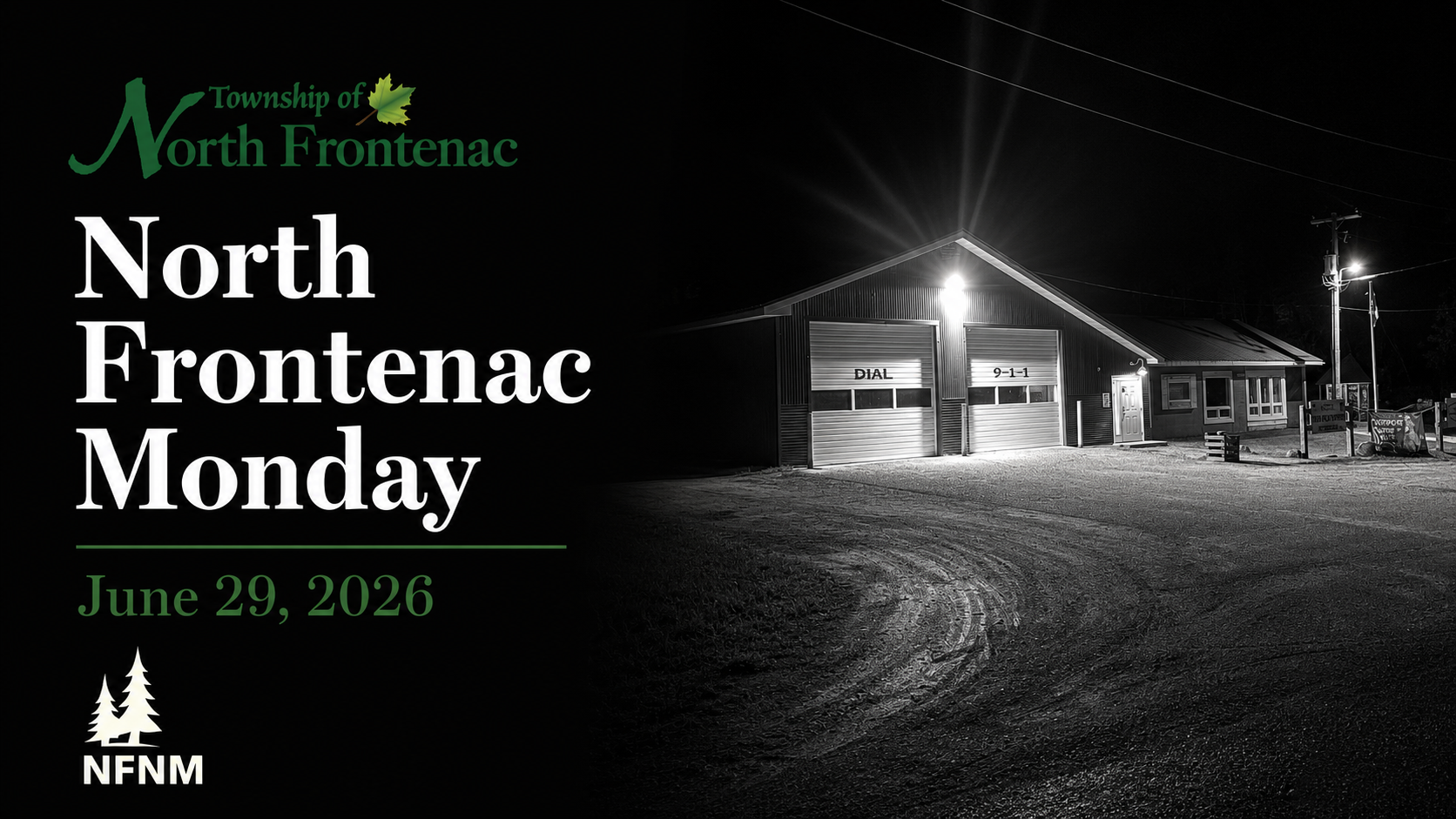
That distinction is the whole of the thing, and it is the part most easily lost. On a clear night at the Ompah fire hall, the building outshines the sky above it. A wall-pack floodlight throws hard glare up and outward off the bay doors marked DIAL 9-1-1. These are township fixtures, on township property, in the township that bills itself as Canada's first dark-sky municipality. The designation's one real test is whether North Frontenac lights its own house to the standard it sells, and on the evidence the township has work to do before it asks anything of anyone else.
North Frontenac earned the designation by promising to light its own property responsibly and to teach residents why dark skies matter. The promise was never a licence to police what a homeowner does on private land. The gap between those two ideas is where this story sits, and it matters to anyone in Plevna, Ompah, or Snow Road who has been told, or who worries they soon will be told, that a dark-sky town can dictate the lights on their own porch. It cannot, and the record from the astronomers who grant the title says so plainly.
What the designation actually is
The Royal Astronomical Society of Canada designated North Frontenac a Dark-Sky Preserve on June 28, 2013. By the society's own count, the township was the 16th Dark-Sky Preserve in Canada and the first municipality the society had ever designated. That "first municipality" detail carries weight, because it marks the kind of commitment a town takes on when it accepts the title. A preserve inside a provincial park commits a parks department. A preserve that covers a whole township commits a council, a public works crew, and a budget.
The public face of it sits just southwest of Plevna. The North Frontenac Astronomy Park, at 5816 Road 506, gives residents and visitors a dark place to look up, anchored by the 16-inch Fred Lossing Telescope. It is the kind of asset a small rural township rarely gets to claim, and on a clear, moonless night it draws people who would otherwise have no reason to point a car toward Plevna after dark. Anyone who has stood there and watched the Milky Way come up over the treeline understands, without a lecture, what the township is protecting.
A RASC designation is not a vague pledge, and the society spells out what it requires. In its Canadian Guidelines for Outdoor Lighting, the standard lists what a preserve commits a community to: limited use of artificial light at night, visitor facilities and night access for stargazing, measures that limit artificial sky glow, astronomy and stargazing outreach, and the promotion of light-pollution abatement (RASC Canadian Guidelines for Outdoor Lighting, 2020, Appendix M). Every item on that list describes something the community installs, operates, or teaches. None of them describes inspecting a neighbour's porch light.
The scope is written into the guidelines themselves. The standard governs lighting within the preserve and the lighting the preserve manager controls, in the society's words: "There shall be no installed artificial light within a Preserve. However if the manager deems it necessary, artificial lighting will conform to these guidelines" (Section 1.0). The same document says its appendices "will also be useful to municipal officials who are tasked with reducing the ecological impact of urban infrastructure." Municipal infrastructure means streetlights, parks, parking lots, and public buildings. That is where the designation lives, and it is the only place it was ever designed to reach.
Why the dark is worth keeping
The case for darkness is biological before it is anything else, and it has nothing to do with anyone's taste for constellations. The harm shows up first in the creatures that live and move at night.
Most songbirds migrate after dark, orienting by the stars and the line of the horizon, and artificial light pulls them off course. Lit structures draw migrating birds in, disorient them, and wear them out, and the result is collisions. A 2013 study in the journal Avian Conservation and Ecology estimated that roughly 25 million birds die each year in Canada from collisions with windows and buildings (Machtans et al., 2013). Lighting is one driver among several, and it happens to be the one a community can change at almost no cost.
The same pattern runs through the rest of the night. A large share of insects, including many pollinators, are active at dusk, overnight, and at dawn, and lit nights interfere with how they feed, breed, and pollinate (DarkSky International). The science on human sleep is no longer a fringe worry either: bright, blue-heavy light at night disrupts the circadian rhythms of the people living under it.
That last point lands harder in North Frontenac than in almost any community in the province. This is an old township in the literal sense: no Ontario municipality with more than 1,000 residents has an older population than North Frontenac does, where the median age was 61.6 in the 2021 census. A place with that many older residents is a place full of people for whom steady sleep is not a small thing, and for whom a dark, quiet night is part of why they chose to live here or to stay. For them the designation is concrete, the reason a bedroom window faces a black sky instead of a streetlight's glare.
None of this asks a community to live in the dark. What it asks for is light aimed down, shielded so it does not spray sideways or up, no brighter than the task in front of it, and warmer in colour. The RASC guidelines and DarkSky International agree on those basics, and the RASC standard sets them out in its own Section 4 (RASC Canadian Guidelines for Outdoor Lighting, 2020, Section 4; DarkSky International). A well-lit driveway and a dark sky sit comfortably together. A bare lamp glaring off a wall does not.
The township does not light its own house to the standard it sells
The designation's promise gets tested on township property, and that is where North Frontenac is falling short. NFNM holds night photographs, taken and attested by this writer, of municipal fixtures in Ompah that do not match the design the township brands itself on. The photographs are documented examples, not a full audit, and they are described here as exactly that.
The clearest of them shows the Ompah fire hall, a municipal emergency-services building, lit at night by an unshielded wall-pack floodlight that glares up and outward rather than down onto the ground it is meant to cover. Two others show municipal streetlights on rural Ompah roads, each throwing a hard glare and a visible starburst, the light spilling sideways onto grass and treeline instead of pooling where it is needed. The photographs were taken at night and the location is attested as Ompah. They carry no embedded capture time, and NFNM makes no claim about how bright the fixtures measure, nor that these three are the only such fixtures in the township. NFNM intends to document the township's other settlement areas, Plevna among them, and will report what the record shows when that work is done.
What turns three photographs into an accountability matter is the scope of the designation itself. The RASC standard puts the obligation on municipal lighting and public education, the very places the township controls. The one place North Frontenac can actually keep its promise is its own property: the buildings, streetlights, parks, and lots it owns. That is where authority and responsibility sit together. Policing a neighbour's yard was never the township's job. Its own lighting was, and a township that markets the designation while its own fixtures spray the night sky is failing at the part of the deal that genuinely belonged to it.
The fix is not costly relative to what the township already spends on lighting. Shielded fixtures aimed down, at a warmer colour, do the same safety job while they stop throwing light and money upward. The question worth putting to council and staff is plain: when a municipal fixture is replaced or installed, does North Frontenac specify dark-sky-compliant design, and if it does not, why is a dark-sky township buying lights that work against its own designation?
Engagement is part of asking for the job
There is a related accountability matter in this election year, and it has nothing to do with light fixtures. It has to do with how a small township fills the seats that decide everything else, lighting included.
The North Frontenac 2026 Municipal Election Information Hub, a page former Mayor Ron Higgins created to share election information ahead of the October 26, 2026 vote, has invited candidates and residents into the conversation. That is the kind of open civic space a healthy local election needs.
On the public record, only a handful of candidates actually engage with local media and public discussion. Rob Lesperance and Art Hannigan are among the candidates who show up for it, and in fairness and full disclosure, so is the author of this article, Donald Morton, who is running for mayor and publishes NFNM. The point is not to single anyone out. Voters are entitled to expect engagement from every candidate, the author included. A public forum invited everyone, and showing up to answer questions, defend a position, and take the hard ones is part of asking for the job. No candidate, incumbent or challenger, should rest on a name and skip the part where the public gets to push back.
What the designation is not
The boundary set at the top of this piece has documents behind it, and they are worth laying out, because the surest way to kill public support for a dark-sky preserve is to turn it into a complaint form. When "too much light" comes to mean whatever any given complaint says it means, the designation stops protecting the sky and becomes a lever to use against a neighbour. In a township this sparsely settled, with very little bylaw enforcement to begin with, a subjective standard protects nothing. It creates a new way to lean on a private citizen who broke no rule.
RASC built the warning into its own document. The Canadian Guidelines for Outdoor Lighting carry a plain disclaimer in Section 5.0: "no warranty is either expressed, implied, or made as to the conclusions, advice and recommendations offered in this document," and "This document does not provide a legal opinion regarding compliance with applicable laws" (RASC Canadian Guidelines for Outdoor Lighting, 2020, Section 5.0). The astronomers who wrote the standard put it in writing that the standard is professional advice, not law. So the question council should answer before anyone drafts an enforceable lighting bylaw is the obvious one: should the township be fining residents to enforce a guideline whose own authors say it carries no warranty and could change tomorrow?
And if a light genuinely shines into a resident's bedroom, the question is whether that is a township enforcement job at all, or the kind of private dispute between neighbours that the courts have long handled on their own. Those are the questions worth asking out loud before any complaint-driven enforcement mechanism gets built, rather than after it is already in place.
What the township should do instead
The honest response to the gap is to lead with the designation. Backing away from it would throw away a real asset over a problem the township can fix on its own property.
The work starts where the township's authority is. It can repair the municipal fixtures, specify dark-sky-compliant design on every replacement, and put real signage at the Astronomy Park and along the way in. It can hand the lighting guidance to every applicant who pulls a building permit, so a resident putting up a garage learns how to light it well at the moment the decision is being made, long before a neighbour has any cause to complain. That is education at the point of action, and it costs almost nothing.
From there the designation should travel outward, because that is where its value compounds. Most of the light that washes out a rural sky does not start on rural land. It drifts in from larger, brighter places down the road. A dark-sky municipality that presents to its neighbouring councils, and that carries its astronomy story into classrooms, does two useful things at once. It addresses light pollution closer to where it actually begins, and it markets North Frontenac as a place worth visiting and worth living in. Outreach that protects the sky while it sells the township is the rare program that pays for itself twice.
The reality check
A community cannot live on dark sky alone. North Frontenac needs business, jobs, and young families more than it needs a perfect score on any environmental ledger, and an honest case for the designation holds those two truths together instead of setting one against the other. The designation earns its keep when it draws visitors, anchors a tourism pitch, and gives the township a story no neighbour can copy. It becomes a liability the moment a handful of people try to turn it into a weapon, because that is the version that splits a small place and drives people away from a thing that should pull them together.
So this is a promise about coverage rather than a prediction about council. NFNM will keep watching the township's own fixtures and asking what gets specified when a municipal light is replaced, and it will hold the line between the part of the deal the township owes the public and the part nobody owes a neighbour. The sky over Plevna is worth protecting. Protecting it means the township lighting its own property to the standard it advertises and teaching the rest, with no complaint form anywhere in the plan.