A four-lot Sand Lake severance came back before North Frontenac's planning committee, and a neighbour found out by accident.
Jason Tooley owns property on Sand Lake, and on the afternoon of April 27 he told North Frontenac's Committee of Adjustment that he only knew a plan to split a nearby waterfront parcel into four lots was back before them because he happened to be on the township website. He "did not receive notification of the meeting today," the minutes record him saying, "and found out because he just happened to be on the Township website." He added "that there has not been enough time to prepare."
He was not wrong about the notice, and the township was not wrong to skip it. That is the part worth slowing down on. A plan first heard nearly two years earlier had returned to a three-member committee that meets at 1 p.m. on a Monday, and under the rules that govern severance applications in Ontario, nobody was required to mail Tooley a fresh notice. The proposal had not substantially changed, so the obligation that had attached when the file was new in 2024 did not attach again when it came back in 2026. What that minimum produced was a directly affected neighbour learning by chance about a decision on the lake he lives on. The committee that heard him is the quiet venue where North Frontenac's shoreline and land-use rules are applied or set aside, and it draws almost no public attention until a file like this one surfaces.
What was on the table
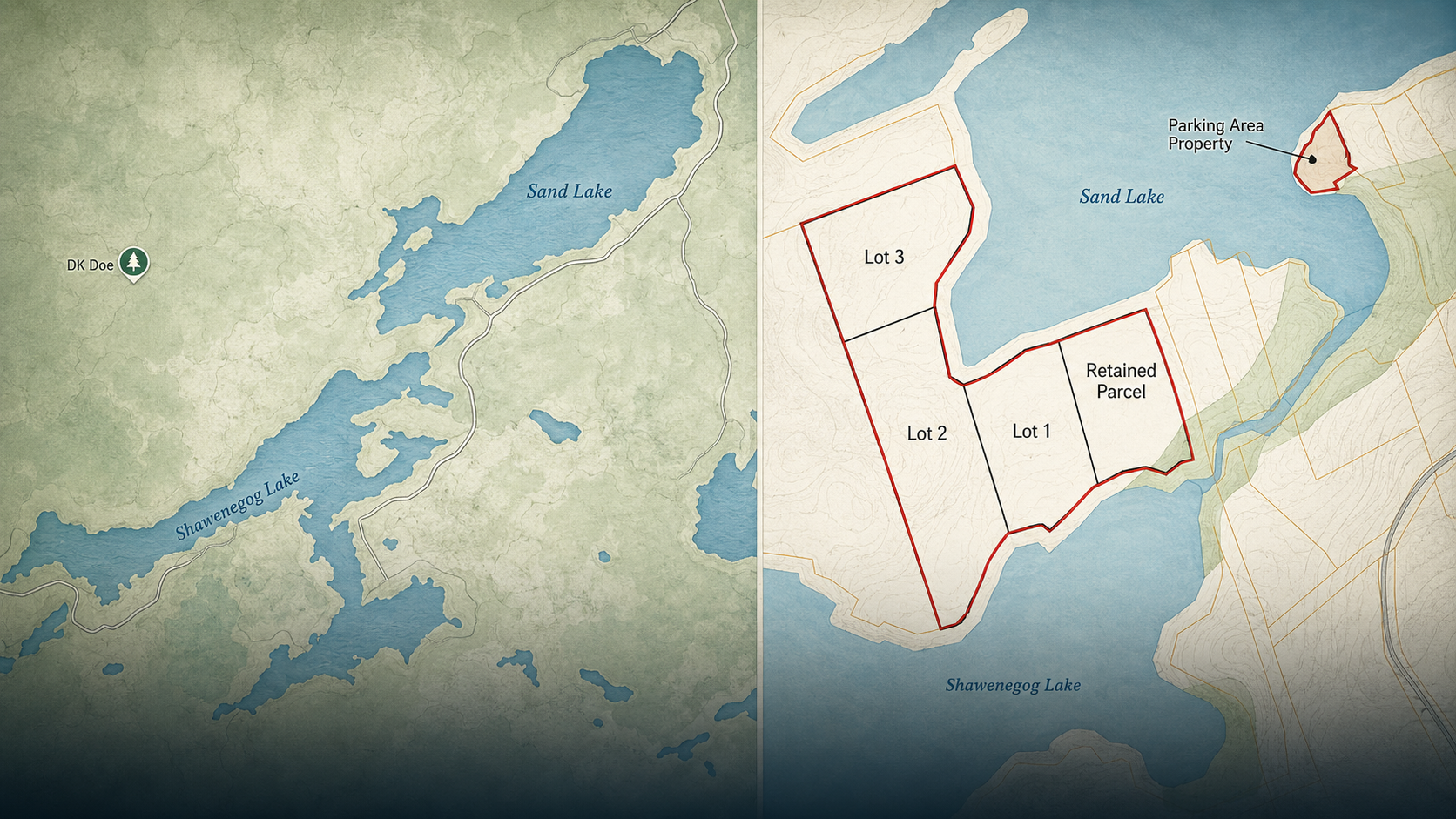
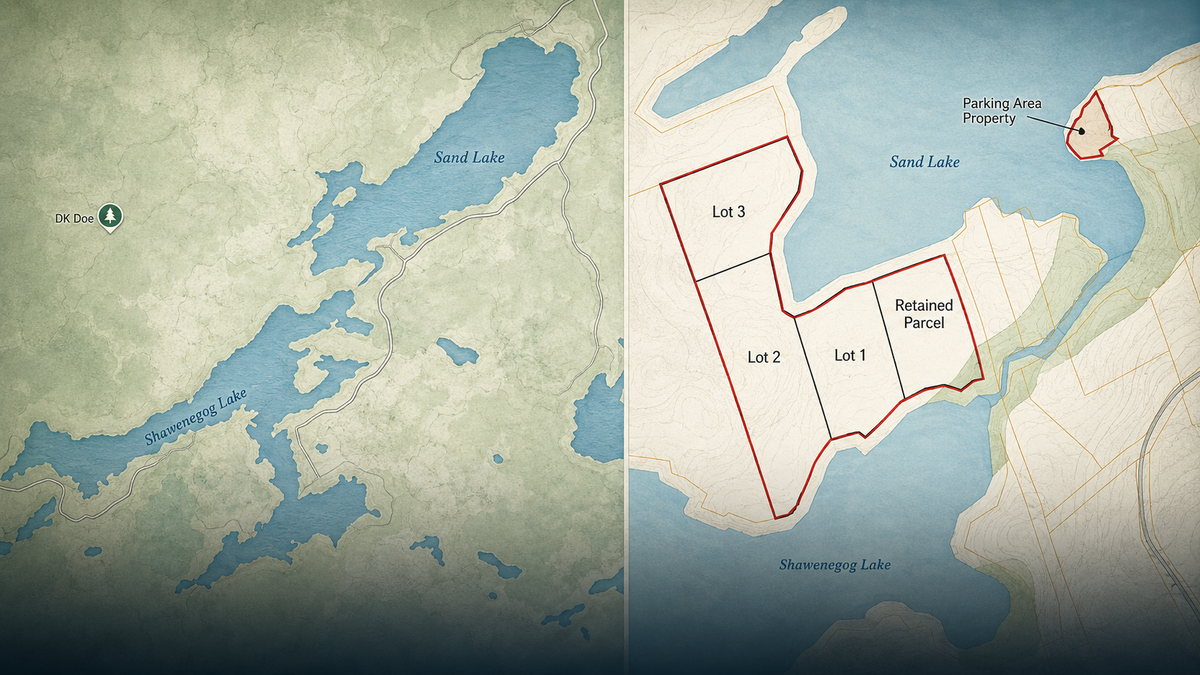
The applicant of record is Gaylord Family Properties Inc. Lewis Gaylord and Rosemary Gaylord appeared in person. The plan, carried on the agenda under its 2024 resolution number, would divide a peninsula between Sand Lake and Shawenegog Lake into three new water-access residential lots plus a retained parcel, each reachable only by boat. According to the County planning report, the parent property runs to about 11.29 hectares with 561 metres of Sand Lake frontage and 434 metres on Shawenegog Lake.
The new lots would be large. The minutes record proposed Lot 1 at roughly 2.12 hectares with 129 metres of frontage on both lakes, Lot 2 at about 4.0 hectares, and Lot 3 at about 2.8 hectares with 213 metres on Sand Lake. A separate application, B05/24, would create an easement on the mainland at 1628C Beach Road for a parking area of eight spaces, two for each new lot and the retained parcel, plus a central turn-around, giving the water-access lots their deeded route in. Lewis Gaylord told the committee he has no plans for future development on the mainland, that the existing structure there will be used for storage and occasional residential use, and that he "would like to have a spot for each of his children and grandchildren to use in the future."
The committee did not approve the four lots. It deferred them, for the second time, and that distinction matters. What it did approve the same afternoon was a smaller request tied to the same family: permission to add covered, unenclosed porches to a 64.1-square-metre building on the mainland that sits 21.6 metres from the high-water mark, inside the 30-metre shoreline setback the zoning by-law normally requires. That approval, Resolution 9-26, was the only Gaylord decision made on April 27. The lot creation was held over to August 24.
The committee, and who drives it
The Committee of Adjustment is three people. Garry Wood chaired the April meeting, with Jim Ogilvie as member and Brent Smith sitting in as the alternate; Smith took part in the day's votes, seconding the resolutions that deferred the lots and approved the porches. The committee's planning analysis is done by the County of Frontenac, not the township. Community Planner Jennie Kapusta authored the Gaylord report and recommended approval of the consents on their merits, subject to standard conditions and an added one requiring that natural drainage not be altered to push run-off toward the wetland or Sand Lake. The committee is where waterfront lots get created, where setbacks get relaxed, and where the township's shoreline policy meets an actual property line. It is also where, on a typical Monday, the public gallery is close to empty.
That is the structural point Tooley's complaint exposes. The decisions are consequential and the audience is thin, and the notice rules are built to a floor rather than a ceiling.
The notice question
Secretary/Treasurer Brooke Drechsler set out the township's position on the record. The 2024 public meeting had notice "as per the requirements of the Planning Act," she said, and "a second public meeting is not required unless there are substantial changes to the application; and additional notice of the matter being brought back to the Committee is not required." Property owners who had provided their contact information and asked to be notified were told; others were not.
NFNM checked that statement against the regulation that governs consent applications, O. Reg. 197/96 under the Planning Act. The reading holds up. The prescribed duty to mail notice to every owner within 60 metres attaches to the application itself and to later changes in its conditions, not to a deferral or a return date on a file that has not substantially changed. Drechsler's account of the legal minimum is accurate.
The committee's own response is the telling part. In deferring, it directed the Secretary to "provide Public Notice of the application a minimum of 14 days prior to the meeting" for August 24, and Chair Wood "requested staff look into the process of notification." A committee that was satisfied the practice was fine would not have asked staff to look into it. The same structural pressure shows up on the committee's own paperwork: the appeal-information notice attached to its meetings warns that a person who does not make written submissions before a decision may have an appeal to the Ontario Land Tribunal dismissed. The legal minimum on notice and the rule that can foreclose a later appeal work in the same direction. Together they can shut out a neighbour who did not happen to check the website on the right week.
No rules for the road
The safety worry that drove the deferral was the access. The water-access lots reach the mainland through a steep private driveway and the proposed parking easement, and that grade is where the planning case ran into a gap. County Senior Planner Dmitry Kurylovich told the committee the township "does not have a policy on the allowable steepness or the width of a shared private driveway," and that the Official Plan offers only guidance on slopes on private lanes. There is no township standard to measure the driveway against.
Wood, who had walked the site, said the mainland topography is steep and raised concern about emergency vehicles reaching the area, noting that "turning around is difficult even for a vehicle without a boat and trailer." Ogilvie asked whether any regulation governed the height or angle of a driveway and raised the risk of washout where water runs along a stretch of road, which Gaylord said is his private driveway rather than Beach Road itself. Against that, Kapusta noted the Fire Chief and Public Works Manager had visited the site and confirmed it accessible and safe for emergency vehicles. The committee was not satisfied enough to decide. Its deferral, Resolution 8-26, requires the applicant to bring back a report from a qualified engineer on the construction standards of the right-of-way, "specifically the degree of the grade of the driveway, and the safety standards for the proposed use." That is the committee exercising diligence rather than waving the file through.
A neighbour pressed the same ground from outside the committee. Tooley said the township "has not done their due diligence in determining the potential for hazards, including the rock shoal, docking area and navigation," concerns he said he had first raised in person at the 2024 hearing. Those are his stated objections, not findings NFNM has confirmed, and the navigation point in particular rests on his own account of the lake bottom.
A recusal the record does not explain
There is one thing the minutes do not say, in either year, and it is a fair question to put to the township. When the Gaylord matter came up on April 27, the minutes note that committee member Carl Tooley "declared a Pecuniary Interest in Item 7a under Business Arising" and that he "left the meeting at this time due to a pecuniary interest." The same thing happened in May 2024, when he declared a pecuniary interest in the Gaylord items and stepped out while Wood chaired in his place. In both sets of minutes the declaration is recorded and the reason is not.
The Municipal Conflict of Interest Act, which applies to a committee of adjustment, requires more than that a member step out. Under the Act, a member with a pecuniary interest must disclose the interest "and the general nature thereof" before the matter is considered, and the clerk or secretary must record that general nature in the minutes of an open meeting. The North Frontenac minutes record the declaration in both years but do not record a general nature. The Act contemplates that the general nature is disclosed and recorded, and the minutes as written do not show it. NFNM is not in a position to say what the interest was, and nothing in the record establishes any connection between committee member Carl Tooley and the objecting neighbour Jason Tooley beyond a shared surname, which is not evidence of one. NFNM raises no suggestion that the two are related, or that the declared interest was improper. Declaring a pecuniary interest and leaving the room is itself what the Act asks of a member. The open questions are for the Clerk: whether a general nature was stated and simply not minuted or recorded elsewhere, whether a written statement is on file in the township's conflict-of-interest registry, and why the general nature does not appear in the minutes the way the Act contemplates.
Four lots, and a lake the township is studying
Step back from the driveway and the notice, and the cumulative picture is the one that should hold a Sand Lake resident's attention. The proposal would put three new residential building lots on a lake where the planning report notes the new lots are larger than many existing developed lots, with one dock permitted per property under the zoning by-law and the existing mainland dock already larger than current rules allow as a legal non-conforming structure. The Official Plan describes the 30-metre setback the porch approval reaches into as a vegetative buffer meant to maintain aquatic habitat, filter run-off, and reduce the visual weight of development on the shoreline.
The same township runs an Environmental Task Force with a working item on the carrying capacity of its lakes. One arm of North Frontenac studies how much its lakes can absorb while another, through a 1 p.m. committee, weighs whether to add four building lots and waive a shoreline setback. That is not a contradiction the township has hidden; it is simply where policy and a property line meet, and the meeting place is the Committee of Adjustment.
The Gaylord files return on August 24, with the engineer's report due and, this time, 14 days of public notice ordered. Whether anyone beyond the people who already asked to be told shows up to watch is the question the spring left open.