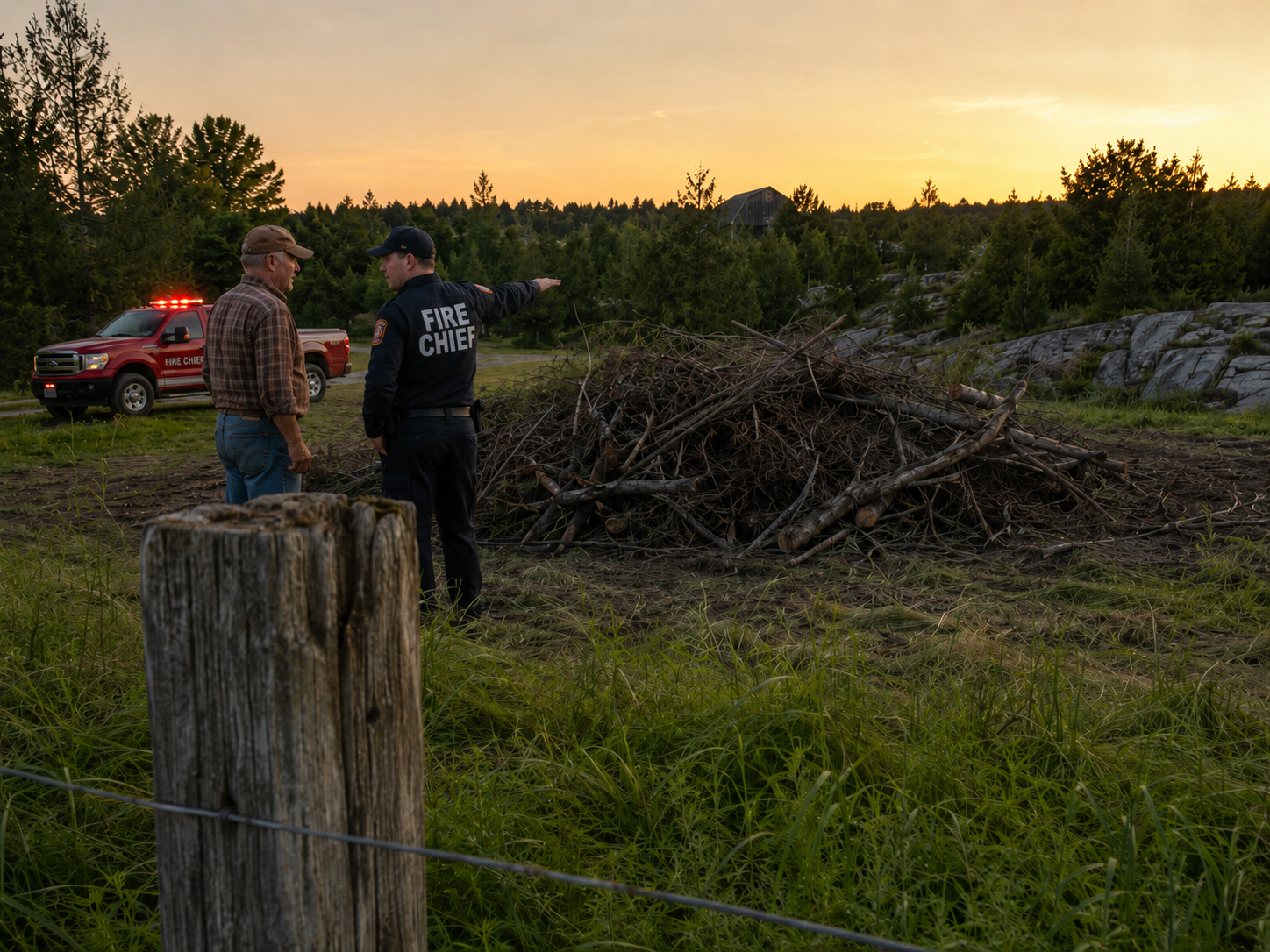
A South Frontenac farmer who wants to burn a brush pile this summer can no longer just light it and call the fire department afterward. Under the new Open Air Fires by-law council passed on May 5, the farmer first has to get South Frontenac Fire and Rescue out to the property to inspect and approve the location. The fire then has to sit at least 90 metres from any building, fence, hedge, overhead wire, tree or lot line, and the pile cannot exceed six metres in any dimension. Burning can only happen between 7:01 p.m. and 6:59 a.m. Two phone calls to (613) 376-3027 are required, one before lighting and one after the fire is out.
Those new rules, set out in Schedule A of by-law 2026-27, are the biggest change in a package of three by-laws council gave all three readings on May 5. It replaces a set of rules in force for more than a decade under which farmers doing the same kind of burn had to do little more than tell the Fire Chief where and when. The May 5 vote also closed a month-long detour: on April 7, council gave first and second reading to an earlier version of the package built around a universal burn permit that would have required every resident to apply before lighting any fire. That proposal was deferred, the by-law numbers reassigned to other items two weeks later, and a revised package brought back on May 5 with the universal permit dropped. The public record sets out the timeline plainly. It does not explain the rewrite.
The April-to-May walk-back did not land evenly. Council pulled back from the universal permit and left backyard fires permit-free, while the by-law it passed for farms sets out a heavier set of conditions than the 2012 rules it replaces.
What backyard fires need
There is no permit requirement to light a backyard recreational fire, run a chiminea or outdoor fireplace, or fire up a propane appliance, smoker, barbecue or charcoal grill. Section 5.1 of by-law 2026-27 exempts those appliances entirely, and the section governing ordinary backyard fires never mentions a permit at all.
What the by-law does require for a backyard fire is five conditions. The fire has to sit in non-combustible metal, masonry, ceramic or stone, or in a pit no larger than 90 centimetres in any dimension. The material burned has to be clean dry wood, in a single pile no bigger than 90 centimetres. The fire must sit at least five metres from any building, fence, tree, overhead wire or lot line. An adult has to be present and in control. There has to be a means of putting it out. An outdoor incinerator is the one piece of backyard infrastructure that still needs sign-off: section 6.9 requires written approval from the Fire Chief before any incinerator burn.
The by-law also defines four prohibited conditions that ban any open-air fire regardless of permit status: wind speeds above 25 km/h as measured by Environment and Climate Change Canada, an active smog alert, drought or dry conditions that increase the risk of a fire escaping, and any period when fire response is unavailable because of a staffing shortage, staff fatigue or out-of-service equipment. The Fire Chief can also declare a Level 1 Burn Ban or Total Fire Ban "at any time" under section 2.2, posted on the township website.
What farm burns need now
By-law 2012-68, which 2026-27 replaces, had no general category for farm burns. The closest thing was its definition of a "smudge," which it described as "a controlled and closely supervised Open Air Fire that is set for the purposes of protecting crops from frost or for relieving distress from biting insects in livestock." For a smudge, the only requirement was to notify the Fire Chief "of the date, location, and other details" and to comply with any conditions "the Fire Chief in his or her sole discretion" might impose. Approved Brush Pile Fires, defined as having a maximum fuel volume of three metres by three metres, needed Fire Department permission but no inspection. The 2012 by-law restricted Open Air Fires to daylight hours, sunrise to sunset, throughout the April-to-October fire season, and to daylight hours outside it.
By-law 2026-27 creates a new defined category, "Agricultural Fire," covering open-air burning of "wood, tree limbs and branches related to a Farming Business" that exceeds the limits for an ordinary brush fire. Schedule A, section 2 sets eight conditions on every agricultural fire:
- South Frontenac Fire and Rescue must inspect and approve the location
- A phone call to (613) 376-3027 is required before the fire is set
- A second phone call to the same number is required after the fire is concluded
- The fire must sit at least 90 metres from any building, hedge, fence, overhead wire, tree, lot line or other combustible material, or further if the Fire Chief specifies
- The material burned cannot exceed six metres in height, width or length
- Burning is restricted to 7:01 p.m. to 6:59 a.m. unless the Fire Chief authorizes otherwise
- A means of extinguishing the fire must be immediately available
- An adult must be present and in control at all times
The brush fire category that applies to non-agricultural burns is also night-only, with a 30-metre setback and a three-metre material cap.
A second gap sits in the definitions. The 2012 by-law gave smudging a defined, lightly conditioned channel for two specific agricultural uses, frost protection on crops and relief of biting-insect distress in livestock. A smudge in that definition is a smouldering fire, not a wood pile. By-law 2026-27 does not carry that category forward. Its "Agricultural Fire" definition is limited to "wood, tree limbs and branches related to a Farming Business," and any open-air fire that does not fit a permitted category in 2026-27 is prohibited. A farmer who lit a smudge for frost or pest control under the old by-law had a regulated route to do so. Under the new by-law, that same fire may not fit any defined category at all.
What the penalties look like
The penalty schedule attached to by-law 2026-27 reaches well beyond the 2012 by-law it replaces. Section 11.2 sets the maximum fine for a first offence at $5,000 per day. Section 11.3 sets the maximum for a second or subsequent offence at $10,000 per day. Both sections add that "the total of all daily fines imposed for the continuing offence may exceed $100,000." The 2012 by-law relied on the default Provincial Offences Act framework with no daily-multiplier language.
By-law 2026-28 layers a parallel Administrative Monetary Penalty system on top of the offence schedule, with set fines of $250 for most contraventions, $500 for obstructing an officer, and $1,000 for setting an open-air fire during a Level 1 Burn Ban or Total Fire Ban. Under section 11.6 of by-law 2026-27, an unpaid AMP that is still outstanding 15 days after it falls due may be added by the Treasurer to the property tax roll and collected the same way as municipal taxes. Section 8.2 also lets any officer enter a property "at any reasonable time" on reasonable grounds of a contravention, after producing identification. The by-law's definition of officer runs from the Fire Chief through fire inspectors, municipal law enforcement officers and the OPP.
Cost recovery changed too. By-law 2026-29 amends Schedule D of the township's Fees and Charges by-law to bill fire response to a contravention at the "current rate dictated by the Province (MTO rate) per hour per truck" plus full recovery of all firefighter wages on the call. The earlier schedule attached to by-law 2004-107 (as carried through 2012-68) set a fixed $410 for the first hour and $205 per half-hour after, plus wages.
The April-to-May rewrite also left a numbering mistake in the paperwork. The body of by-law 2026-28 and the fee schedule entry in by-law 2026-29 both call out "By-law 2026-19" as the Open Air Fires by-law, even though the by-law council actually passed that night carries the number 2026-27. By the time those two amendments were signed on May 5, the number 2026-19 had already been in use for two weeks on a completely different file: an April 21 amendment to the township's planning-delegation by-law. By-law 2026-29 contradicts itself on the same fee row: the Description column names by-law 2026-27 correctly while the Amount cell points readers back to 2026-19.
The mistake is not just cosmetic. The Administrative Monetary Penalty table in by-law 2026-28 hangs its $250, $500 and $1,000 fines off section numbers in "By-law 2026-19" — sections 6.1, 6.2, 6.5, 6.9, 8.1 and the rest. Those section numbers exist in by-law 2026-27. The actual by-law 2026-19 is a one-clause planning amendment with no section 6 and no section 8. A court asked to enforce an AMP under 2026-28 against the words as written would land at sections that do not exist in the by-law the amendment names. Council and staff should fix the cross-references at the next council meeting.
What residents and farms need to do this summer
By-law 2026-27 took effect on May 5, signed by Mayor Ron Vandewal and Clerk James Thompson. The provincial fire season runs from April 1 to October 31 under the Forest Fires Prevention Act, and the by-law authorizes the Fire Chief to extend Level 1 or Total Fire Bans outside that window as well.
Residents lighting an ordinary backyard fire need to meet the five section 6.5 conditions: contained pit, single 90-centimetre pile of clean dry wood, five-metre setback, an adult in control, and a means to extinguish, with no fire when wind exceeds 25 km/h or any other prohibited condition is in effect. Anyone running an outdoor incinerator needs written approval from the Fire Chief before the next burn. Farm operators planning brush burning past the three-metre brush-fire cap should call (613) 376-3027 to schedule a site inspection before they light.
By-law 2026-27, by-law 2026-28 and by-law 2026-29 are available in full on the South Frontenac Township website and in the NFNM municipal documents archive. The April 7 staff report (Report 2026-43) is in the April 7 council agenda package.
Hero image: a brush pile on a rural farm property at dusk under the conditions set by South Frontenac's new Open Air Fires by-law. This image was generated by an AI model and does not depict any real South Frontenac Fire and Rescue inspection, real farm, or real person.