The proposed seven-bedroom build at 469 Miner Lake Lane complies with South Frontenac's zoning by-law because it is a "seasonal dwelling," and the by-law "cannot regulate who can occupy a dwelling, nor the type or length of tenancy." That is the township's position, set out on May 22 by its Manager of Planning, Christine Woods, in two emails to the Miner Lake landowner who has been challenging the project; the second was copied to the full council and to Councillor Steven Pegrum.
It is also the only answer the township has produced. NFNM searched South Frontenac's public record and found none: no agenda item, no staff report, no minute entry on 469 Miner Lake Lane, Miners Lodge, Enhabit Developments, or Black Oak Lodge. The single public trace is the May 5 council agenda receiving James Rettie as a delegation, and the minutes recording that he addressed council. A 20-person build that drew a petition from 19 of the 22 owners on the lake has been handled, on the township side, in correspondence the public would never see. That is what changed since NFNM first reported the dispute on May 27.
After the delegation, council referred the file back to planning staff, and a councillor told the residents, by their account, that "Council plays no role in interpreting (in this case) the RLSW zone," citing a legal opinion. The call now rests with one planner whose reasoning exists only in her sent mail. NFNM is putting further questions to Woods and the township; this is the first account of a still-developing file.
Woods set out that reasoning in her emails. "As the Township's Manager of Planning, it is my opinion that the building proposed for 469 Miner Lake Lane complies with the Zoning By-law," she wrote. "The proposed building design is that of a single detached dwelling, but my understanding is that it would be used as a seasonal dwelling." The property's Residential Limited Services Waterfront zone permits a seasonal dwelling, which the by-law defines as "a detached building constructed and used as a secondary place of residence for seasonal vacations and recreational purposes and not as the principal residence of the owner or occupant thereof," with the by-law's silence on tenancy the line the residents have fixed on.
Rettie wrote back that the answer skipped his central questions: whether intended use is meaningfully weighed, and why the build was read as a single detached dwelling when it met the definitions "in form, but not in function." Woods replied that evening. "Regarding #1, yes, intended use is considered. In this case, a seasonal dwelling," she wrote. "Regarding #4, the proposed building is a seasonal dwelling not a tourist home. A tourist home is like a bed and breakfast but with more rooms for rent."
The dispute turns on form versus function. The zone does not permit a Tourist Home, which By-law 2003-75 defines as a private dwelling with at least five rooms for rent to the travelling or holidaying public. The Miners Lodge marketing page describes a seven-bedroom building that sleeps 20, with a 4 p.m. check-in and an 11 a.m. check-out, bookable on the same channels as Enhabit's other rentals; the residents read that as a Tourist Home by function. They also press a setback, arguing a commercial use must sit 50 metres back with no room on the lot. NFNM confirmed against the verbatim text of By-law 2003-75 a minimum 30-metre setback from the high water mark, but found the only 50-metre setbacks to be site-specific and environmental-feature provisions, so the larger figure is the residents' reading rather than a by-law rule.
The building next door, and who would have to rule on it
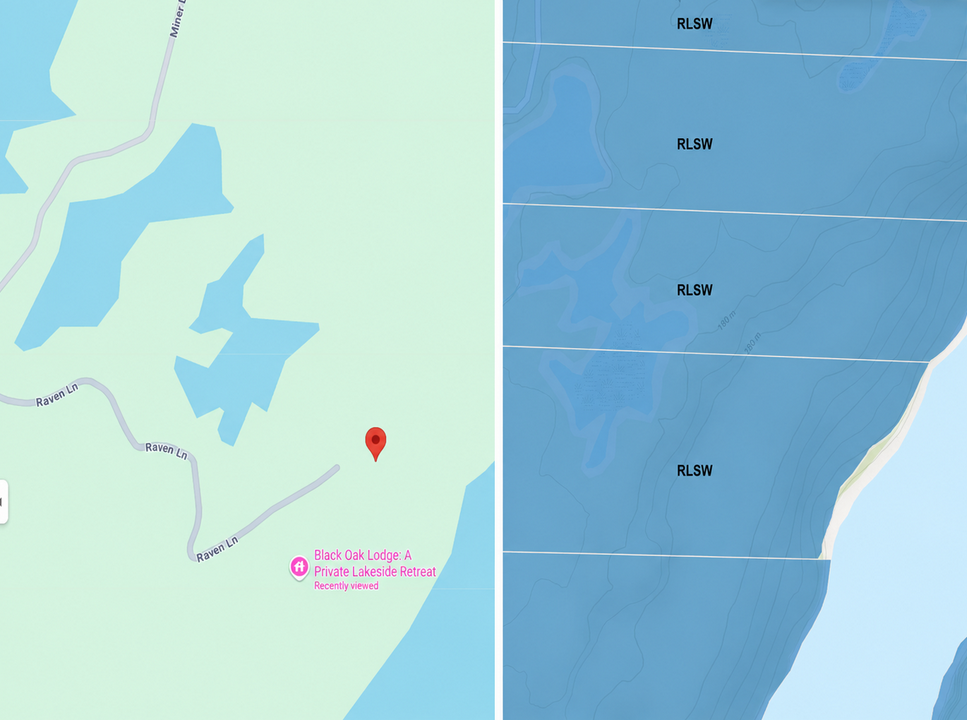
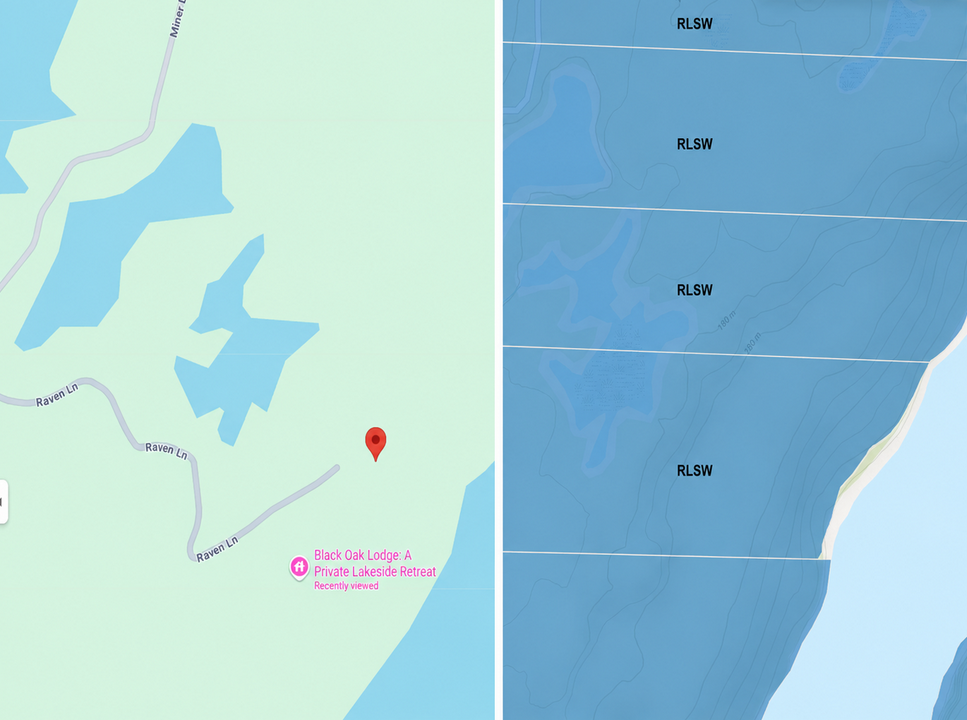
The residents say they have been forced to draw in the rental off the same road. Black Oak Lodge, a six-bedroom rental Enhabit advertises as sleeping 14, runs year-round on the operator's own site, on Airbnb, and on VRBO. Enhabit's page places it on Canoe Lake, and the delegation describes it as reached off Miner Lake Lane onto Raven Lane, the same private-lane network serving the proposed Miners Lodge. The landowners contend it fits the Tourist Home definition and is not a permitted use, an argument that turns on the parcel actually carrying that zone.
NFNM cross-referenced Black Oak Lodge's location against the County of Frontenac's zoning mapping, and on the County's public zoning layer the Canoe Lake shoreline at that location reads as Residential Limited Services Waterfront, consistent with the residents' contention that the lodge sits in the RLSW zone. The match comes with a limit: NFNM identified the property by its mapped position rather than by a parcel-level record, working from the County's 2019 reference layer, and has not obtained the township's parcel-specific zoning confirmation for the lot.
They also say South Frontenac’s planning department had earlier signed off on Black Oak Lodge, so a finding against Miners Lodge would, on their account, reach back to an approval they say the township has already granted. They call Woods's seasonal-dwelling determination "a conflict of interest of sorts." NFNM has seen no evidence that Christine Woods acted improperly and is not asserting a conflict of interest; the characterization is the residents' lay phrase, not NFNM's. The residents say Woods "approved Black Oak Lodge's Building Permit," but NFNM holds no permit record and cannot confirm that. The terms matter: under the Building Code Act a building permit is issued by the Chief Building Official, while the zoning sign-off is a separate document South Frontenac calls a Planning Certificate, so the residents likely conflate the two. On Miners Lodge, they say only that a Planning Compliance Certificate was "very likely" already issued, their own speculation, not a record NFNM has seen.
The tribunal question
The residents also cite an Ontario Land Tribunal decision they say sets a transferable principle, that a short-term rental is judged on how it functions, not on its label. The Oro-Medonte ruling they point to cuts against them. In 2022 the tribunal, on an appeal by an association of short-term-rental operators, struck down Oro-Medonte's By-law 2020-073, which restricted short-term rentals, finding it "did not represent good planning and was not in the public interest"; a 2024 Divisional Court appeal was dismissed. The outcome removed a municipal restriction rather than upholding one, so it favoured the operators, not the neighbours. Coverage reports the tribunal also treated platform short-term rentals as a commercial land use, but that framing reaches NFNM through how the operators' group characterized the decision, which NFNM has not reviewed.
Woods rejected the decision's relevance. "Regarding the OLT decision that was cited, that decision relates to a different municipality's zoning by-law and a different context," she wrote. "It cannot be used to interpret South Frontenac's Zoning By-law." Rettie disagrees, arguing the ruling states a general principle that applies across Ontario. Both characterizations are the speakers' own, and NFNM adopts neither: a tribunal decision on one township's by-law does not bind another's interpretation, while the function-over-label method is, as Rettie says, broadly used.
A township with few rental rules, and a process that was available
Underneath the dispute is a township that, by its own account, has little short-term-rental regulation. In a message the residents attribute to the township's Planning Clerk, the clerk is quoted as writing that "if the [owners] decide to use it as an AirBnB the municipality cannot do anything as [we] don't have any bylaws that regulate short term rentals." That quotation reaches NFNM through the residents, not the township directly; NFNM has not obtained the underlying email and is seeking it, so the line stays the residents' account until the original is in hand.
The residents also place Black Oak Lodge within a wider short-term-rental presence on the lake, citing the analytics service AirROI, whose public market page for South Frontenac lists the lodge at about $146,000 in annual revenue. That figure is a third-party modelled estimate, not an audited or government number, and NFNM presents it as AirROI's estimate. The same page puts the township's short-term-rental supply up about 10 percent over the past year and rental revenue up about 17 percent, a steady rise rather than a surge.
That is where the residents say the larger stake lies. Enhabit already markets several South Frontenac lakefront rentals, including The Frontenac and Black Oak Lodge, with Miners Lodge proposed to join them. If the zone can accommodate a custom-built, year-round commercial rental as a seasonal dwelling, they ask what stops the rest of the shoreline from following. Their worry is cumulative: one lot at a time, a small residential lake becomes, in effect, commercial accommodation, with no single decision ever framed as that choice. The concern is theirs, but the precedent it raises is the public's.
There is a route the township did not take. South Frontenac rezones individual lakeshore lots routinely, through a Planning Act process that brings formal notice and a public meeting; the by-law record shows more than 140 site-specific Residential Limited Services Waterfront provisions since 2003, reaching RLSW-142 in 2024. The residents did not ask that 469 Miner Lake Lane be rezoned. They asked instead that no building permit issue for a use they see as not allowed, which let the township skip that public process.
NFNM has seen the pattern before. In the Palmerston Lake matter NFNM reported in July 2025, a North Frontenac cottage community pushed back when a proposed rural cooperative zoning would have opened the door to bed-and-breakfast and home-business uses regardless of the operators' intentions. Frontenac News covered the May 5 delegation in a May 13 article by reporter Jeff Green, recording the same council exchange NFNM reported.
Woods's two May 22 emails are the township's answer on the record; her answers to NFNM's further questions, with the planning and permit records still being sought, will feature in the continuing coverage. With council standing back, the residents say their remaining route runs through by-law enforcement. The question they keep returning to is the one the by-law was never written to settle directly: at what point a custom-built, absentee-owned, check-in and check-out rental sleeping 14 to 20 people, advertised year-round across several booking platforms, stops being a seasonal dwelling and becomes the commercial accommodation the Residential Limited Services Waterfront zone does not allow.